Pathley News
D1 Softball Colleges: Compare Programs, Rosters, and Fit in 2026
Explore D1 softball colleges through roster fit, conference competition, academics, travel, and recruiting signals. A practical guide for athletes and families.
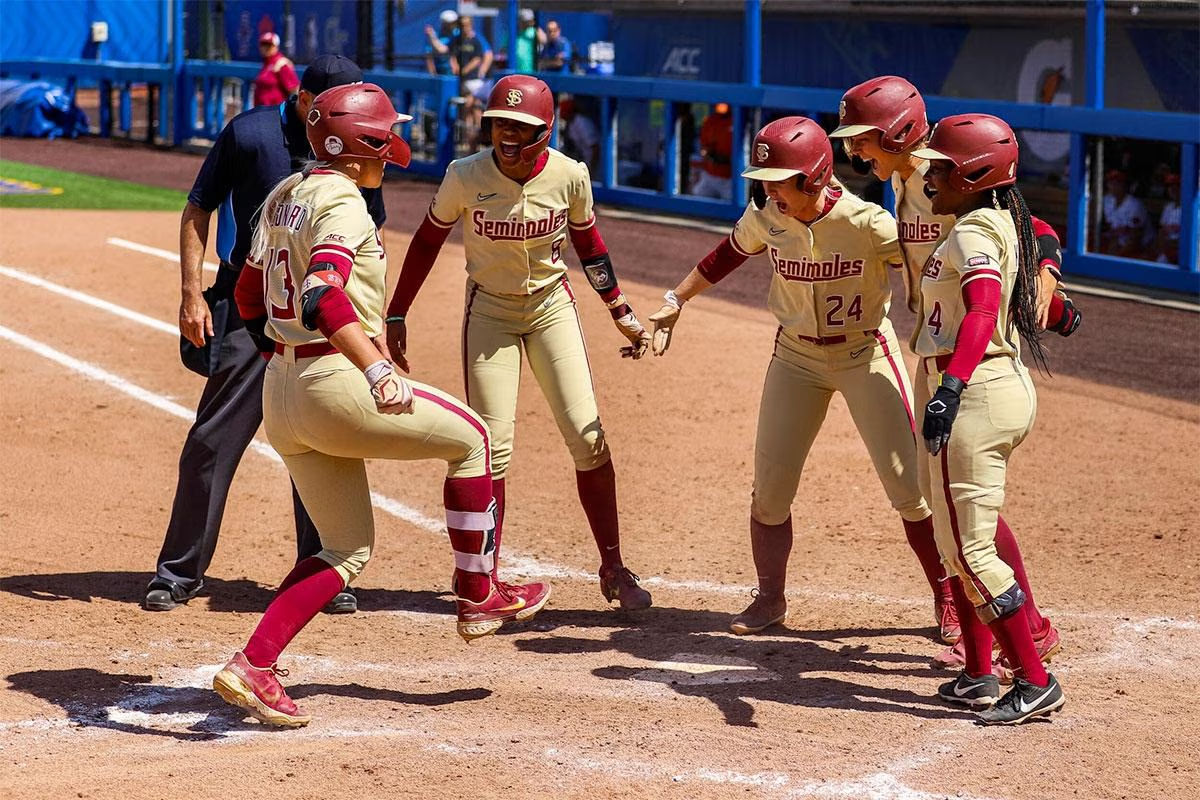
A softball player opens a list of Division I schools and recognizes a few names from postseason games. Those programs are exciting. They are also a tiny part of the picture. Across Division I, teams differ in competitive level, roster construction, coaching style, academic options, and the kind of experience an athlete has between games.
That variety is what makes searching for D1 softball colleges both promising and confusing. A school can be an excellent softball program and still be the wrong place for a particular recruit. Another can be less visible nationally but offer the right combination of competition, development, and campus life.
An early question worth considering is How can a softball player tell whether Division I is the right competitive level? The answer starts with understanding what the label does, and does not, tell you.
Division I identifies an NCAA membership level. It does not mean every softball team plays at the same pace, recruits from the same talent pool, or has the same expectations for a first-year player. A nationally prominent team and a program rebuilding within its conference both compete in Division I. Their immediate needs and competitive environments may be very different.
Conference affiliation is a useful starting point, but it is not a complete scouting report. Look at a team's recent schedule, the opponents it plays regularly, and how competitive its games are. A record alone can mislead: a team facing a demanding nonconference schedule may reveal more about its level than a team with a stronger record against a different slate.
The NCAA member directory provides a way to verify a school's division and conference. The NCAA Division I softball page offers broader context on the sport and postseason. Neither source can tell you whether a player will fit a particular roster. That takes a closer look at the team itself.
The fastest way to overwhelm a recruit is to begin with every school that has a familiar logo. A better starting list includes several types of programs: teams that appear competitive with the athlete's current level, teams that might become realistic as the athlete develops, and schools that offer a strong academic and personal fit regardless of softball results.
The college sports directory can help identify programs by sport. From there, each school's athletics website should answer more specific questions: Who is on the roster? What does the schedule look like? Which majors are available? Where does the team travel?
Geography matters in ways that rarely show up in recruiting graphics. Think about distance from home, climate, where games are played early in the season, and how much travel is likely during conference play. An athlete who enjoys frequent travel may see that schedule differently from one who wants a steadier campus routine.
Campus setting matters too. A large university in a city, a smaller school in a college town, and a campus in a quieter region can all field Division I teams. The athlete has to live there on days without a game.
An initial list is a research tool, not a declaration of where an athlete will enroll. If every school on it has the same national profile, the list may be missing programs where the athlete could contribute and develop. If every school has a similar location or academic focus, it may be missing other environments worth considering.
The goal is not to collect the most school names. It is to gather enough different examples to learn what a good fit actually looks like for this athlete.
Among D1 softball colleges, roster pages can reveal how a team is constructed. They cannot reveal a coach's private recruiting board, an athlete's future role, or who might change positions. That distinction keeps roster research useful instead of speculative.
Start with the positions a recruit plays, then look beyond position labels. A utility player may cover several defensive spots. An infielder's listed position may not be where she plays most often. Pitching staffs may include athletes with different roles, such as starters, relief options, and players used in specific matchups.
Class years offer another clue, but they are not a countdown to an opening. A senior-heavy position group could change by the time a recruit arrives, while younger players can develop into new roles. Recruiting classes, transfers, redshirts, and coaching decisions all complicate a simple class-year calculation.
A useful question at this stage is What should a recruit look for when reading a college softball roster? The best answer connects the roster to game participation, not just names on a page.
Check box scores and season statistics to see who actually plays and in what roles. Does the team regularly use several pitchers? Are defensive substitutions common? Do newcomers appear in games? None of these patterns guarantees an opportunity for a future recruit, but they provide better context than a roster count alone.
A recruit does not need one perfect statistic to belong in Division I softball. Coaches evaluate a combination of current ability, projectable development, position-specific skills, and how a player performs against credible competition.
Pitch velocity can matter, but it is only part of pitching evaluation. Command, movement, pitch sequencing, durability, and the ability to adjust after hitters see a pitch all shape a staff's decision. Game video can show whether a pitcher gets ahead in counts and handles difficult innings. A short clip of maximum effort cannot show the whole picture.
When comparing college pitchers, account for their roles and experience. The staff's most established pitcher is not necessarily the right reference point for an incoming recruit. Recent first-year contributors may offer a different view, though even that comparison is imperfect because players improve after arriving on campus.
Hitters should consider the quality of pitching they face, how they recognize pitches, and whether their contact translates in games. An isolated batting average can hide differences in competition and sample size. Defensive players should look at range, decision-making, throwing accuracy, and how quickly they execute plays under pressure.
Catchers have another layer of responsibility: receiving, blocking, throwing, communication, and managing the game. A player who covers multiple positions may also bring flexibility a coach values. These are reasons to use recent game footage alongside measurable information rather than treating either as a complete evaluation.
That raises a natural question: How do college softball coaches evaluate pitchers and position players differently? Position changes what coaches need to see, but consistent performance against meaningful competition matters across the field.
Rankings are snapshots of team performance, not personal fit scores. A program's postseason history can tell you something about its competitive standard and resources. It cannot tell you how a specific coach teaches, whether an academic major works with the team's schedule, or how an athlete feels in the locker room.
Look for evidence of player development over time. Do athletes appear to take on larger roles as they progress? Are players improving in ways that fit their positions? These questions require context. A player with limited game appearances may still be developing well, while a statistical jump can reflect a change in role or schedule.
Coaching continuity deserves attention without turning every staff change into a warning sign. Read current team information rather than assuming a program operates the way it did several seasons ago. An athlete recruited by one staff should also understand that teams, styles, and responsibilities can evolve.
Finally, consider the daily demands behind the highlights. Practices, strength work, travel, recovery, and classes make up far more of a season than postseason clips. A good fit has to make sense on an ordinary weekday.
Being admitted to a university and being able to pursue a preferred major while playing a sport are related but separate questions. Some courses have labs, placements, or required sequences that need careful planning around travel and practice. Requirements also differ substantially between schools.
The college directory provides an initial way to compare schools, but the university's current academic catalog is the source for major requirements. A conversation with an academic adviser can add context once a recruit has a specific program in mind.
Division I eligibility is another separate matter. High school athletes considering NCAA competition should understand applicable academic and amateurism requirements through the NCAA Eligibility Center. A coach's interest does not replace eligibility review, and a strong academic record should not be treated as a reason to skip checking requirements.
For families balancing high school athletics with recruiting, the National Federation of State High School Associations offers high school sports context. Rules governing a particular school season should be confirmed through the relevant state association and school.
Not every email, camp invitation, or questionnaire means a school is actively recruiting an athlete for a place on its team. Some outreach goes to many athletes. More meaningful conversations tend to become specific: a coach asks about upcoming games, discusses the player's position, explains the program's approach, or makes time for an individual exchange.
Specificity is not the same as a promise. A coach may genuinely like an athlete while still evaluating other players or waiting to understand a future recruiting class. Athletes can pay attention to what is actually being said rather than trying to decode every quick reply as a commitment.
It helps to keep a record of conversations, dates, and unanswered questions. When a program shows sustained interest, useful topics include how the staff develops players at the athlete's position, what a typical week looks like in season, and how the team supports demanding academic paths.
Communication rules can vary by sport, division, and recruiting calendar period. Before drawing conclusions from silence or timing, consult current NCAA guidance rather than relying on a rule quoted in an old social media post.
Early in high school, development should carry more weight than predictions about a final college level. Athletes grow at different rates, gain strength, change positions, and encounter tougher competition. A narrow list built too early can become outdated quickly.
As a player moves through high school, the evidence gets clearer. More recent game footage, position-specific progress, academic interests, and conversations with coaches can reshape the list. A school that once looked unrealistic may become plausible. Another may remain attractive on paper but prove mismatched once the athlete learns more about its daily demands.
Later in the process, details matter more than broad labels. A recruit may need to distinguish between general interest and a clearly explained opportunity, verify current admission and eligibility requirements, and understand what role a coach realistically envisions. Timelines differ across programs, so another athlete's announcement is a poor measure of whether someone is ahead or behind.
Changes in NCAA policies or team circumstances can also affect recruiting assumptions. For any consequential decision, current information from the school and NCAA matters more than a roster screenshot or an older article.
The strongest search for D1 softball colleges is not a contest to name the most recognizable programs. It is an effort to understand where an athlete can compete, develop, study, and live well. Roster research and team results help, but neither should override what the athlete learns about the people and the place.
Near the end of a search, a useful question is How should a softball recruit narrow a college list without relying on rankings? One answer is to ask whether the athlete can explain, in specific terms, why each remaining school belongs there.
If the answer rests only on a logo, a ranking, or an imagined roster opening, there is more to understand. If it rests on credible competitive fit, an appealing academic path, and a daily environment the athlete can picture herself in, the list is becoming something far more useful than a collection of names.
Rosters, coaches, and division breakdowns for every NCAA and NAIA program we track.








