Insight
How to Read a College Roster for Recruiting in 2026 | Pathley
Learn how to read a college roster like a recruit. Spot depth, class-year turnover, role clues, and fit signals so you target smarter schools in 2026.

Most families open a team page and immediately count seniors. If three players at your position are about to graduate, the school feels like an opportunity. If the roster looks crowded, you move on. That sounds logical, but it is way too shallow for real recruiting.
A college roster is not just a list of names. It is a window into how a program builds depth, what kinds of athletes a coach likes, how quickly a lineup turns over, and whether your profile makes sense there. Read it well, and you stop guessing. Read it badly, and you can waste months emailing schools that were never a fit.
If you have been wondering What should I look for on a college roster as a recruit? you are already thinking like a smart recruit.
Learning how to read a college roster is one of the most practical skills in the whole recruiting process, because it helps you connect the dots between athletic opportunity, school fit, and realistic target setting. That matters whether you are pursuing NCAA, NAIA, or JUCO options.
A lot of athletes chase brand names first. They look at rankings, social media clips, or a program's recent record and assume that tells the full story. It does not. A famous school can still be a poor recruiting fit. A less flashy school can be the place where you actually get recruited, develop, compete, and afford the experience.
Rosters help you move from fantasy to fit. They show who is already on the team, what kinds of athletes the staff has trusted before, and how crowded each position or event group may be over the next few years.
That is why college list building should never start with random names. It should start with evidence. A good place to explore schools broadly is the Pathley College Directory, then narrow from there using roster clues, academic fit, and cost.
If you want to know how to read a college roster, start with class years, not highlight clips and not the team record. Look at how many freshmen, sophomores, juniors, seniors, and graduate students are on the team. That tells you where turnover may happen and where continuity already exists.
A roster loaded with underclassmen usually means the coach already has a young core. That does not mean you should cross the school off. It does mean you should understand that immediate playing time might be harder to project.
A roster with many seniors or graduate students can suggest upcoming turnover, but do not assume that every departure creates a clean opening. Injured athletes can redshirt. Graduate students can return in some situations. Transfers can arrive. Incoming recruiting classes may already be committed even if they are not listed yet.
What you are really looking for is pattern, not certainty. One graduating player is noise. A whole position group turning over is a signal.
What does class year distribution on a roster tell me about recruiting fit?
The second step is to zoom in. Team size alone means very little. A soccer roster with thirty players can be fine for one recruit and a bad fit for another. A baseball roster can be full overall but still thin in a specific role. A track roster can look massive while your actual event group is small.
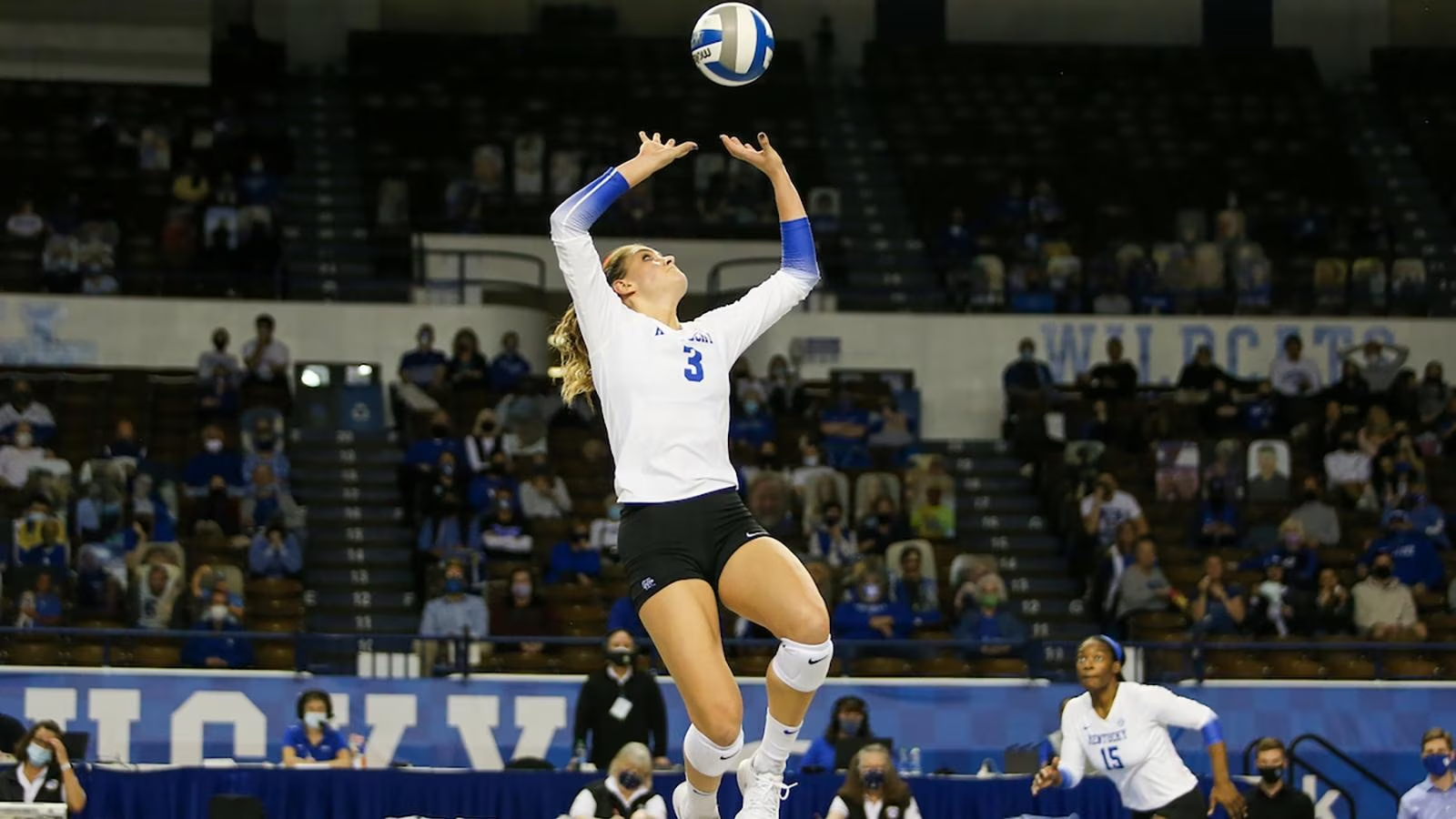
Look specifically at your position, event cluster, or role. If you are a goalkeeper, count goalkeepers, not the whole soccer team. If you are a middle blocker, check how many middles are on the volleyball roster. If you are a distance runner, see how many athletes are actually listed in distance events or appear in cross country and distance results.
Also look for versatility. Some rosters list broad positions. A player labeled defender may also play wide back, center back, or defensive midfield. In baseball, an athlete might be listed as an infielder but see time in several spots. In track, one athlete may cover multiple events. That matters because a coach may view depth more flexibly than the roster page suggests.
The goal is not to find an empty room. The goal is to understand how crowded your lane really is.
How many players at my position is too many on a college roster?
Families often see a large roster and panic. That is a mistake. Some programs intentionally carry extra depth because of training demands, injury protection, developmental pathways, or the structure of the sport itself. In sports with multiple lineups, travel squads, or event groups, a big roster can be completely normal.
A large roster can also mean the coach likes to develop players over time. That may be a green flag if you are willing to grow into a role instead of needing instant minutes as a freshman.
On the other side, a short roster is not automatically a recruiting opportunity. Sometimes it reflects budget limits, a coach's preference for a tight group, recent attrition, or a team that plans to add transfers. Sometimes it means the program is thin because it has not found enough fit yet. That is very different from a team actively prioritizing your position.
This is why context matters. Look at roster size together with results, lineup usage, recent performance, and the overall level of play. Reading one data point in isolation leads to bad conclusions.
Player bios often reveal where the program finds talent. Are most athletes from one state or region? Does the roster include national recruits? Are there many international athletes? Those details matter more than families think.
If almost the entire roster comes from within a few hours of campus, the staff may recruit heavily in its local network. If the roster is spread across many states, the coach may be more open to broader outreach. Neither model is better. It just helps you see the program more clearly.
Bios can also show patterns in club level, high school level, prep school backgrounds, showcases attended, and previous honors. You are not reading bios to compare yourself to every player one by one. You are reading to understand the recruiting profile the program has historically valued.
If the team consistently signs athletes from strong club systems, selective academic schools, or high-level regional competition, that tells you something. If the roster includes late bloomers, multi-sport athletes, or a wide mix of backgrounds, that tells you something too. A program's roster history is often more honest than its marketing.
Some roster bios emphasize majors, academic awards, leadership roles, service, or internships. That is not filler. It can reveal how the athletic department and coaching staff talk about identity. If a program constantly highlights engineering majors, research, or honors students, academics may be a big part of team culture. If it spotlights community involvement or campus leadership, social fit may matter a lot.
This is important because recruiting is not just about making a roster. It is about finding a school where your life actually works for four years.
A roster page is only the starting point. To make smart decisions, match it with stats, box scores, conference results, and schedule strength. That is where you learn who actually plays, how lineups rotate, and how competitive the program really is.
In soccer, basketball, lacrosse, softball, baseball, and hockey, look at games played, starts, minutes, innings, and who appears in big moments. In volleyball, see who takes major sets and who stays in the rotation. In track, swimming, tennis, golf, and cross country, check who scores, who travels, and what marks or times consistently appear in conference competition.
This step keeps you from making the classic mistake of assuming that every athlete listed on the roster has the same role. Some are key contributors. Some are developmental depth. Some may be coming off injury. Some may not travel much at all. Opportunity is about role, not just membership.
By 2026, many program pages also include news stories, season recaps, and social posts that hint at who the staff trusts. Use those clues carefully. They are not perfect, but together they paint a more realistic picture.
This part matters just as much as the analysis above. A roster can guide you, but it cannot promise anything. It will not tell you whether a coach plans to recruit your exact role next month. It will not show the full incoming class before every commitment is public. It will not explain financial aid strategy, admissions flexibility, or how the coach sees your long-term development.
Rosters can also be outdated. Some schools update quickly. Others lag behind. Position labels can be vague. Class years can be stale. A player may still appear on the page even if their role has changed. That means you should treat rosters like clues, not final answers.
Before you get too deep into any target list, make sure you also understand the broader rules of the level you are pursuing. NCAA athletes should review the NCAA Eligibility Center, and NAIA athletes should understand the process through PlayNAIA. Rules and eligibility matter just as much as roster fit.
If you want help translating roster clues into something more useful, the free Analyze Team Roster tool can break down what a roster may be signaling for the next few recruiting cycles.
A good fit is not a school with the fewest names at your position. A good fit is a school where several pieces line up at the same time.
Key signs of a strong fit:
• The competitive level is realistic for your current profile or near-term development.
• Your position or event group is not blocked for years by a deep young core.
• The coach has historically recruited athletes with a background similar to yours.
• The school works academically, socially, and financially for your family.
• The overall recruiting path feels achievable, not just exciting.
That is why families who only focus on roster openings often end up with shaky college lists. The smarter move is to combine roster analysis with admissions, cost, geography, school size, and your own honest athletic level. If questions keep popping up as you research, the Family Recruiting Q&A is a solid place to dig deeper.
Most recruiting mistakes are not dramatic. They are small misreads that stack up.
• Assuming every senior will leave and create a direct opening.
• Counting total roster size instead of your actual position group.
• Ignoring whether the program recruits locally, regionally, or nationally.
• Looking at names without checking stats, results, and lineup usage.
• Treating a public roster like a promise of future playing time.
• Chasing schools that feel impressive instead of schools that make sense.
When families learn these lessons late, they usually say the same thing. They wish they had spent less time guessing and more time building a structured list earlier.
This is where the process usually breaks for athletes. They gather information, screenshot rosters, save a few school pages, and then stall. Data without a plan does not move recruiting forward.
The next step is deciding which schools are reach, target, and safety options, which positions you actually fit at each level, what gaps you need to close, when to email coaches, and how to stay organized over the next few months.
If you are asking How can I build a college list using roster clues, academics, and cost together? you are asking the exact question that separates random research from a real plan.
Rosters, coaches, and division breakdowns for every NCAA and NAIA program we track.