Pathley News
University of Mississippi posts record $284.6 million fundraising year
University of Mississippi set a record with $284.6 million in private support for 2026, including major gains for academics, health care and athletics.
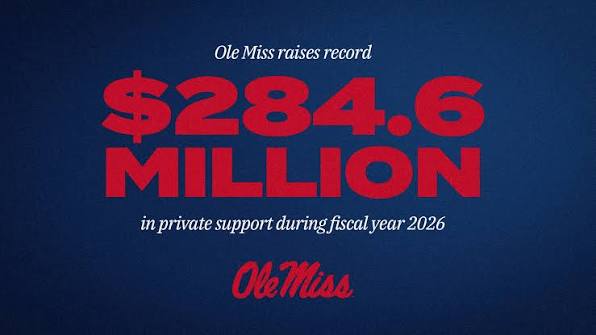
The University of Mississippi delivered one of the biggest institutional announcements in college athletics and higher education this week, reporting that private support reached a school-record $284.6 million in fiscal year 2026. The total, announced August 20, was up 32 percent, or $69 million, from the prior year and marked the third straight annual fundraising record for Ole Miss.
For a Division I SEC university balancing growth in academics, health care and athletics, that number is significant on its own. What makes the update especially notable is how broad the support appears to be and how directly it connects to current issues across the modern college landscape, including scholarship funding, facility investment, student support, research expansion and the increasingly expensive infrastructure around top-level athletics.
The announcement also reinforced that momentum from the university's Now & Ever campaign, which closed in 2025 after generating $1.75 billion, has carried into the year after the formal campaign ended. In other words, the big finish did not lead to a drop-off. Instead, giving accelerated.
That matters for anyone tracking the future of the University of Mississippi, from prospective students to SEC observers to recruits trying to understand which programs and campuses are building with long-term intent.
The $284.6 million total is the lead, but the shape of the fundraising year may be just as important as the size of it. According to the university, the fiscal year ended June 30 and included 101,000 gifts from more than 28,000 donors. More than 6,300 of those donors gave for the first time.
That level of participation suggests a broad giving base rather than a result driven by only a handful of transformational gifts. For universities, especially public institutions with ambitious academic and athletic goals, that kind of donor depth can be a stronger indicator of long-term stability than a single large campaign close. It shows recurring engagement across alumni, families, supporters and institutional partners.
Ole Miss also said it receives only 12 percent of its operating budget from the state. That detail helps explain why philanthropy is so central to institutional strategy in Oxford. Private support is not simply additive. It is foundational to how the university funds major priorities, expands programming and responds to emerging needs.
The university further reported that its endowment now stands at about $1.16 billion. In practical terms, endowment growth can strengthen a school's ability to support scholarships, faculty positions, research and programmatic investment over time. In an era when families often look closely at long-term institutional resources, that number adds another layer to the story.
For readers comparing colleges more broadly, tools like a college directory or a sport directory can help place developments like this in a wider recruiting and campus context. But in this case, the core takeaway is straightforward: Ole Miss is operating with unusual fundraising momentum.
A large share of the fiscal year support was directed toward academics and the student experience. The university said donors contributed more than $83.4 million to academic programs, research and economic development, an indication that the headline total was not primarily athletic in nature even though the sports side also posted a major year.
Among the named commitments, the Joseph C. Bancroft Charitable and Educational Fund renewed support for the Croft Institute for International Studies with a $5 million commitment. Bill and Melanie Roper added $3 million to an academic-scholarship endowment and another $1.8 million to create the Roper Scholar Travel Experience Endowment for Honors College students.
More than 120 donors also helped establish a major endowment for the political science department. Additional gifts included $2.8 million from the estate of Larry Hardy for the Patterson School of Accountancy and $2 million from Leslie and Bill Ashford for physics education.
Those gifts point to a familiar reality in modern college development strategy. Major universities increasingly need fundraising strength across many units at once. It is not enough to win donor support only in athletics or only in a single flagship academic area. Schools that want to stay competitive nationally are trying to build research, scholarship aid, honors opportunities, professional preparation and student enrichment at the same time.
The alumni side of the university also had a notable year. The Ole Miss Alumni Association secured a record $8.3 million toward the new Triplett Alumni Center, a project valued at more than $51 million, and a separate $2.25 million gift will support its welcome center. These are not the kinds of projects that dominate recruiting headlines, but they matter to how a university presents itself to visiting families, graduates and donors.
There was also a more immediate student-support dimension to the year. After Winter Storm Fern, more than 1,990 gifts totaling $530,000 flowed to the Rebel Relief Fund for emergency student aid. In a fundraising report full of large capital and endowment figures, that number stood out for a different reason. It showed donors responding not only to long-range planning, but also to direct student need.
Another major pillar of the announcement was health care. The University of Mississippi Medical Center received $93.3 million in support during the fiscal year, making it one of the biggest engines behind the overall record.
Much of that attention centered on the It's About Time campaign for the Cancer Center and Research Institute. The university said the campaign is seeking $125 million for a five-story, 250,000-square-foot center dedicated to cancer treatment, research and education. Ole Miss reported that the campaign has already moved beyond 80 percent of its goal.
The state of Mississippi has also committed public backing to the project. According to the university, the Mississippi Legislature appropriated $100 million for the cancer center, a figure separate from the private fundraising total. Groundbreaking is scheduled for October 22.
Other health-related commitments included a $9 million gift from Priscilla and David O'Donnell to support the heart program at Children's of Mississippi, nearly $5 million from the late Betty Sue Dettre, and $5 million from Lisa and Michael Johnson for scholarships and nursing support on the Oxford campus.
For a public university system trying to grow both educational and medical influence, the connection between health care fundraising and broader institutional standing is important. It expands research capacity, strengthens clinical partnerships and can raise a university's profile well beyond athletics. In the SEC, where brand identity often begins with sports, this kind of parallel investment can reshape how a school is viewed nationally.
Because this is a college audience and because SEC fundraising is often discussed through the lens of competitive positioning, the athletics portion of the report is likely to draw outsized attention. The university said the Ole Miss Athletics Foundation raised $107.9 million, the largest athletics fundraising total in school history.
A separate athletics release in July added more context, noting that the total nearly doubled the previous record of $55.4 million. That jump alone illustrates just how unusual the 2025-26 fiscal year was for Ole Miss athletics.
The money is slated for scholarships, academic guidance, wellness support, capital projects, revenue sharing and deferred maintenance at athletic venues. Those categories reflect the current reality of Division I athletic departments, especially in power conferences. Donor money is no longer just about scoreboards, luxury spaces or isolated facility upgrades. It is now tied to the full structure of athlete support and departmental operations.
Planned work includes a new golf facility, renovated basketball locker rooms, a new field at the football practice facility and a new playing surface at Swayze Field. The athletics department also highlighted three donor-supported facility namings during the year: Alisa and Mark Bourne Stadium, the Rayner Family Courtside Club at the Sandy and John Black Pavilion at Ole Miss, and the Berry Family Field Club at Vaught-Hemingway Stadium.
Even without a single sport attached to this story, the implications are broad for the University of Mississippi football program and for other Ole Miss teams competing for talent, retention and visibility. Infrastructure, athlete experience and operational support increasingly shape how programs recruit and sustain success.
That does not mean fundraising totals automatically produce wins. College sports does not work that neatly. But sustained donor support gives programs more ways to solve problems, retain momentum and invest in the pieces recruits and families ask about most often, including facilities, academic services, sports medicine, nutrition, travel and long-term player development.
The timing of this fundraising surge is part of what makes the story so strong. The university itself connected donor enthusiasm to a highly visible athletic year. In its August 20 announcement, Ole Miss pointed to a Smallbore National Championship in rifle, a College Football Playoff semifinal appearance and a College World Series berth as examples of broader institutional momentum.
That pattern is common across major college athletics. Winning seasons and postseason runs can energize donor bases, deepen alumni attachment and create urgency around facility and program investment. At the same time, those donations can then reinforce the conditions that help programs remain competitive. It becomes a feedback loop, though one that still depends on leadership, roster management, coaching stability and institutional alignment.
For the Ole Miss football team, public visibility tends to drive much of the outside conversation. But the fundraising report suggests the broader athletic department is also benefiting from the school's current profile. Golf, basketball, baseball and other sports all appear in the project list or in the institutional framing around the year.
That kind of cross-campus momentum is not easy to create. It usually requires a mix of competitive success, donor trust, clear capital priorities and a university-wide story that supporters believe in. Ole Miss appears to have had all four working in its favor over the past year.
At one level, this is a university advancement story. At another, it is a clear example of the resources race shaping the top tier of Division I athletics. The NCAA directory lists Ole Miss as a Division I institution in Oxford, Mississippi, competing within one of the most resource-intensive environments in college sports, the Southeastern Conference.
In that setting, fundraising has become a direct measure of institutional readiness. Schools are trying to support athlete wellness, maintain facilities, absorb deferred maintenance, expand scholarship backing and prepare for the evolving economics of roster building and revenue distribution. Ole Miss specifically said this year's athletics fundraising will support revenue sharing, a phrase that underscores how quickly the financial structure of college sports has changed.
For recruits and families, that does not mean bigger is always better in every case. Fit still matters. Development still matters. Coaching fit, playing opportunity, academic goals and campus environment still matter. But resource strength is part of the evaluation, especially in high-major athletics where expectations are tied closely to support systems.
Anyone trying to understand how schools compare on a broader level often starts with external references such as the NCAA member directory at NCAA.org or a campus overview page. In Ole Miss's case, the fundraising report provides fresh evidence that the university is trying to compete comprehensively, not selectively.
The easiest way to read the announcement is as a collection of very large numbers. That is fair, but it misses a more durable point. The breadth of participation, from first-time donors to emergency-aid contributors to major benefactors supporting cancer care, scholarships and athletics, may be what gives this year staying power.
A single blockbuster campaign can change a university's skyline. Broad-based donor confidence can change its operating future.
That is why the 101,000 gifts and 28,000-plus donors matter. So does the fact that more than 6,300 people gave for the first time. Universities talk often about engagement, but those figures suggest actual expansion of the donor base. If that trend continues, Ole Miss could be in a stronger position not only for headline projects but also for recurring annual support across campus.
For students and recruits, the practical effect is that philanthropy can touch almost every part of campus life. It can fund scholarships, improve athlete support, expand academic programs, support travel opportunities, modernize venues and create emergency relief pathways. Those outcomes are less flashy than a fundraising total, but they are ultimately what make the money matter.
No additional colleges were provided in the source college list for this story, so the clearest program context remains internal to Ole Miss itself. Readers looking to explore the campus can find the University of Mississippi college page, while those tracking athletics can review the football team page as one visible entry point into the department's competitive profile.
The next phase of this story is not the announcement itself, but the follow-through. Groundbreaking for the Cancer Center and Research Institute is scheduled for October 22. Within athletics, the key questions will center on how quickly donor-backed projects move, how effectively the department uses new support for scholarships, wellness and revenue-sharing needs, and whether the recent surge in donor energy can be sustained beyond a single standout year.
There is also a broader question for the university as a whole. Can Ole Miss continue turning athletic visibility into university-wide philanthropic momentum without allowing one side of the institution to overshadow the others? The 2026 report suggests that, for now, the answer may be yes. Academics, health care and athletics all showed major gains in the same year.
That is what makes this more than a fundraising headline. It is a snapshot of an SEC university using private support to build across multiple fronts at once. In the current college landscape, where institutions are judged by both competitive results and long-term capacity, that kind of alignment can matter as much as the total on the press release.
Rosters, coaches, and division breakdowns for every NCAA and NAIA program we track.








