Pathley News
Kentucky women’s volleyball opens 2026 with statement sweep of Wisconsin
Kentucky opened the 2026 women’s volleyball season by sweeping No. 6 Wisconsin at AVCA First Serve, delivering an early top-10 statement in Milwaukee.

The University of Kentucky began the 2026 season with one of the strongest opening results anywhere in college volleyball, beating No. 6 Wisconsin in straight sets on Aug. 21 at the AVCA First Serve event inside Fiserv Forum in Milwaukee. Kentucky won 25-20, 26-24 and 25-18, turning a matchup between preseason top-10 teams into a performance that looked polished from the first serve to the final point.
For the Kentucky women’s volleyball team, the significance went beyond a single nonconference win. This was a nationally relevant opener against a traditional Big Ten power, a rematch of the 2025 NCAA national semifinal, and one of the showcase pairings of opening weekend. Kentucky entered the year ranked No. 3 in the preseason poll, and the Wildcats played like a team fully expecting to stay in the center of the national title conversation.
What stood out most was not just the sweep itself, but how complete it looked. Kentucky hit .380 as a team, finished with 43 kills and only eight attack errors, and controlled the match at the net. Wisconsin was limited to a .186 attack percentage, and the Badgers never found a long enough stretch of offensive rhythm to truly change the momentum of the night.
The AVCA First Serve was designed as an early spotlight event for the sport, bringing together eight of the nation’s premier programs to launch the 2026 season. According to the NCAA’s event preview, Kentucky’s meeting with Wisconsin was one of the headline matchups in Milwaukee.
That mattered because this was not an ordinary first match. Kentucky and Wisconsin had already built recent postseason history. The two programs met in the 2025 NCAA semifinal, a five-set match Kentucky won on the way to another deep tournament run. Friday night offered a very different script, but the same level of national attention.
In these early showcase matches, the result often matters less than the shape of the performance. Teams are still sorting out rotations, timing and pressure moments. Kentucky, however, looked unusually settled for August. The Wildcats were efficient in transition, disciplined defensively and far more comfortable in the biggest stretches of the match.
That combination is why the result landed as more than just an upset style headline, even though Kentucky was already ranked ahead of Wisconsin. The Wildcats did not merely survive a difficult opener. They dictated it.
The offensive numbers tell the story quickly. Kentucky hit .380 as a team, a striking figure against a top-10 opponent in the first match of the season. Clean execution usually reflects more than one hot hitter, and that was the case here. The Wildcats spread the attack, avoided long error stretches and consistently turned good passing into high quality swings.
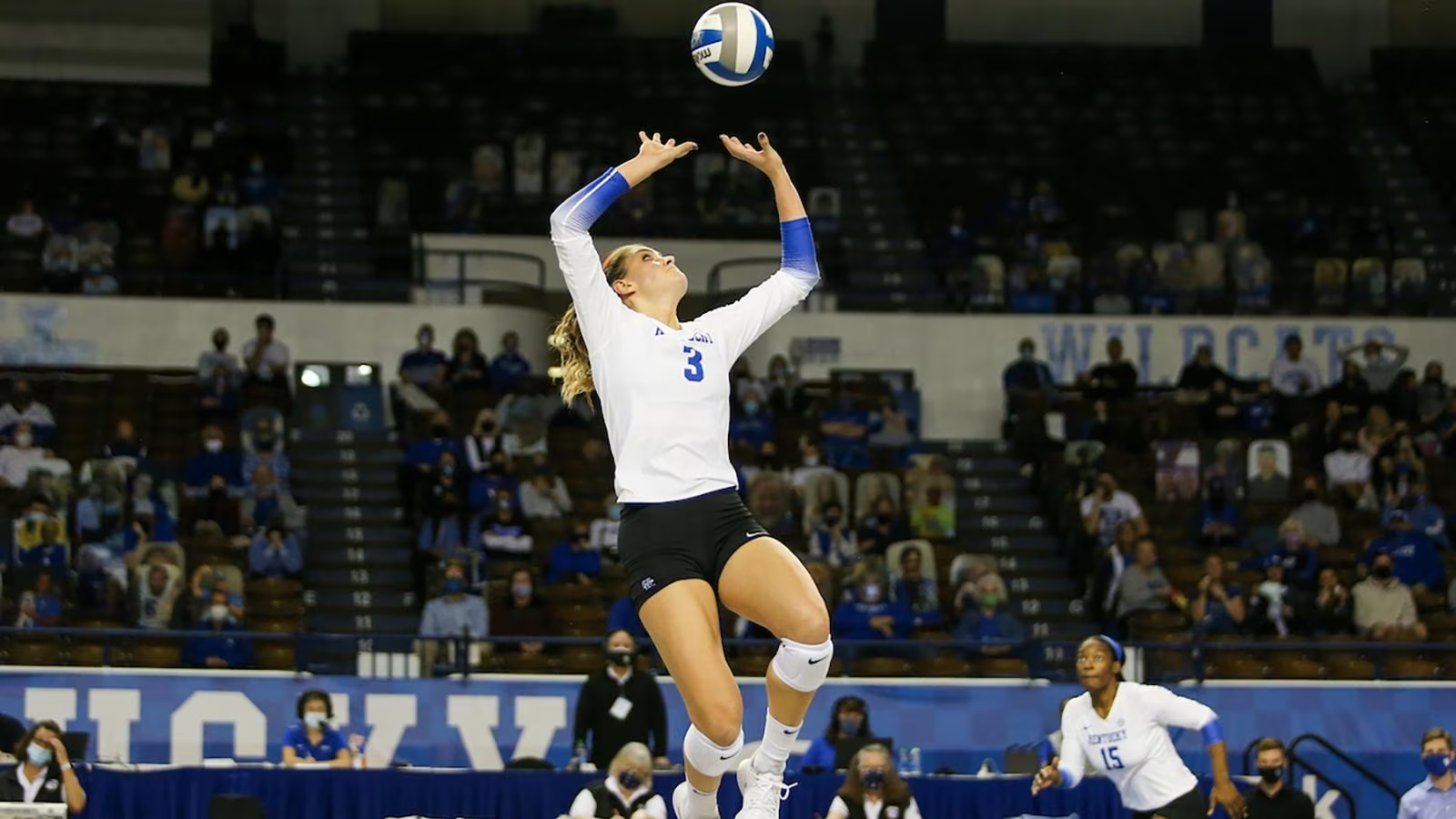
Brooklyn DeLeye led Kentucky with 12 kills, while Morgan Gaerte added 10. Middle blocker Lizzie Carr was especially efficient, posting eight kills without an error on 14 attacks for a .571 hitting percentage. Setter Kassie O’Brien directed the offense with 33 assists and also contributed two kills and four blocks.
That balance is one of the most encouraging elements for the Wildcats’ women’s volleyball program going forward. When a team can get front-row production from multiple areas while the setter is also affecting the match at the net, opponents have fewer chances to load up on one primary option.
Kentucky’s official recap emphasized the key roles of DeLeye and Gaerte in steering the attack, while also underscoring how efficiently the team played across the board, especially in system offense and at the net, according to UK Athletics.
Early in the season, hitting efficiency can fluctuate dramatically because timing is still developing and opponents often bring physical serving pressure. Producing a .380 team percentage against a defense and block as established as Wisconsin’s suggests Kentucky was ahead of the curve in several areas at once.
Against elite opponents, efficiency is usually the separator. Kentucky did not need a five set shootout or an unsustainably high service run. It won by being cleaner.
As strong as Kentucky looked offensively, the blocking numbers may have been just as revealing. The Wildcats outblocked Wisconsin 10-5. O’Brien, Carr and Gaerte each recorded four blocks, while libero Molly Tuozzo finished with a team-high 12 digs and anchored the back line.
That defensive shape matters because Wisconsin traditionally succeeds when it can establish tempo and force defenses to honor multiple attacking lanes. Kentucky repeatedly disrupted that rhythm. The block touched enough balls to slow down the Badgers, and the backcourt cleaned up what was left. Holding Wisconsin to a .186 attack percentage was not just the product of one phase. It was a coordinated defensive performance.
Wisconsin did receive nine kills from freshman outside hitter Audrey Flanagan, according to Wisconsin’s match recap, but the Badgers never found the sustained scoring runs needed to reverse the match. Kentucky’s size and organization took too much away too early.
For recruits, coaches and anyone tracking top-level women’s volleyball, that is one of the biggest indicators from this opener. Good teams can score. Great teams can also force elite opponents into uncomfortable swings, lower percentages and rushed decisions. Kentucky looked like that kind of team on opening night.
Kentucky never trailed in the first set and hit .448 in the opener, which immediately set the tone for the night. Wisconsin made a brief push, but Kentucky had enough control to keep the margin healthy and close out a 25-20 win. Carr and Gaerte made important plays late in the set, and the Wildcats showed early that their block and transition game would be difficult to solve.
The first set established two important truths. First, Kentucky was not overwhelmed by the environment or the occasion. Second, the Wildcats were already comfortable executing at a level that many teams do not reach until later in September.
The second set was tighter and, in many ways, the most telling part of the evening. Wisconsin led for much of the frame, forcing Kentucky to prove that the opener was not just about early momentum. The Wildcats responded by absorbing pressure and assembling a 5-2 run to move in front at 15-14.
That stretch reflected maturity more than flash. Kentucky did not panic, overhit or drift away from its structure. A successful challenge helped the Wildcats regain momentum, and when the set moved into deuce, Kentucky stayed composed. Carr finished the frame with an emphatic overpass kill for a 26-24 win.
That moment may have been the pivot point of the whole match. If Wisconsin had taken the second set, the contest could have turned into the kind of long, emotional battle many expected beforehand. Instead, Kentucky tightened its grip.
Rather than letting Wisconsin gather itself after the close second set, Kentucky opened the third by jumping ahead 8-4. From there, the Wildcats extended the margin at the media timeout and never really let the Badgers back into striking distance. The 25-18 finish was decisive and fitting.
Strong teams often reveal themselves in how they close, not just how they start. Kentucky did not limp to the finish line after winning the first two sets. It played its cleanest volleyball when the match was there to be taken.
Every early season result needs context. One night in August does not decide a conference race, guarantee a Final Four return or define a roster for four months. But some openers tell the sport something real, and this was one of them.
For the University of Kentucky, the message was clear. The Wildcats are already operating with the efficiency, physicality and composure of a team expecting to contend nationally. That matters in a season where perception forms quickly, rankings shift weekly and top programs are judged not just by wins, but by how those wins look.
Kentucky had several reasons to face pressure in this spot. It was the season opener. It came on a national stage. It was against a top-six opponent. It carried emotional residue from a recent NCAA semifinal meeting. And it arrived in a season where the program is under more national television attention than ever.
Earlier this month, UK Athletics announced that Kentucky is scheduled for 11 nationally televised regular-season matches in 2026, the most in program history. That kind of exposure tends to follow programs that have moved beyond regional relevance and into the national championship tier.
Kentucky did not spend its opener trying to justify the ranking. It played in a way that made the ranking feel reasonable.
From a recruiting perspective, the performance offered a useful snapshot of what high-level roster construction looks like in modern women’s volleyball. Kentucky won because several pieces aligned at once, not because one player had to carry the entire match.
The Wildcats received production on the pins, efficient middle offense, reliable setting decisions, real block presence and stable back-row play. That formula is familiar across national contenders, but it is difficult to achieve. For prospects studying elite programs, this is the kind of match that shows how interconnected every position group is.
Families comparing schools often use broad resources such as a college directory or a wider sport directory to understand where programs sit across divisions and regions. What Kentucky displayed in Milwaukee is the upper end of Division I volleyball standards, where efficiency, physicality and lineup depth all need to hold up under national scrutiny.
It also highlights an important truth about recruiting evaluation. The strongest programs are not only looking for talent. They are looking for athletes who can fit within a fast, disciplined system where every contact matters. Matches like this reward decision making as much as raw power.
That is especially true at setter, middle and libero, where O’Brien, Carr and Tuozzo each influenced the match in ways that shaped every rally, even when the box score only captures part of the impact.
Kentucky’s season-opening statement did not end the weekend story line. The Wildcats were scheduled to face No. 4 Pittsburgh on Aug. 23 in another marquee AVCA First Serve matchup, a pairing Kentucky had known was coming months in advance when the event field and schedule were announced by the school in January, according to UK Athletics.
That next match is significant because it offers an immediate follow-up test against another national contender. Early showcase events can quickly reshape perception, but they can also confirm whether an opener was a one-night peak or part of a larger pattern. If Kentucky brings the same serving pressure, blocking discipline and attacking efficiency against Pittsburgh, the Wildcats will leave opening weekend with even more momentum.
Beyond the next opponent, there are several longer-term questions worth tracking:
Those questions are not concerns as much as they are the normal checkpoints for a team with championship expectations. Kentucky answered the first major test well. The challenge now is maintaining that standard.
Within the same state, Transylvania University offers another college option in Lexington, though at a very different level and in a different competitive context from Kentucky’s national Division I stage. For readers exploring the wider in-state landscape, the broader college search often starts by understanding how schools differ in division, scale and athletic profile before narrowing to specific team opportunities.
Opening weekend can tempt overreaction, but this was the sort of result that deserves real attention. Kentucky did not just beat Wisconsin. The Wildcats controlled long stretches of the match, won the most pressure-filled set, defended the net at a high level and looked further along than most teams do in late August.
For the Kentucky women’s volleyball team, that performance reinforces what the preseason ranking suggested, that this roster has the tools to remain in the national championship conversation. For recruits and coaches watching the sport closely, it was also a clear example of the current standard at the top of Division I women’s volleyball. The teams that separate themselves early are usually the ones that can blend power with precision, absorb pressure without losing shape and turn showcase moments into controlled victories. Kentucky did all of that in Milwaukee, and that is why the rest of the season will be watched a little differently now.
Rosters, coaches, and division breakdowns for every NCAA and NAIA program we track.