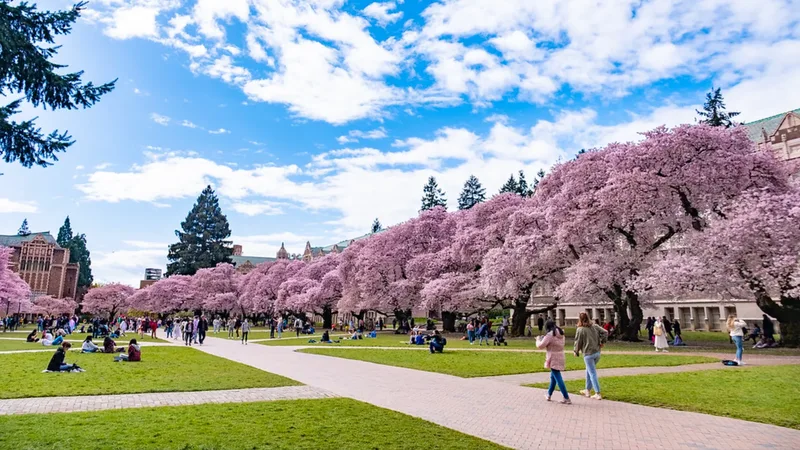

University of Washington
Seattle, WA
Big Ten competition, research-focused academics and Seattle career opportunities give athletes compelling reasons to consider this campus.
Browse programs
College directoryEvery program, filtered by what fits Sport directoryMen's and women's, every division State directoryPrograms in the states you would play inGo deeper
Major directoryYour major and your sport in one list Camp directoryID camps and showcases at college programs Conference directoryEvery conference and its member colleges
Washington offers a solid mix of women’s cross country programs across NCAA and NAIA levels. Use this page to compare divisions, recruiting opportunities, and overall college fit in-state.
11 of 15 play in divisions that allow athletic scholarships
At a glance
15 women's cross country programs in Washington. Tap a level to jump to its schools.
Division I has the most options here, with 5 of 15 programs (33%).
NCAA Division I
Division I in Washington is a viable route for athletes targeting the highest college competition level. Recruiting can be competitive, so focus on verified meet times, progression, and how your profile matches each roster’s needs.
Strongest programs first, by Pathley's program strength score.
Seattle, WA
Big Ten competition, research-focused academics and Seattle career opportunities give athletes compelling reasons to consider this campus.
Spokane, WA
Nationally prominent basketball, reachable faculty and strong career outcomes give athletes compelling reasons to consider this campus.
Seattle, WA
Close faculty connections and Seattle internship access complement competitive athletics and a service-centered Jesuit education.
Pullman, WA
Division I competition, hands-on research and a spirited residential community give recruits distinct reasons to consider Pullman.
Cheney, WA
Hands-on academics, Big Sky competition and in-state value give athletes practical reasons to consider studying here.
NCAA Division II
D2 programs in Washington can offer a strong balance of competitive racing, campus community, and recruiting access. This level is often a good fit for athletes who want meaningful team roles while still pursuing athletic aid possibilities.
Strongest programs first, by Pathley's program strength score.
Lacey, WA
Athletes can pair competitive conference play with career-focused academics, personal attention and a supportive Benedictine community.
Seattle, WA
Close faculty relationships and Seattle internship opportunities help athletes connect their college experience with future careers.
Bellingham, WA
Competitive athletics, accessible admissions and an outdoor-oriented campus give recruits several reasons to consider studying here.
NCAA Division III
Washington’s D3 options are more limited than many states, but they can be a great fit if you want a strong academic and campus experience with competitive running. Since D3 does not offer athletic scholarships, prioritize coaching fit, admissions, and total cost planning.
Strongest programs first, by Pathley's program strength score.
Tacoma, WA
Close faculty relationships, professional programs and Northwest Conference competition give athletes several reasons to consider this campus.
Tacoma, WA
Close faculty relationships and a residential Tacoma campus complement regional competition in the Northwest Conference.
Walla Walla, WA
Close faculty relationships and a residential community help athletes pursue demanding academics alongside Northwest Conference competition.
Spokane, WA
Accessible admissions, faculty mentoring and Northwest Conference competition give athletes practical reasons to consider this Spokane campus.
NAIA
NAIA programs in Washington add additional recruiting options, often with a practical, coach-driven process. NAIA teams can offer athletic aid, so it is worth asking early how the program packages scholarship and need-based support.
Strongest programs first, by Pathley's program strength score.
Kirkland, WA
A small campus, reachable faculty and regional competition offer a personal setting for balancing academics and athletics.
Olympia, WA
Athletes choose Evergreen for regional competition, flexible academic pathways and a campus culture centered on sustainability.
College Place, WA
Close faculty connections, professional programs and a faith-centered community give athletes reasons to consider competing here.
Free school matcher
Pick your position and level, and we score every women's cross country program on roster openings at your position, athletic level and academics.
Conferences
Every women's cross country conference with at least one program in Washington, across every division.
Scorecard
This scorecard summarizes women’s cross country opportunity in Washington based on in-state program availability, division access, scholarship-eligible pathways, and overall college-fit signals.
Overall opportunity score
AverageWashington is an average in-state option for women’s cross country, with multi-division access but fewer total programs than a typical state.
Washington has a limited-to-moderate number of women’s cross country teams compared with many states, so widening your school list can help.
With NCAA D1, D2, D3, and NAIA all represented, Washington gives recruits multiple levels to target in one state.
Scholarship-eligible options exist through D1, D2, and NAIA, but the overall volume is a bit thinner than the average state for this sport.
Across the listed schools, Washington tends to be more accessible by acceptance rate but can skew more expensive than the typical state for women’s cross country.
Recruiting snapshot
Who it suits, what the landscape looks like, where the money is and what gives this state an edge.
Recruits who want access to multiple divisions in one state and are open to comparing NCAA and NAIA paths.
The in-state landscape is spread across several levels, but overall program availability is more limited than many states, so multi-state recruiting lists are common.
Athletic scholarship opportunities are most commonly tied to NCAA D1, NCAA D2, and NAIA programs, while NCAA D3 recruiting is more academic and fit-driven with no athletic scholarships.
Washington’s Pacific Northwest location can be convenient for West Coast recruiting and regular competition opportunities, especially for athletes prioritizing regional travel.
Key metrics
How women's cross country programs in Washington compare with the average state on program count, tuition, enrollment and admissions.
Three ways to start
Pick the option that matches where you are, and we will show you the plan that fits.
News
Resources
National rankings
Sport hub
The Women's Cross Country hub brings every division together: how D1, D2, D3 and NAIA compare, the strongest programs in each state, camps, and the recruiting guides for each level.