How D2 Women's Track & Field Coaches Evaluate Players
What D2 track & field coaches actually look for, how they weigh it, and where you need to stand out to earn a roster spot.
What D2 coaches weigh, in order
- 1Verified Marks
Official times and measured marks come first because they let a Division II women's staff compare a recruit with its...
- 2Event Scoring Fit
After confirming the mark, a staff looks at where it could contribute within its event lineup.
- 3Improvement Trend
A progression across seasons helps assess room for development, but it sits behind demonstrated results and present...
Reviewed Sep 2026
What should I do next?Overview
How D2 Women's Track & Field Coaches Evaluate Recruits
Division II women's track and field coaches begin with official times and marks. They compare season bests with repeat performances, then use meet results and event footage to understand how an athlete competes and executes under pressure. At this level, a mark is read against a program's conference competition and event-group needs rather than a universal cutoff. A recruit who can contribute in more than one event may offer a Division II women's team a different kind of value than a single-event specialist.
- Division
- NCAA Division II
- Sport
- Women's Track & Field
- Last reviewed
- Sep 2026
What matters
Coach Priorities
Most important
Verified Marks
Official times and measured marks come first because they let a Division II women's staff compare a recruit with its current athletes and competition. Video or training claims cannot replace a recorded result.
Then
Event Scoring Fit
After confirming the mark, a staff looks at where it could contribute within its event lineup. A useful secondary event can separate athletes with similar primary marks.
And then
Improvement Trend
A progression across seasons helps assess room for development, but it sits behind demonstrated results and present event fit. One late breakthrough carries more weight when subsequent meets support it.
Evaluation
Key Evaluation Factors
What coaches weigh when sizing up a recruit.
Verified event results
official FAT times, measured field marks and wind readings where applicable.
Competitive comparison
finishes and marks against established high school and open-meet fields.
Repeatability
performances across meets rather than one isolated personal best.
Event-group fit
potential contribution in individual events and relays.
Technical execution
hurdle rhythm, jump approaches, throwing mechanics and race distribution.
Focus
What Coaches Watch at Each Event
Sprints
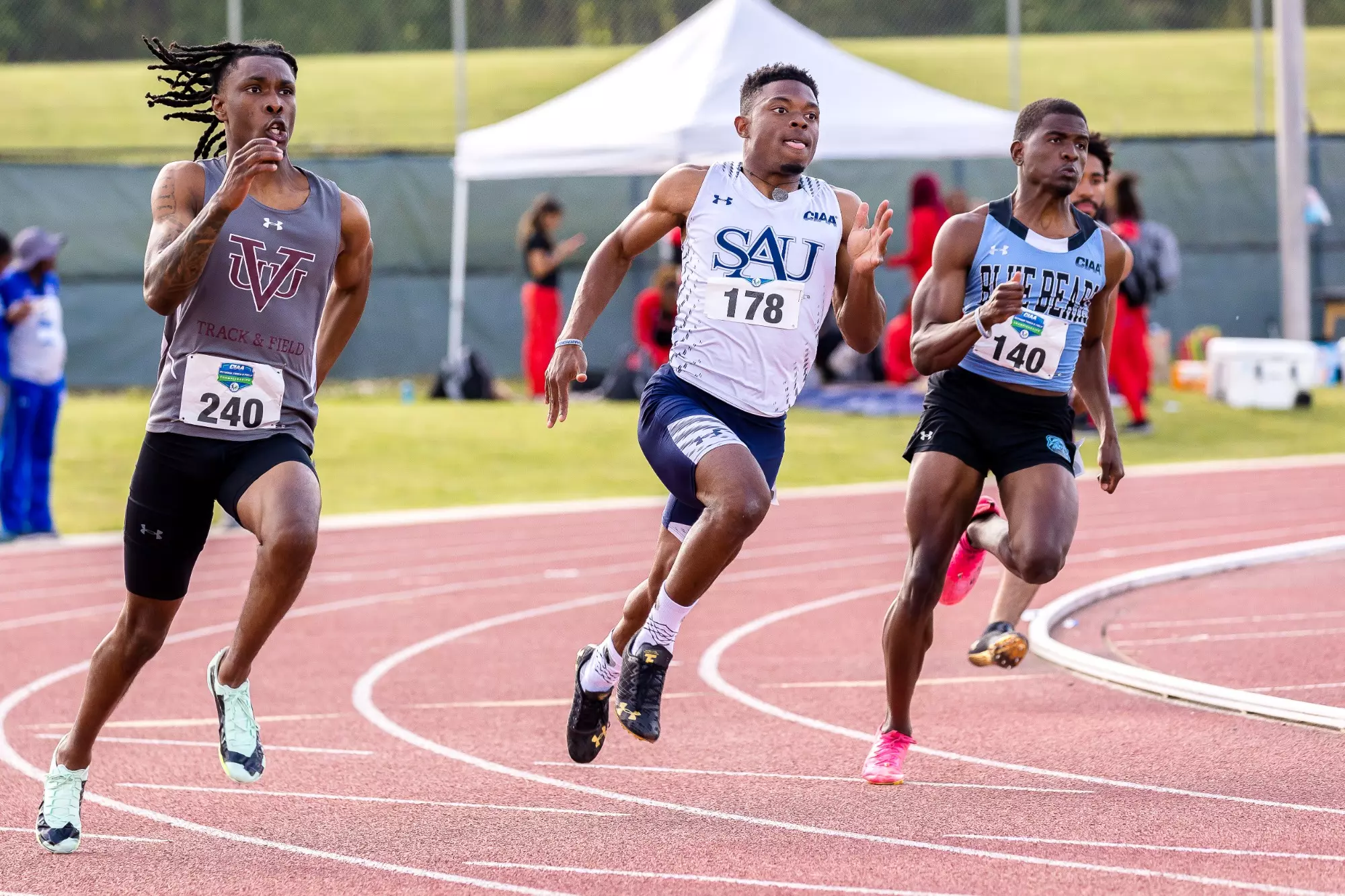
Coaches compare open 100m, 200m and 400m FAT times, then examine starts, acceleration and speed maintenance. For relay candidates, they also watch curve running, exchange-zone execution and whether an athlete can reproduce a strong leg after an individual race.
Distance
Coaches examine 800m, 1500m, 5000m and steeplechase results for pace control and the ability to close after honest early splits. They compare track performances with cross country results when those results help show how an athlete handles varied race conditions.
Throws
Shot put, discus, hammer and javelin prospects are evaluated on legal measured throws and the depth of a meet series, not just a standout attempt. Coaches use video to assess entry or approach mechanics, release and whether technique holds up in competition.
Jumps
Long jump and triple jump evaluation includes legal marks, wind readings, takeoff accuracy and approach consistency. For high jump and pole vault, coaches look at clearance progression, missed attempts and how reliably the athlete executes the run-up at greater heights.
Hurdles
Women's 100m hurdles and 400m hurdles require different evidence: coaches study block-to-first-hurdle execution and rhythm in the short race, then stride pattern and late-race form in the long race. Official times matter, but video shows whether time is lost at individual barriers.
Where to be seen
Where Coaches Watch
During the indoor and outdoor seasons, send coaches links to official meet results with event, mark, timing method and wind reading when relevant. Large invitationals and postseason meets provide useful comparisons, while a short video can clarify hurdling, jumping or throwing technique. Contact programs whose recent results give your primary event a plausible place in their lineup, rather than relying on a highlight reel alone.
- Official results databases that list marks, wind readings and meet conditions
- State championships and deep invitationals with strong event fields
- USATF meets and sanctioned summer competitions beyond the school season
- Submitted technical video, especially for jumps, throws, hurdles and pole vault
Level check
Signs You Are a D2 Level Recruit
- Official FAT sprint or hurdle times appear consistently in meet results.
- Field-event marks hold up across multiple legal attempts and meets.
- Results remain competitive at larger invitationals against unfamiliar athletes.
- An athlete advances to meaningful finals or places near the front in her event group.
- A primary event is supported by credible results in a related event or relay.
Stand out
What Helps and What Hurts
What helps
Habits that move you up coaches' boards
- An easy-to-check results history with meet names, dates and official result links.
- Video that identifies the athlete and shows a complete hurdle race, jump approach or throwing attempt.
- Legal marks with wind readings for affected sprint and jump events.
- Split information that matches an official distance race result.
- Accurate identification of primary and secondary events in coach outreach.
What hurts
Mistakes that quietly cost opportunities
- A practice PR presented as though it were a meet result.
- A wind-assisted sprint or horizontal jump mark presented without its wind reading.
- A one-meet wonder whose other results are far behind her advertised best.
- A relay-only sprinter with no comparable open FAT time or clear exchange footage.
- Edited throwing clips that hide fouls or omit the measured result.
Avoid these
Common Mistakes
- Assuming Division II women's track coaches use one national time standard for every program.
- Sending a screenshot of a result instead of a link to the official meet page.
- Treating a hand-timed sprint as directly interchangeable with a FAT result.
- Paying for exposure events while overlooking official competition results.
- Emailing the same event list to every program without checking which events it contests.
Action plan
What to Do This Month
- Collect official links to your recent meet results and label each event, timing method and wind reading.
- Identify your strongest event and one related event with credible results.
- Film a complete race or a clear set of attempts at your next meet this month.
- Use Pathley at pathley.ai to compare Division II women's track programs with your marks, event group and academic interests.
- Use Pathley to refine a concise coach email that links your results and names the events you want evaluated.
- Send that email to a focused list and update it when you record a new official mark.
College fit finder
Find the Colleges Where You Fit
Now that you know what coaches look for, see which schools to aim it at. Pick your position and level, and we score every college program in your sport on roster openings at your position, athletic level and academics.
Explore programs
Search top D2 Women's Track & Field colleges
Four ways to rank the programs in this division, from the strongest overall to the easiest to get into.
FAQ
Frequently Asked Questions
Do D2 women's track coaches care more about times and marks than video?
Yes. Measurable performance drives the initial evaluation. Video helps most in technical events, but sprint, distance, and many field event recruits are first screened by verified results.
How good do my marks need to be for NCAA Division II?
A useful benchmark is whether your marks are near conference finalist or scoring ranges at the schools you are targeting. Being a strong high school athlete alone is not enough if the marks do not translate to that level.
Does versatility help in women's track and field recruiting?
Yes, especially in Division II. Athletes who can help in relays, cover multiple events, or contribute indoors and outdoors often become more attractive because they provide more roster value.
Are state meet qualifiers automatically strong D2 recruits?
Not automatically. State qualification helps, but coaches still compare actual marks, field strength, and consistency against their conference standards and roster needs.
When should I contact D2 track and field coaches?
Contact them once you have credible marks and a clear event profile, then update them after meaningful improvements. Junior year and the periods around major indoor and outdoor meets are especially important.
Three ways to start
Where are you in the search?
Pick the option that matches where you are, and we will show you the plan that fits.
Your 20 to 25 best-fit schools, picked for you.



- Starter: the list, fit reads, real costs and a dated timeline
- Complete: adds roster reads and coach emails for every school
The roster at your position, at the schools you pick.

- Who is graduating at your position, class year by class year
- Where spots are likely to open, in plain words
One school, covered end to end.
- Your honest odds, the roster and the verified coach
- Intro email, three follow-ups, admissions steps and timeline
News and guides
Track & Field: The Latest from Pathley


Resources
Keep exploring
Sport hub
Everything for Women's Track & Field recruiting
The Women's Track & Field hub brings every division together: how D1, D2, D3 and NAIA compare, the strongest programs in each state, camps, and the recruiting guides for each level.

How this page was built. General NCAA recruiting guidance, public track and field results and Pathley internal analysis. Updated Sep 2026.