Pathley News
Athletic Scholarship Requirements: Real 2026 Guide | Pathley
Learn the real athletic scholarship requirements in 2026, from grades and test scores to athletic level and recruiting habits, plus clear steps to improve your chances.

Most athletes grow up hearing some version of this idea: if you are good enough, college coaches will find you and the scholarship money will follow. For a tiny number of blue chip recruits, that is almost true. For everyone else, treating recruiting like a talent contest instead of a process is how good players end up paying full price or quitting the search too early.
The truth is that scholarship decisions are not random. Coaches use a fairly clear checklist, even if no one has ever sat down and explained it to you. Once you understand what matters, what does not, and how your family fits into the picture, you stop guessing and start making real moves.
If you are already wondering where you stand, you can get instant, personalized feedback by asking Pathley directly: How do athletic scholarship requirements change for my sport and target division?
A lot of people hear the phrase requirements and think only about stats or how big, fast, or strong an athlete is. At a basic level, athletic scholarship requirements fall into three buckets that every college coach is paying attention to.
In reality, coaches evaluate three big areas:
• Academic eligibility, including your GPA, core courses, and test scores where required.
• Athletic level, meaning your size, speed, skills, production, and long term upside compared with the level of play at their program.
• Recruiting process habits, like how you communicate, whether you are coachable, and whether you follow through on what you say.
If any one of those three areas is way off, your odds of getting scholarship money drop fast. The good news is that all three are trainable. You can improve your grades, you can train smarter and compete at better events, and you can learn to run a real recruiting process instead of waiting around.
You can be the best athlete in your conference and still lose scholarship opportunities if your academics are not in order. The major governing bodies set minimum academic standards that you must meet just to be eligible for varsity collegiate competition and in many cases for any athletics based aid.
For NCAA programs, the academic bar includes core course requirements, a minimum GPA in those courses, and in some divisions a sliding scale that ties test scores to GPA. You can see the official expectations on the NCAA website under its initial eligibility resources at NCAA initial eligibility requirements.
The NAIA runs its own Eligibility Center and also publishes clear academic thresholds for freshmen and transfers. Those include combinations of GPA, class rank, and test scores. If you are considering NAIA schools, it is worth reading through the current rules directly at NAIA Eligibility Center information.
Here is how academics really affect your scholarship options in practice.
• Your core GPA controls whether you can even compete in Division I or II, and it can open or close doors at selective Division III and NAIA schools.
• Strong grades make you more recruitable because coaches feel safer investing money in athletes who are likely to stay eligible and graduate.
• High GPAs and test scores unlock academic scholarships that can stack with athletics based money, shrinking your net cost even at expensive private colleges.
Each school is a little different, but a simple way to think about it is this. The stronger your transcript, the more room a coach has to offer athletic money, because the admissions office and financial aid office are already on your side.
Not sure whether you are on track academically for the levels you care about most? Ask Pathley to translate the rulebook into practical targets for you: What GPA and test scores should I aim for if I want scholarship money at different college levels?
Academic expectations do not disappear after you sign. The NCAA, NAIA, and junior college associations all have ongoing progress toward degree rules that control whether you can keep playing and keep your aid year after year. That usually means passing a minimum number of credits each term, maintaining a certain GPA, and moving steadily toward graduation in a real major.
Coaches know this. When they look at your current habits and transcript, they are asking a simple question in the back of their minds. If we invest money here, is this athlete going to stay eligible and stay on our roster for four years? Strong academic discipline now is one of the most underrated ways to make yourself a safer bet for scholarship dollars.
The athletic side of scholarships gets the most attention, but even here most families are working off rumors or partial information. Every program has its own standards, but there are some common themes in what coaches look for when they decide who deserves money and who is a walk on candidate.
When a coach watches you, they are usually asking:
• Is this athlete physically and technically ready to compete at our level, or at least close enough that we can project real growth?
• Do their measurables, times, or stats line up with players who already contribute in our conference?
• How do they compete when things get tough, and how do they respond to coaching?
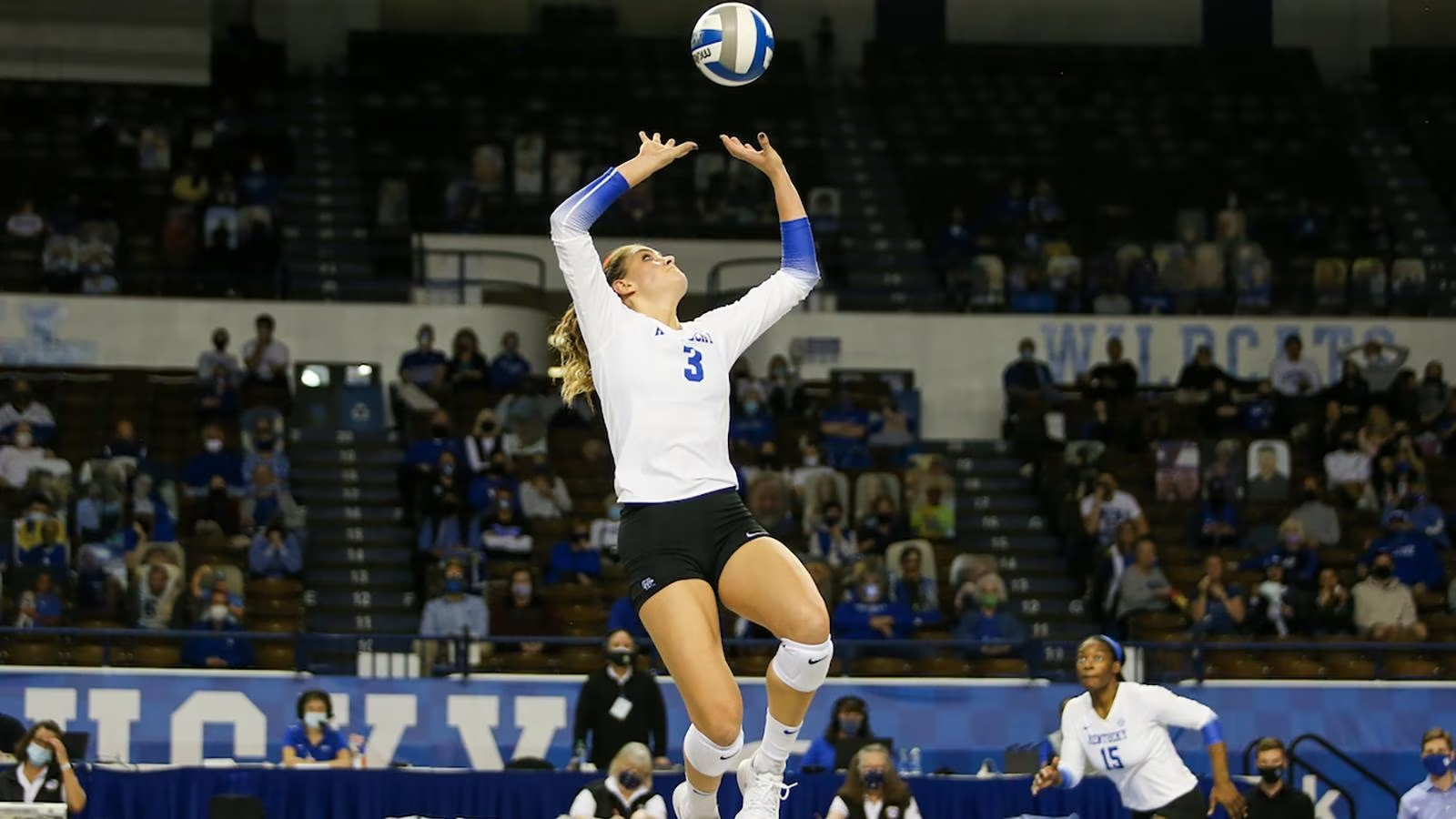
Context is everything. A 5 foot 10 outside hitter who dominates small school high school competition might not be a fit for a top Division I volleyball program, but could be a serious scholarship target in Division II, NAIA, or junior college. A defender who looks average in a low level club league might show very well at a strong showcase or ID camp.
If you play a position driven team sport like football or soccer, tools like the Pathley Football Hub and the Pathley Soccer Hub can help you see which programs match your measurables, style of play, and academic interests. For individual sports like track and field, swimming, or golf, Pathley can compare your verified times or scores to typical roster ranges in a few seconds.
Instead of guessing or comparing yourself to random players on social media, you can get a sport specific answer to a focused question like: What stats or times do college coaches usually expect for scholarship players at my position?
There is no universal stat line that guarantees money. A pitcher throwing 86 miles per hour in a major baseball hotbed might be one of many similar recruits. The same pitcher in a region with fewer travel programs might be a priority for multiple Division II, NAIA, or junior college coaches.
Coaches look at your body type, your movement, your skill detail, your competition level, and your improvement curve. A slightly smaller athlete who keeps getting better, competes like crazy, and checks every academic box will beat out a bigger, more inconsistent player for scholarship money more often than social media would make you think.
The last category of requirements is the one that does not get talked about enough. Even if you are strong academically and athletically, you still need to show coaches that you are organized, serious, and ready for the responsibility that comes with college athletics.
Coaches pay attention to details like:
• Whether you respond to messages and emails quickly and professionally.
• How prepared you are when you visit campus or jump on a video call.
• Whether your highlight film, schedule, and academic information are easy for them to access.
• How your high school and club coaches talk about your work ethic and attitude.
A clean, updated highlight video is a big piece of this. It gives coaches a fast way to see your tools and decide whether to invest more time. If you are not sure where to start, Pathley breaks down what to include, what to leave out, and how to share it in its guide at College Recruiting Highlight Video: Complete Guide for Recruits.
The same goes for campus visits, whether they are official or unofficial. Knowing what to ask, what to observe, and how to follow up can be the difference between a polite visit and a real scholarship conversation. For a deeper look at visit rules and strategy, check out Pathleys breakdown at NCAA Official Visit Rules: What Recruits Need to Know.
Running your process like a serious recruit signals to coaches that you will also handle practice, travel, and academics like a pro. Pathley helps you stay on top of that side of the game by tracking tasks, messages, and college research in one place so nothing slips through the cracks.
The next layer of understanding is how scholarship money is structured at different college levels. The label scholarship sounds simple, but under the hood the rules are very different across the NCAA divisions, the NAIA, and junior colleges.
At the NCAA level, each sport has set limits on how many scholarships a program can offer. In some sports at certain divisions, scholarships are headcount, which means every athlete on aid receives a full scholarship. In many others, they are equivalency, which means the coaching staff splits a fixed amount of money across a larger roster through partial awards.
The NCAA explains how athletics scholarships work on its own site at pages such as What is a scholarship. While the exact numbers change occasionally, the key takeaway is simple. Even at the Division I level, most athletes are on partial scholarships, and coaches have to stretch their budget as far as possible.
Division III programs do not offer athletics based scholarships at all, but they still recruit hard and can build very strong packages combining academic aid, need based aid, and other institutional grants. For many families, a DIII offer that looks like no athletic money on paper can still be more affordable than a partial scholarship at another level.
NAIA schools compete outside the NCAA structure and have their own scholarship rules. Many NAIA sports use an equivalency model similar to NCAA Division II, where a coach can divide a set number of scholarships among the roster.
Because NAIA campuses tend to be smaller and more flexible, coaches often have more freedom to blend athletic money with academic and need based aid to build competitive offers. If you are willing to look beyond the brand names, NAIA programs can offer strong competition plus serious financial help.
Junior colleges, often referred to as JUCOs, are a separate but very real path into four year scholarships. Many two year programs compete in the NJCAA or similar conferences and offer athletic aid, especially in sports like baseball, basketball, football, and soccer.
Spending one or two years at a junior college can give you time to raise your grades, gain size and strength, and build a better recruiting resume before transferring to a four year program. Organizations like the NJCAA outline their championship sports and opportunities at sites such as NJCAA student athlete information, which can help you see how wide the junior college landscape really is.
Here is a reality check that surprises a lot of athletes. The majority of money that brings your college price down will often not be labeled athletic. Academic scholarships, need based aid, and other grants can be just as powerful, and you can often combine them with athletic money.
Strong grades and test scores can unlock automatic merit awards from colleges, honors programs, and departmental scholarships. FAFSA based need can trigger federal grants, work study, and campus specific need based grants. Local organizations, foundations, and community groups add another layer of potential awards.
When a coach sits down with admissions and financial aid to talk about you, they are not just asking how much sports money they can spare. They are looking at your entire profile and asking how affordable they can make their school by stacking different kinds of aid. Pathley breaks this wider picture down in more depth in its guide at Stacking Athletic and Academic Scholarships: Complete Recruit Guide.
The athletes who win the financial aid game are the ones who treat academics like part of their sport and apply the same discipline to improving their transcript that they do to improving their vertical jump or sprint speed.
To make smart decisions, you also need to clear out some of the noise that floats around club sidelines and message boards.
• Myth: Only Division I athletes get real money. Reality: There is serious scholarship and financial aid at every level, including NAIA and junior college, and many DIII packages end up being more affordable than small partials at higher divisions.
• Myth: If a coach likes you, grades do not matter. Reality: Coaches walk away from talented athletes every year because admissions will not clear them or because they are too big a risk to stay eligible.
• Myth: A full scholarship is the only win. Reality: Very few sports at any level offer full scholarships to most of their roster. Partial offers combined with academic and need based aid are how most families actually pay for school.
• Myth: Requirements are identical for every sport. Reality: A cross country runner, a volleyball setter, and a baseball catcher will face very different recruiting timelines, evaluation standards, and competition for scholarships.
Once you understand the real athletic scholarship requirements and how they shift across levels and sports, you stop chasing someone elses path and start building your own.
All of these rules, exceptions, and moving parts can feel overwhelming when you try to manage them out of a notebook or a spreadsheet. That is exactly why Pathley exists, to turn a messy, confusing recruiting world into a clear, personalized game plan for your family.
Pathley uses an AI powered chat experience that lets you ask specific questions in plain language and get answers tailored to your sport, graduation year, and goals. Instead of scrolling generic forums, you can ask a focused question like How can I build a realistic college list that matches my scholarship chances and academic goals? and get a structured response with schools to research and next steps.
Inside the platform, you can explore programs across all levels using the Pathley College Directory, then save favorites, compare options, and keep refining your list as your stats and academic profile improve. You can also build and update your athletic resume, track communication with coaches, and see which tasks you should be focused on each month.
Most importantly, Pathley keeps the focus on fit, not hype. Instead of pushing you toward one level or selling you on a dream that does not match your reality, it helps you see clearly where you stand today and what specific moves will improve your academic, athletic, and process profile.
Rosters, coaches, and division breakdowns for every NCAA and NAIA program we track.