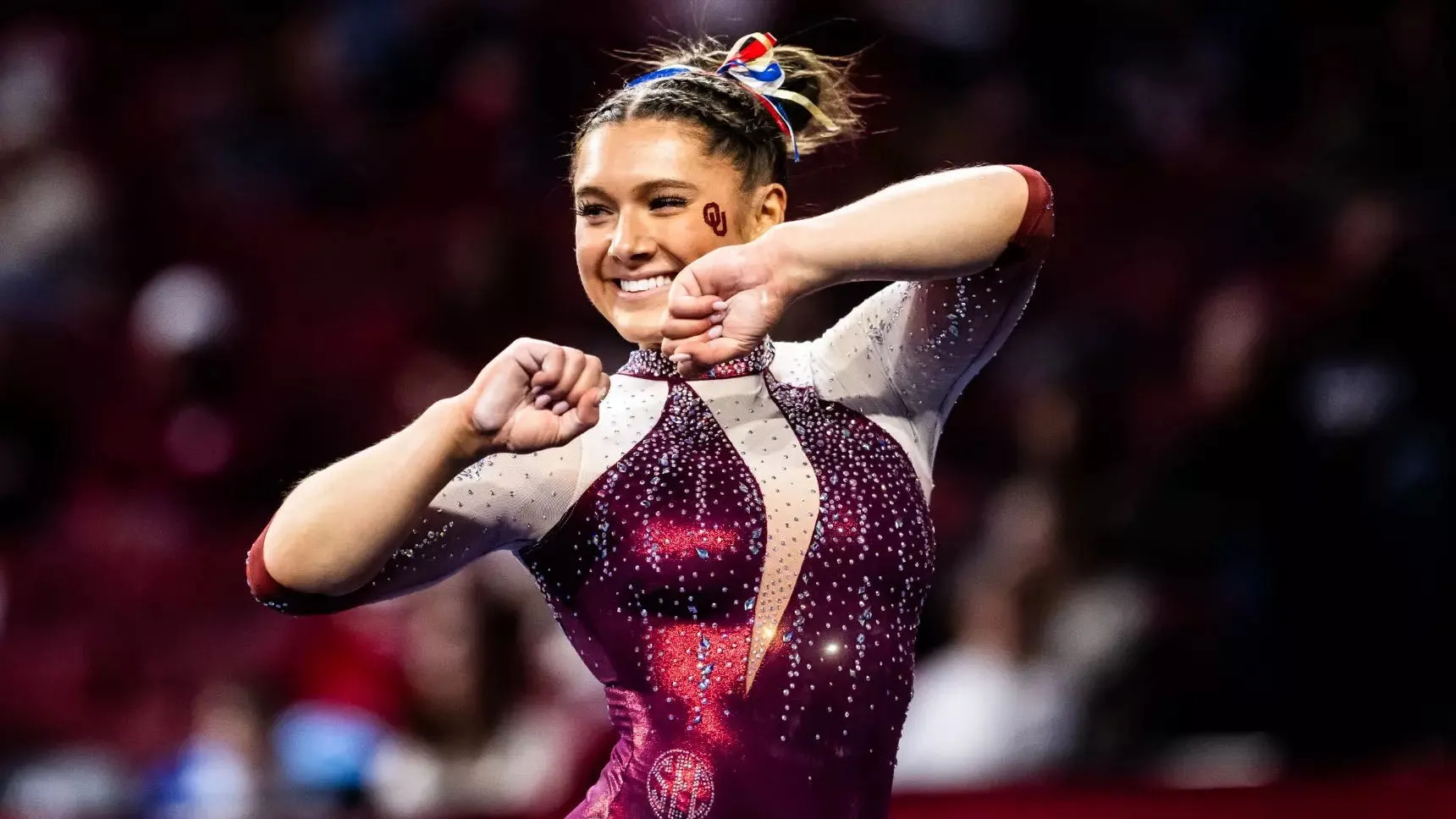
No. 1 Oklahoma women’s gymnastics used a record-caliber vault rotation and a breakout perfect 10 from freshman Mackenzie Estep to win the 2026 Metroplex Challenge with a 198.175. The performance underscored the Sooners’ depth, their freshman impact and their status as the team to beat in this year’s NCAA title race.
Oklahoma Freshman Mackenzie Estep Nails First Perfect 10 as Sooners Dominate Metroplex Challenge
No. 1 The University of Oklahoma women’s gymnastics team did more than win another meet in early February. Behind a history-making vault from freshman standout Mackenzie Estep and season-best scores on key events, the Sooners turned the 2026 Metroplex Challenge in Fort Worth into a statement about where the national title race runs through this year.
Perfect 10, Powerful Message
On February 8, 2026, Oklahoma posted a 198.175 at the neutral-site Metroplex Challenge, topping No. 10 Arkansas (197.700), Arizona (195.825) and Texas Woman’s University (195.025). The headline moment came from Estep, who delivered the first perfect 10 of her college career on vault and the first 10.0 by any freshman in the 2026 NCAA women’s gymnastics season.
Estep, part of Oklahoma’s highly touted freshman class, stuck a Yurchenko 1½ for a 10.0 in the vault lineup, helping the Sooners to a 49.725 event total. According to Oklahoma, that mark is the third-highest vault score in program history and the highest vault total by any team in the nation so far this year.
Her performance had multiple layers of significance:
- First collegiate perfect 10 of her career
- First Oklahoma freshman since Jordan Bowers in 2022 to score a 10.0 on any event
- First perfect 10 recorded by any freshman in the 2026 NCAA women’s gymnastics season
- First perfect 10 of the year for the Sooners
Nationally, a Division I tracker had recorded only eight perfect 10s across all events through five weeks of the 2026 season. Estep’s vault was the most recent addition to that elite list and made her just the third gymnast to achieve a 10.0 on vault this year, joining Utah’s Avery Neff and UCLA’s Jordan Chiles as the only vault perfect-10 scorers to date (GymnasticsVille perfect 10 tracker).
For recruits, families and coaches watching from afar, that kind of rarity is important context. In a sport where routines are judged to the tenth and deductions are expected, a perfect 10 signals nearly flawless execution, precise landings and top-tier difficulty under pressure. Put simply, it is one of the clearest signs a gymnast can send that she belongs among the nation’s best.
How Oklahoma Built a 198.175 at the Metroplex Challenge
Vault Sets the Tone
Oklahoma opened the meet on vault and immediately established separation. The Sooners’ 49.725 rotation not only set the tone in Fort Worth but reinforced why they entered the weekend ranked No. 1 in the country on this event.
Key vault scores for Oklahoma included:
- Mackenzie Estep: 10.0 on a stuck Yurchenko 1½
- Addison Fatta: 9.975 in the anchor spot, matching her career high
- Elle Mueller: 9.950
- Keira Wells: 9.950
- Elizabeth Blessey: 9.85 on a handspring pike half
- Faith Torrez: 9.825 in her return to the vault lineup
By the end of the first rotation, Oklahoma held a 0.150 lead over Arkansas. Perhaps more importantly, the Sooners had just showcased four stuck 1½-twisting vaults, illustrating a combination of difficulty and control that only a handful of teams nationally can match.
Uneven Bars: Steady and Efficient
On bars, Oklahoma’s scoring pace leveled off slightly but remained strong. The Sooners posted a 49.200 in the second rotation to reach 98.975 at the meet’s halfway point.
Torrez led the way with a 9.90 thanks to a clean set capped by a double-layout dismount. Ella Murphy, Fatta and others added stable 9.825 routines that helped the Sooners avoid major mistakes and keep Arkansas at arm’s length. While it was not the flashiest event of the night, bars provided the kind of solid, low-deduction work that title contenders need on the road or at neutral sites.
Balance Beam: No. 1 in the Country for a Reason
The third rotation is where Oklahoma reclaimed control. On balance beam, the Sooners posted a 49.450 to stretch their total to 148.425, building a 0.400 cushion over Arkansas heading into the final event.
The beam lineup was all about composure and depth:
- Addison Fatta opened with a 9.90
- Keira Wells followed with a 9.875
- Freshman Ella Murphy matched Fatta with a 9.90 in the third slot
- Mueller added a career-best 9.85
- Torrez anchored with a 9.925, marking her sixth straight beam routine scoring 9.90 or higher
Those routines reflected why, in the national event rankings released after the weekend, Oklahoma held the No. 1 spot on beam with a 49.517 average, narrowly edging out the rest of the field. For recruits, that ranking illustrates why beam specialists in high school and club systems see Norman as one of the premier destinations in college gymnastics.
Floor Exercise: Capping the Night With a Season High
If vault set the tone, floor exercise finished the argument. Oklahoma closed the meet with a season-best 49.750, a number that stood as the top floor score in the country to that point in 2026.
The lineup was stacked with both veterans and high-impact freshmen:
- Lily Pederson led off with a 9.90, giving the Sooners a strong starting point
- Murphy followed with a 9.925, raising the standard for the rest of the rotation
- Estep bounced back from a floor mistake two nights earlier with a career-high 9.95 in the third position
- Mueller matched that 9.95, showcasing powerful tumbling and sharp choreography
- In her first appearance as floor anchor this season, sophomore Kamila Pawlak tied her career high with another 9.95
- Fatta, already near-perfect on vault, earned a 9.975 on floor to win the event title
Fatta’s 9.975 secured her the floor crown and contributed to a 39.675 all-around total, the highest of the meet and among the best scores nationally for the week. The performance also underlined the point that Oklahoma’s success does not hinge on a single star; multiple athletes are capable of delivering 9.9-plus routines when it matters most.
Context: A Weekend That Defined Oklahoma’s 2026 Push
The Metroplex Challenge win did not happen in isolation. It came less than 48 hours after Oklahoma opened its home SEC slate with a 198.200–197.475 victory over No. 4 Alabama, giving the Sooners back-to-back 198-plus scores for the weekend.
That kind of consistency is rare and significant. In modern NCAA women’s gymnastics, a 198 is a benchmark of elite performance, representing a team average just shy of 9.9 per routine across four events and six gymnasts per lineup. Programs that can consistently flirt with or surpass 198 are typically the ones standing on the floor at nationals with hardware in hand.
Oklahoma entered 2026 as the preseason No. 1, and the Metroplex performance validated that status. The Sooners are the reigning NCAA women’s gymnastics champions and have claimed seven national titles across program history. They have also been ranked No. 1 in the country for three straight weeks, with the top event averages on both vault and beam as of the second week in February.
The Metroplex result came just before another major test: a looming top-five road showdown at Florida later in the week. That stretch of schedule shows the reality of life at a powerhouse like The University of Oklahoma: competition against top-10 programs is routine, and every weekend offers another opportunity to prove why you are the team to beat.
Why Estep’s Perfect 10 Matters Beyond the Score Sheet
For casual fans, it can be easy to see a perfect 10 as a flashy number and move on. For athletes and coaches, though, it represents years of refinement and the rare night when execution, nerves and judging all align.
In Estep’s case, the milestone also speaks to Oklahoma’s long-term roster strategy. The Sooners’ 2026 signing class was widely regarded as the best in the country, and the Metroplex Challenge showcased why. Estep, Murphy and Pawlak were all central pieces in the team’s highest-scoring rotations on vault, beam and floor.
At a program that already boasts national titles and top event rankings, it can be difficult for a freshman to break into lineups, let alone deliver routines that change the trajectory of a meet. Estep not only broke through but did so by joining one of the most exclusive clubs in college gymnastics this year.
From a recruiting perspective, that sends a clear message to high school gymnasts and club coaches: if you are good enough to earn a lineup spot at Oklahoma, the staff will trust you in high-pressure environments quickly. The track record of freshmen scoring 10.0s, from Jordan Bowers in 2022 to Estep in 2026, reinforces that idea.
The Rarity of Perfect 10s in NCAA Gymnastics
Even in an era where scoring can trend high at times, perfect 10s remain uncommon at the Division I level. Through the first five weeks of the 2026 season, just eight perfect 10s had been recorded across all teams and events nationwide, with Estep’s vault in Fort Worth as the latest addition to that list.
Independent trackers and national outlets closely follow these scores because they provide a quick snapshot of which athletes and programs are performing at the very top of the sport. In recent seasons, NCAA champions and Olympians alike have used perfect 10s as launching pads for postseason momentum and even international opportunities, as seen with gymnasts like Trinity Thomas and Jordan Chiles in past years (ESPN coverage of NCAA perfect 10 milestones).
For Estep, earning a 10.0 this early in her career puts her squarely on the radar of fans, judges and national media. It also gives Oklahoma yet another proven, high-scoring option as the season moves toward conference championships and NCAA regionals.
Depth and Rankings: Why Oklahoma Keeps Leading the Pack
Oklahoma’s success is not built solely on perfect 10s. It is built on depth: multiple gymnasts capable of delivering lineup-ready routines and posting 9.85-plus scores on any given night. After the Metroplex weekend, eight different Sooners held a combined 17 individual rankings in the national event and all-around lists.
That kind of roster breadth gives head coach K.J. Kindler strategic flexibility. If an athlete needs rest or is returning from injury, there are proven options ready to step in. It also creates a competitive environment in practice, where nothing about lineup spots is guaranteed and daily training intensity can mirror meet-day pressure.
For prospective student-athletes, this is both a draw and a challenge. Joining a program like Oklahoma means you are surrounded by national-caliber talent every day, which can accelerate development. It also means that simply making lineups is an accomplishment in itself, and earning a perfect 10 is the result of rising to the very top of an already elite group.
What This Means for Gymnastics Recruits and Families
If you are a high school gymnast or a parent following Oklahoma’s rise, the Metroplex Challenge offers a blueprint of what a top-tier Division I environment looks like:
- High team expectations: 198-plus scores are not outliers, they are targets.
- Event depth: Multiple athletes can post 9.9 or better on the same event in the same meet.
- Freshman impact: First-year athletes are expected to contribute quickly and can earn marquee opportunities.
- National spotlight: Perfect 10s and 198s attract media coverage and raise an athlete’s profile.
As you evaluate whether a program like Oklahoma is the right fit, it helps to look beyond the final scores and ask:
- Do I thrive in highly competitive environments where every lineup spot is earned?
- How do I project into multiple events at the college level?
- Am I prepared for the academic and time demands of a major Division I program?
Tools like Pathley’s free College Directory and the sport-specific Gymnastics Pathley Hub can help you compare schools, see where a program like Oklahoma fits into the broader landscape and begin building a realistic list of target, reach and safety options.
How to Explore Oklahoma and Other Gymnastics Programs
Because the women’s college gymnastics world is smaller than sports like football or basketball, finding the right fit often comes down to detailed research and honest assessment of your current level and growth potential.
Here are a few ways to take a next step if Oklahoma’s performance at the Metroplex Challenge caught your eye:
- Study program history: Oklahoma is a seven-time NCAA women’s gymnastics champion and a consistent top-5 team nationally. Understanding a program’s trajectory and coaching stability can tell you a lot about what your four years might look like. Basic program and school information is easy to skim through using resources like Wikipedia or school athletics pages (University of Oklahoma overview).
- Compare multiple schools: Use tools like Pathley’s comparison and rankings features to contrast Oklahoma with other programs in terms of academics, cost, conference, and gymnastics tradition. That big-picture view can keep you from focusing on a single name or logo.
- Assess fit beyond scores: Campus culture, academic majors, distance from home and coaching styles all matter just as much as gym size or recent titles.
If you are just starting your search or trying to refine your list, Pathley’s AI recruiting assistant can help you explore possibilities and surface programs you might not have considered yet.
Using Pathley to Turn Big Meets Into Smart Recruiting Steps
Marquee meets like the Metroplex Challenge are must-watch events for serious recruits, but they are also just one piece of the bigger recruiting puzzle. To turn that inspiration into action:
- Track your own progress: Keep an updated record of your scores, skills, videos and academic info. Pathley’s Athletic Resume Builder can turn that information into a coach-ready PDF in minutes.
- Evaluate fit school by school: When a program stands out to you, run a quick check on how you align academically, athletically and socially. Pathley’s College Fit Snapshot can help you visualize that for specific schools.
- Explore your options widely: Even if a powerhouse like Oklahoma feels like a dream destination, it is smart to build a balanced college list. The Gymnastics Pathley Hub makes it easier to discover other strong programs, compare them, and find camps or clinics that match your current level.
The Takeaway: Sooners Still the Team to Beat
By the end of the Metroplex Challenge weekend, Oklahoma had delivered consecutive 198-plus team scores against top-10 competition, maintained its hold on the No. 1 national ranking and added another perfect 10 to its growing list of high-profile moments.
For Estep, the night in Fort Worth will be remembered as the meet where she officially arrived on the NCAA stage, becoming the first freshman in 2026 to earn a perfect 10 and the linchpin of a vault rotation that may stand as the best in the country this season.
For the Sooners as a whole, the performance underscored a larger truth about their 2026 campaign: between veteran anchors like Fatta and Torrez and a fearless freshman class headlined by Estep, Murphy and Pawlak, the path to the NCAA title still runs directly through Norman.
If you are dreaming about competing on a stage like that one day, start by learning everything you can about programs like Oklahoma, then use tools such as Pathley’s College Directory and College Fit Snapshot to build a realistic, personalized path to your own perfect fit.