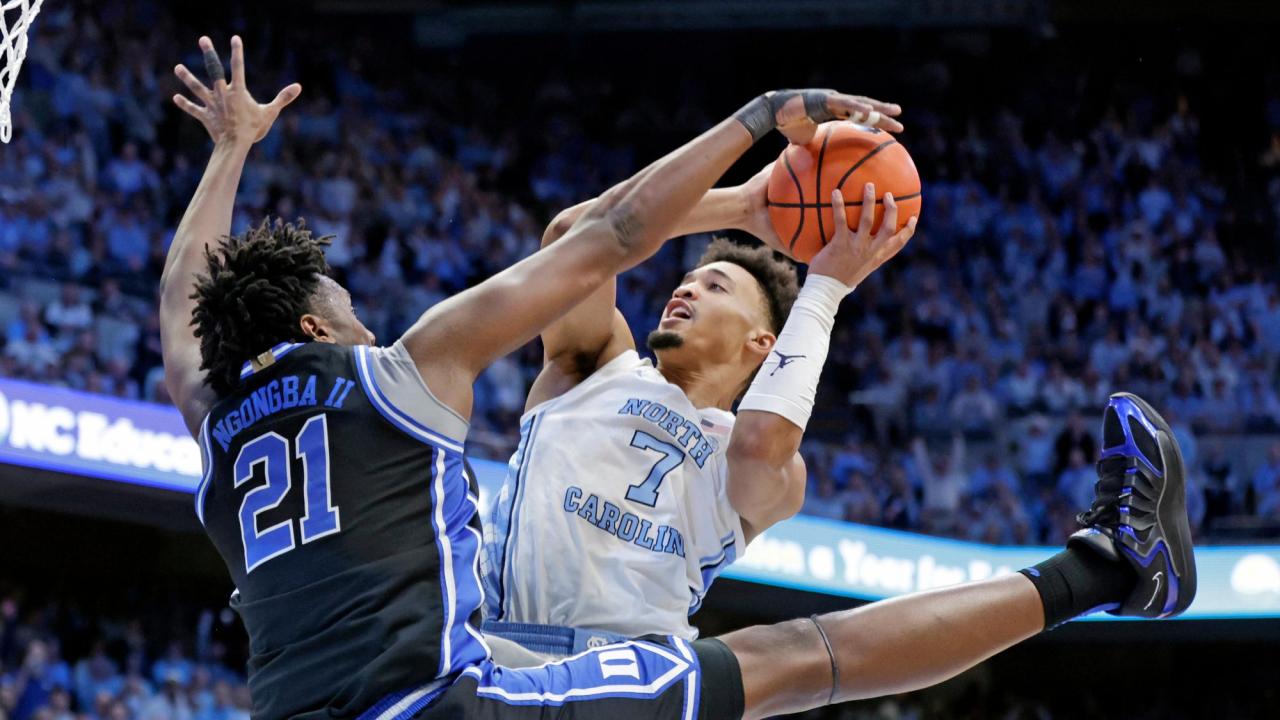
On February 7, 2026, No. 14 North Carolina stunned No. 4 Duke 71–68 at the Dean E. Smith Center, erasing a double-digit deficit in one of the rivalry’s most dramatic finishes. Sophomore guard Seth Trimble hit a right-corner three with 0.4 seconds left, delivering UNC’s only lead of the night and extending the Tar Heels’ perfect home record.
Seth Trimble’s Last-Second Three Lifts No. 14 North Carolina Over No. 4 Duke 71–68
In a rivalry defined by big moments, the University of North Carolina at Chapel Hill added another instant classic to the series with Duke on February 7, 2026. Trailing for all but the opening seconds and down by 12 at halftime, the fourteenth-ranked Tar Heels surged back to stun the fourth-ranked Blue Devils 71–68 at the Dean E. Smith Center, capped by a right-corner three-pointer from sophomore guard Seth Trimble with just 0.4 seconds remaining.
The shot gave North Carolina its first and only lead of the night, completing a 9–0 run over the final two and a half minutes and snapping Duke’s 10-game winning streak. It also preserved UNC’s perfect home record, pushing the Tar Heels to 14–0 in Chapel Hill and 19–4 overall (7–3 in ACC play), while Duke fell to 21–2 and 10–1 in the conference.
For current and future college basketball players eyeing Chapel Hill, this game was a vivid example of the resilience, depth, and national profile that define the University of North Carolina at Chapel Hill men’s basketball program.
First Half: Duke Dominates the Paint and Builds a Double-Digit Lead
Duke seized control from the opening tip. The Blue Devils came out with a clear plan: attack the interior and crash the offensive glass. They hit six of their first eight shots and nine of their first eleven, racing out to leads of 14–5 and then 20–9 as North Carolina struggled to find any rhythm beyond one standout freshman.
Nearly every early Duke basket seemed to come at the rim or on second-chance opportunities. By halftime, the visitors had outscored North Carolina 18–4 in the paint and 13–4 in second-chance points, numbers that underscored how thoroughly Duke controlled the physical aspects of the game in the first 20 minutes. At one point, the Blue Devils led by as many as 13 before closing the half on an 11–2 surge to take a 41–29 advantage into the locker room.
For North Carolina, the first half could have spiraled into a blowout if not for freshman forward Caleb Wilson. While the rest of the Tar Heels’ offense sputtered, Wilson delivered a poised, confident performance beyond his years. He scored 17 of UNC’s 29 first-half points and finished the night with 23 on 8-for-12 shooting, according to the official recap on GoHeels.com.
Even so, the numbers at the break painted a bleak picture: North Carolina was shooting just 33.3 percent from the field, being outmuscled on the glass, and losing almost every efficiency battle inside. In most games, that kind of deficit against an elite opponent like Duke is the beginning of the end. Instead, for this Tar Heel group, it was the setup for a historic rally.
Second Half Surge: Adjustments, Efficiency, and a Different Tar Heel Team
Coming out of halftime, North Carolina transformed. According to the program’s postgame notes, the Tar Heels trailed for 37 minutes and 39 seconds overall and by 12 at the half, making the comeback their largest rally from a halftime deficit this season and tying the fifth-biggest comeback ever in the Smith Center.
The shift was immediate. UNC opened the second half by hitting 10 of its first 14 field goal attempts, reversing the efficiency that had favored Duke before the break. Over the final 20 minutes, North Carolina outscored the Blue Devils 42–27, turning a game that had looked like a comfortable Duke road win into a possession-by-possession battle.
One of the biggest differences was the emergence of center Henri Veesaar. After being held scoreless in the first half, Veesaar became a force at both ends. He scored all 13 of his points and grabbed nine of his 11 rebounds in the second half, anchoring UNC’s surge. His improved physicality and positioning on the glass helped the Tar Heels stay within striking distance, even as Duke continued to win the overall rebounding battle.
At the same time, guards Seth Trimble and Derek Dixon began to find seams in Duke’s defense. Combining aggressive drives with timely perimeter shooting, they forced the Blue Devils to defend the whole floor instead of simply packing the paint. Trimble’s slashing and on-ball pressure, paired with Dixon’s composure and shot-making, gradually eroded Duke’s comfort level.
Statistically, the turnaround was stark. Per GoHeels’ postgame report and national box scores on ESPN, North Carolina boosted its shooting from 33.3 percent in the first half to 60.7 percent in the second, while holding Duke to just 37.5 percent after the break. Even though the Tar Heels were outrebounded 38–26 overall and lost the paint battle 36–22, they took care of the ball, committing only seven turnovers, and hit enough jump shots to compensate for those interior disadvantages.
UNC’s Key Second-Half Catalysts
Several individual performances fueled the comeback:
- Caleb Wilson: Finished with 23 points on 8-for-12 shooting, marking his fifth straight 20-point game and his 17th of the season. Those numbers continued to extend multiple freshman scoring records at North Carolina.
- Henri Veesaar: Posted a 13-point, 11-rebound double-double, with all but two of those rebounds coming after halftime. It was his ACC-best 13th double-double of the season.
- Seth Trimble: Delivered 16 points and three steals, playing one of the most impactful games of his UNC career, highlighted by the game-winning three-pointer.
- Derek Dixon: Provided steady backcourt leadership in the late stages, attacking off the dribble and knocking down a critical three as UNC closed the gap.
On the Duke side, forward Cameron Boozer showcased why he is considered one of the nation’s most talented players, finishing with 24 points and 11 rebounds. Guards Dame Sarr and Isaiah Evans added 13 and 11 points respectively, but the Blue Devils’ inability to generate stops down the stretch ultimately swung the game.
The Final Minutes: A 9–0 Run and Trimble’s Corner Three
The closing two and a half minutes delivered the kind of drama that has defined North Carolina–Duke for generations. With just under six minutes remaining, UNC trailed 62–58 when a turnover near midcourt led to a Boozer layup, stretching the Duke lead back to six at 64–58 and briefly silencing the crowd.
From there, every possession carried outsized weight. Veesaar responded by trimming the deficit to four, and the Tar Heels hung within two possessions as the clock wound down. With 2:25 left, Dixon stepped into a three-pointer and buried it, pulling UNC within 68–65 and giving the Smith Center its loudest moment to that point.
Less than a minute later, Veesaar made perhaps his most surprising play of the night. Popping beyond the arc, he calmly rose and hit his only three-pointer of the game, tying the score at 68–68. It was the first tie since the opening 30 seconds and signaled that North Carolina was no longer just chasing; the Tar Heels were in position to win.
Both teams then came up empty on subsequent possessions, each failing to find a clean look or convert under escalating pressure. On Duke’s final meaningful attempt, Boozer once again attacked the lane, but Veesaar was there, contesting the drive and forcing a miss. Trimble secured the rebound with roughly 15 seconds remaining, and head coach Hubert Davis called timeout to set up one last play.
The Play Call: Space, Drive, Kick, and History
Out of the timeout, North Carolina spread the floor, trusting Dixon to create off the dribble. With shooters spaced around the perimeter, Dixon drove into the teeth of Duke’s defense, drawing help and attention. As defenders collapsed toward the lane, he kicked the ball to Trimble in the right corner.
Trimble caught, squared, and released. The shot snapped through the net with 0.4 seconds left, triggering a roar inside the Smith Center and giving UNC its first lead of the night at 71–68. Officials reviewed the play, restored the time, and briefly cleared celebrating fans from the court so Duke could attempt a final inbounds heave, but the desperation pass was off the mark, sealing the Tar Heels’ rivalry win.
In a building that has witnessed national titles, All-Americans, and countless rivalry moments, Trimble’s shot instantly joined the conversation among the Smith Center’s signature plays.
Program History and Rankings: Why This Win Matters for UNC
Beyond the immediate thrill, the victory carried significant weight for the Tar Heels’ season and their broader place in men’s college basketball. According to UNC’s postgame notes on GoHeels.com and national coverage from NCAA.com, several milestones stood out:
- Home dominance: The win moved North Carolina to 14–0 at the Dean E. Smith Center this season, reinforcing Chapel Hill as one of the toughest road environments in the country.
- Rivalry history: UNC improved its all-time series edge over Duke to 146–120. In Chapel Hill, the Tar Heels now lead 67–40, including a 22–19 advantage in games played at the Smith Center.
- Top-five breakthrough: This was North Carolina’s first victory over an Associated Press top-five opponent since its upset of fourth-ranked Baylor in the 2022 NCAA tournament.
- Blueblood sweep: It also marked the first season since 1981–82 that North Carolina has beaten Kansas, Kentucky, and Duke in the same year, a statement of the program’s national relevance under Hubert Davis.
- Ranked wins under Davis: The result gave Davis his 18th career win over a ranked opponent and his ninth against a top-10 team as UNC’s head coach.
For recruits and families evaluating their options, these benchmarks reinforce why the University of North Carolina at Chapel Hill remains one of the most visible and competitive destinations in Division I men’s basketball. The combination of national schedule, iconic rivalry games, and a track record of winning high-stakes matchups helps keep UNC consistently in the national conversation.
Inside the Numbers: How UNC Won Despite Interior Disadvantages
Box score data often clarifies how a game was won; in this case, it highlights how improbable UNC’s path was. Duke finished with a 38–26 edge on the boards and a commanding 17–4 advantage in second-chance points. The Blue Devils also outscored UNC 36–22 in the paint and looked more physically imposing for long stretches.
Typically, those numbers are a recipe for a comfortable victory. Instead, North Carolina found other ways to tilt the game:
- Turnovers: UNC committed only seven turnovers, limiting live-ball mistakes that could have fueled Duke’s transition game.
- Second-half efficiency: The Tar Heels’ 60.7 percent field-goal shooting after halftime, combined with their defensive improvement, flipped the game’s trajectory.
- Perimeter shot-making: Timely threes from Dixon, Veesaar, and ultimately Trimble gave UNC the high-leverage scoring plays it needed to erase the deficit.
That balance of shot-making, poise, and defensive adjustments is exactly what college coaches highlight when talking to recruits about how games are actually won in March and in high-pressure rivalry environments.
Hubert Davis’ Message: Perseverance, Toughness, and Togetherness
After the game, head coach Hubert Davis framed the comeback as more than just a memorable night for the rivalry. He pointed to perseverance, toughness, and togetherness as the defining traits of his team’s performance, a foundation he believes they can lean on as they chase their full potential in the stretch run of the 2025–26 season.
From a recruiting standpoint, that message matters. Prospects and their families are not only looking at rankings and facilities; they are trying to understand a program’s identity and how a staff responds to adversity. Rallying from a 12-point halftime deficit against one of the nation’s top teams, in one of the highest-pressure environments of the season, offers a clear answer.
For student-athletes considering a future in ACC basketball or other top Division I leagues, games like UNC–Duke are a reminder of how thin the margins are at the highest level. Every possession, every rotation, and every late-game decision can swing outcomes and seasons.
What This Means for Recruits Watching North Carolina
For high school guards, wings, and bigs dreaming of playing in front of 20,000 fans, this game put a spotlight on how different roles can shine within a program like UNC:
- Lead guards see how creators like Dixon and Trimble are trusted with the ball in late-game situations.
- Forwards and centers can study how Veesaar shifted from a quiet first half to a dominant second, impacting the game through rebounding, rim protection, and even perimeter shooting.
- Freshmen can look at Caleb Wilson’s usage and production as a first-year player extending scoring records and understand that impact roles are available early for the right fit.
If you are an athlete or parent trying to understand where a program like UNC fits in your own recruiting journey, tools like the Pathley College Fit Snapshot can help translate a college’s on-court profile into a clear view of academic, athletic, and campus fit. You can also explore more programs that match your goals using the Pathley College Directory.
Context Within Men’s College Basketball
North Carolina’s win over Duke came on a Saturday loaded with high-impact results across the national landscape. As NCAA.com noted in its weekend roundup, the day featured buzzer beaters, overtime thrillers, and potential tournament-shaping upsets. UNC’s victory stood out not only because of the stakes in the ACC race, but also because of the historical layers connected to the rivalry and UNC’s broader season arc.
Beating Kansas, Kentucky, and Duke in the same season for the first time since 1981–82 echoes one of the most storied eras in Tar Heel history. Pair that with the program’s first AP top-five win in four years, and it is clear that this team has positioned itself among the true contenders nationally.
For players hoping to land at that level, using a sport-specific hub like Pathley’s Basketball Pathley Hub can be a strategic way to find schools that combine strong basketball traditions with academic and campus environments that match your priorities, whether or not you ultimately reach a blueblood like UNC.
From Chapel Hill to Your Recruiting Path
Not every recruit will end up playing in a rivalry as big as North Carolina–Duke, but the principles on display in this game are relevant across the college landscape:
- Programs that respond well to adversity often reflect strong culture and player development.
- Coaches who trust their players in pressure moments can be attractive destinations for competitors who want the ball when it matters.
- Balanced rosters, where freshmen, sophomores, and veterans all have meaningful roles, can be especially appealing to recruits looking for early opportunity.
If you are navigating your own recruiting process, you can use Pathley’s tools to bring some of that same clarity to your search. Start at Pathley’s home to learn how AI can help you discover schools that match your profile, then dive deeper with tools like the College Directory, sport hubs, and the College Fit Snapshot.
Closing: A Signature Night in Chapel Hill
On a February night at the Dean E. Smith Center, No. 14 North Carolina showed why the program remains central to college basketball’s story. Down by double digits, dominated in the paint, and facing a top-five Duke team riding a 10-game win streak, the Tar Heels responded with toughness, adjustments, and big-time shot-making when it counted most.
Caleb Wilson’s scoring, Henri Veesaar’s second-half double-double, and Seth Trimble’s fearless corner three combined to turn what looked like a Duke statement win into a defining moment for UNC’s 2025–26 campaign. For the University of North Carolina at Chapel Hill, this game was more than just another victory in a historic rivalry. It was a loud reminder, to opponents and recruits alike, that the Tar Heels remain one of the sport’s most resilient and relevant powers.
If this type of stage is what you are chasing, tools like the College Fit Snapshot and the broader Pathley College Directory can help you map your own path, whether your dream is Chapel Hill, another ACC campus, or a hidden-gem program that fits your goals just as well.