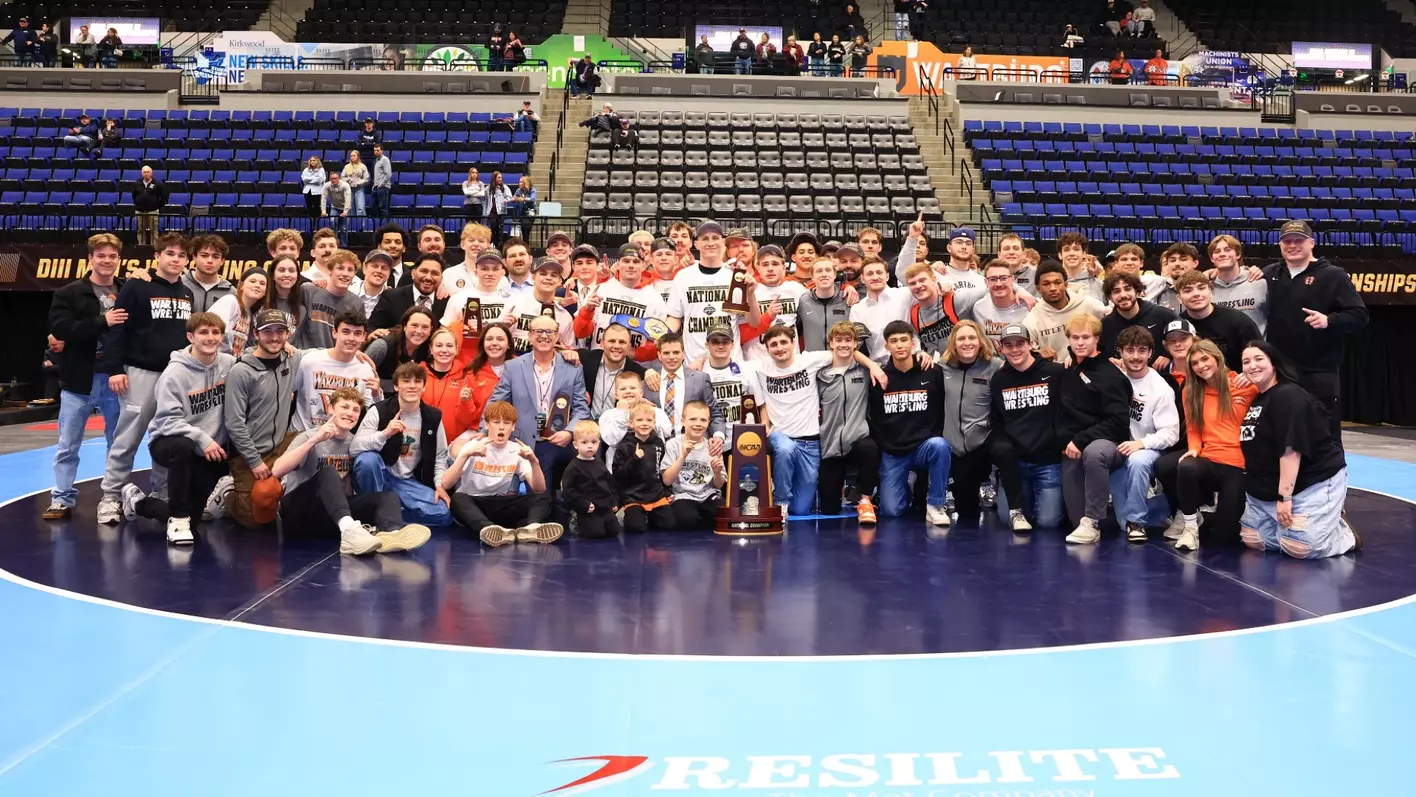
With 110 team points and seven All-Americans, Wartburg College men’s wrestling turned Cedar Rapids back into “Titletown” at the 2026 NCAA Division III Championships. The Knights captured their 17th national title behind stars like Kade Blume and Kasey Ross while head coach Eric Keller tied a program record with his 10th championship.
Wartburg Men’s Wrestling Dominates 2026 NCAA Division III Championships for 17th National Title
On March 13–14, 2026, Wartburg College did what Wartburg College has done better than any other Division III wrestling program in history: win big on the sport’s biggest stage.
Inside the Alliant Energy PowerHouse in Cedar Rapids, Iowa, the Knights overwhelmed a deep national field to capture the 2026 NCAA Division III Men’s Wrestling National Championship. Wartburg piled up 110.0 team points over four sessions, cruising to a 42-point margin over runner-up Wisconsin–La Crosse and cementing yet another title in a run that has defined Division III wrestling for three decades.
The result delivered Wartburg’s 17th national championship in men’s wrestling, extended a back-to-back title streak after winning in 2025, and reinforced the program’s identity as the premier small-college wrestling power in the country.
“Titletown” Returns: Wartburg Turns Cedar Rapids Orange Again
The final team standings told the story of separation as much as domination. After the last whistle on Saturday night, Wartburg sat at the top with 110 points. Wisconsin–La Crosse followed with 68, Augsburg finished with 67.5, NYU with 65.5, and The College of New Jersey (TCNJ) rounded out the top five at 58.5.
By the time the final round began, the Knights had already crossed the mathematical threshold to clinch the team title. That turned the closing championship matches into an extended celebration of Wartburg’s depth, toughness, and star power, with individual titles and All-America finishes adding shine to a trophy that was already secured.
The 110-point outburst was Wartburg’s highest team total at nationals since 2018, when the Knights scored 136.5 en route to another national championship. In an era where parity is growing across NCAA Division III, that kind of margin underlines just how complete the 2026 lineup proved to be.
A 30-Year Standard in Division III Wrestling
For wrestling families and recruits trying to understand the landscape of NCAA Division III, Wartburg’s 2026 title is not an isolated moment. It is part of a long-running story of dominance. According to the school’s own reporting, the Knights have now claimed 17 national crowns in the last 29 years, including five in the past nine seasons and this latest back-to-back run in 2025 and 2026.
Since 1995, the Division III team title has effectively been the domain of two programs: Wartburg and Augsburg. Between them, they have won or shared every NCAA Division III national championship for 30 straight years, creating one of the most remarkable two-program dynasties in college sports. The 2026 result simply extends that reign.
For context, the NCAA itself notes that Division III wrestling includes hundreds of programs built around a balance of academics and athletics, limited or no athletic scholarships, and smaller campus environments that prioritize student experience alongside competition (https://ncaaorg.sidearmsports.com/sports/2013/10/23/division-iii-wrestling.aspx). Within that broad and increasingly competitive field, Wartburg’s consistency at the top is extraordinary.
For Wartburg College, a private Lutheran liberal arts institution in Waverly, Iowa, the 2026 championship is another chapter in a story that shapes the identity of the entire campus. The Knights have now recorded six separate stretches of back-to-back or multi-year national title streaks, including extended runs from 2011–14 and 2016–18. They have also dominated whenever nationals land in Cedar Rapids, claiming six of the seven NCAA Division III team titles ever awarded there.
Blume and Ross Lead the Way With Individual NCAA Titles
While the team score reflected balance from top to bottom, two Knights put an exclamation point on the weekend by climbing to the top of the podium.
Freshman 141-pounder Kade Blume Arrives in a Big Way
At 141 pounds, freshman Kade Blume delivered one of the breakout performances of the entire tournament. In his first trip to the NCAA championships, Blume navigated a loaded bracket with poise well beyond his class year.
In the semifinals, he edged second-seeded N. Diaz of Stevens Institute of Technology 1–0 in a tense, low-scoring battle defined by mat control and discipline. That set up a championship showdown with defending national champion and top seed M. Samuel of Roanoke College.
In the final, Blume seized the match in the second period. He generated an escape and produced a late takedown to build a 4–3 lead, then managed the third period with composure to secure the 141-pound national title. He finished his freshman season at 25–2 and contributed 21.5 team points, immediately establishing himself as one of the cornerstones of Wartburg’s future.
Senior 184-pounder Kasey Ross Caps a Perfect Season
If Blume represented the future, senior 184-pounder Kasey Ross embodied everything that has defined Wartburg’s dynasty over time: development, toughness, and the expectation of winning on the biggest stage.
Ross entered nationals unbeaten and proceeded to dominate his side of the bracket. In the semifinals, he rolled to a 9–0 major decision over No. 14 seed H. Moore. That win set up a marquee final against top-seeded G. Smith of Elizabethtown College, a showdown between two of the nation’s best upper-weight wrestlers.
In the championship match, Ross controlled the pace and positions throughout, earning a 5–0 decision and handing Smith his first loss after a 38–1 start to the season. Ross closed his Wartburg career with a 30–0 senior record and produced a team-leading 22.0 points at nationals.
Afterward, the Urbandale, Iowa native captured the program’s ethos in a single line: “If you want to win national titles, you come to the ’Burg.” For recruits and families considering where to pursue a Division III wrestling path, that message resonates, especially when backed by 17 team trophies.
Heavyweight Star Power: Williamson’s Runner-Up Finish and Three-Time All-America Career
Wartburg nearly added a third individual national champion at heavyweight.
Senior 285-pounder Mitchell Williamson advanced to the final after a dramatic overtime semifinal against M. Mihalopoulos of Wisconsin–La Crosse. With the bout tied 1–1 after regulation, Williamson broke it open in overtime, scoring a takedown and near-fall to move on to the championship match.
In the final, he faced No. 3 seed J. Harkless of Rochester Institute of Technology. Williamson came up short in a 4–1 decision and settled for national runner-up honors, but still closed his season with a 25–1 record and another deep postseason run.
The performance solidified Williamson as a three-time All-American. He won the NCAA heavyweight title in 2025 and followed with this second-place finish, becoming a symbol of the standard Wartburg expects from its upper weights: national podiums, title contention, and leadership in the postseason.
Seven All-Americans Showcase Wartburg’s Depth
What ultimately separated Wartburg from the rest of the field in Cedar Rapids was not just star power, but quality at nearly every weight class.
In addition to individual champions Blume and Ross, the Knights placed five more wrestlers on the podium to finish with seven All-Americans, their highest total at the national meet since 2022. That depth helped Wartburg extend a streak of earning at least five All-Americans at every NCAA championship since 2019.
- 157 pounds: Charlie Dojan finished third, closing his career with a 66–10 overall record and a standout 31–2 mark this season. His 32 career technical falls rank third in Wartburg history, underscoring how often he turned matches into bonus-point wins that boost team scoring.
- 133 pounds: Patrick Mullen took fifth, wrapping up his freshman campaign with a 28–7 record after going 4–2 at nationals. His emergence gives Wartburg yet another young cornerstone in the lower weights.
- 125 pounds: Brett Birchman placed seventh, adding key early-session points at the lightest weight class and backing up a season that also included a regional title.
- 197 pounds: Cal Dorota finished seventh as well, earning his first All-America honor on the strength of a 28–6 record and a 4–2 run in Cedar Rapids.
Those podium finishes, stacked across the lineup, are how championship teams separate from good ones. Every advancement, every consolation win and every bonus point contributes to the kind of 110-point total that puts a trophy out of reach early.
From Region VI to the National Podium: Wartburg’s Postseason Blueprint
The national championship performance in Cedar Rapids was built on a postseason where Wartburg never really took a step back.
Two weeks before nationals, the Knights traveled to Dubuque, Iowa, and dominated the NCAA Division III Region VI meet. They scored 210.5 team points, captured their fifth straight regional title, and qualified nine wrestlers for the national tournament, one of the highest qualifying totals of any regional field in 2026.
At Region VI, Wartburg crowned five individual champions: Birchman, Blume, Ross, Dorota, and Williamson each won their brackets. Head coach Eric Keller and his staff swept Region VI Coach and Coaching Staff of the Year honors, a preview of the recognition they would earn again on the national stage.
That regional dominance did more than just add a line to the program’s résumé. It created momentum, set expectations, and confirmed that Wartburg entered nationals not just as a contender, but as the favorite to defend its title.
Eric Keller Ties Jim Miller With 10 National Championships
Behind every sustained dynasty is a leader who sets the standard, and for this era of Wartburg wrestling, that figure is head coach Eric Keller.
In Cedar Rapids, Keller was named NCAA Division III Tournament Coach of the Year, and his staff earned Coaching Staff of the Tournament honors. The recognition reflected not only the Knights’ 110-point outburst, but also the consistency and culture they displayed across every match and every mat.
The 2026 championship marked Keller’s 10th national title with Wartburg, including seasons when he served as co-head coach. That milestone ties legendary former head coach Jim Miller for the most championships in program history.
The overlap between the Miller and Keller eras explains a lot about why Wartburg College has remained at the center of Division III wrestling for three decades. There has been continuity of standards, expectations, and daily habits. Recruits who choose Wartburg know they are joining a program where the goal is not just to qualify for nationals, but to compete for team and individual titles every single year.
What Wartburg’s 2026 Title Means for Recruits and Families
For high school wrestlers, parents, and club coaches, the 2026 NCAA Division III championships are more than a headline. They are a snapshot of what it looks like when a Division III program builds and sustains a championship culture.
Several themes stand out:
- Development over four years: Wrestlers like Kasey Ross and Mitchell Williamson illustrate what can happen when an athlete grows inside the same system, year after year. From freshman roles to national titles and All-America honors, their paths show how Wartburg develops athletes over time.
- Immediate impact from freshmen: Wrestlers such as Blume and Mullen demonstrate that if you are ready, Wartburg will put you in positions to compete right away. Impact freshmen scoring big points at nationals says a lot about the training environment and trust in young talent.
- Depth is the difference: Seven All-Americans and nine national qualifiers show that the Knights recruit and develop across all 10 weights, not just a few headliners. For recruits, that means intense in-room competition and a lineup where every spot matters.
- Fit within Division III values: As the NCAA notes, Division III emphasizes a balance of academics, athletics, and campus life, without the pressure of athletic scholarships (https://www.ncaa.org/sports/division-iii). Wartburg’s success within that structure offers a template for athletes who want both a serious wrestling experience and a strong liberal arts education.
If you are exploring schools like Wartburg and trying to understand your options in college wrestling, you can use tools such as the Pathley Wrestling Pathley Hub to see a wide range of programs, compare options, and get a clearer picture of where you might fit competitively and academically.
How to Evaluate a Program Like Wartburg in Your Own Recruiting Journey
It can be tempting to look only at championship banners when evaluating a college program, but recruits and families should dig deeper to understand day-to-day realities. Wartburg’s 2026 title provides a helpful checklist of questions you can ask whether you are looking at the Knights or another Division III contender:
- What does the program’s track record of development look like over four years, not just one season?
- How many athletes qualify for nationals or earn All-America honors each year?
- What is the culture around academics, community, and life after wrestling?
- How stable is the coaching staff, and what is their long-term vision?
- Do freshmen have a genuine opportunity to compete if they are ready?
If you want structured help working through these questions for any school, Pathley’s free tools can make the process more efficient. The College Fit Snapshot lets you run a quick fit analysis on a specific college and see your academic, athletic, and campus match in one clear PDF. You can also use Pathley’s Compare Two Colleges tool to look at multiple options side by side and decide where to focus your visits, coach emails, and applications.
Why Wartburg’s Dynasty Matters for the Broader NCAA Landscape
Wartburg’s 17th national title is not only about one school’s success. It illustrates a broader truth about the NCAA landscape: elite opportunities are not limited to Division I or scholarship programs.
In Division III wrestling, the training can be intense, the competition national-level, and the expectations sky-high. Programs like Wartburg, and its long-time rival Augsburg, have shown that small campuses with carefully built cultures can shape entire sports.
For families who might initially focus only on Division I recruiting, the 2026 championships are a reminder to widen the search. A program like Wartburg offers:
- A proven path to national titles and All-America status
- A smaller, community-centered campus environment
- Academic experiences grounded in the liberal arts
- Opportunities to contribute early if you are ready and committed
Exploring these kinds of options can be the difference between chasing an uncertain roster spot at a higher division and thriving in a program that fits your goals on and off the mat.
Looking Ahead: Wartburg’s Next Chapter After the 2026 Title
As the 2026 season closes, Wartburg stands once again atop Division III, but the story is far from over. With freshmen like Blume and Mullen already scoring big at nationals, and a staff under Eric Keller that has shown no signs of slowing down, the Knights are positioned to contend for more titles in the years ahead.
They will do so with the same framework that produced this championship: a deep lineup, a demanding room, and a culture where the expectation is not only to reach nationals, but to win there. For prospective student-athletes considering a future in orange and black, the message is clear: if your goal is to train in a room built around national championship standards, Wartburg is going to be part of that conversation.
How Pathley Can Help You Find Your Own “Right-Fit” Wrestling Program
Not every wrestler will end up at a national powerhouse like Wartburg, and that is okay. The real goal in recruiting is finding a program where your athletic level, academic goals, and campus preferences all line up.
Pathley was built to help athletes and families do exactly that. You can start by exploring the full Pathley College Directory to discover schools you might not have heard of yet, then dive into the Wrestling Pathley Hub to see how different programs compare across divisions and regions.
Wartburg’s 2026 national title shows what is possible at the highest level of Division III wrestling. With the right information and planning, you can find the program where your own championship story has the best chance to unfold.