UCLA women’s basketball dominated South Carolina 79–51 to win the program’s first NCAA national championship and cap a 37–1 season. Led by seniors Gabriela Jaquez and Lauren Betts, the Bruins overwhelmed a dynastic Gamecocks program with defense, experience, and balance. The victory links UCLA’s modern rise with its 1978 AIAW title and cements the Bruins as a new power in women’s college basketball.
UCLA Women Rout South Carolina 79–51 for First NCAA National Championship
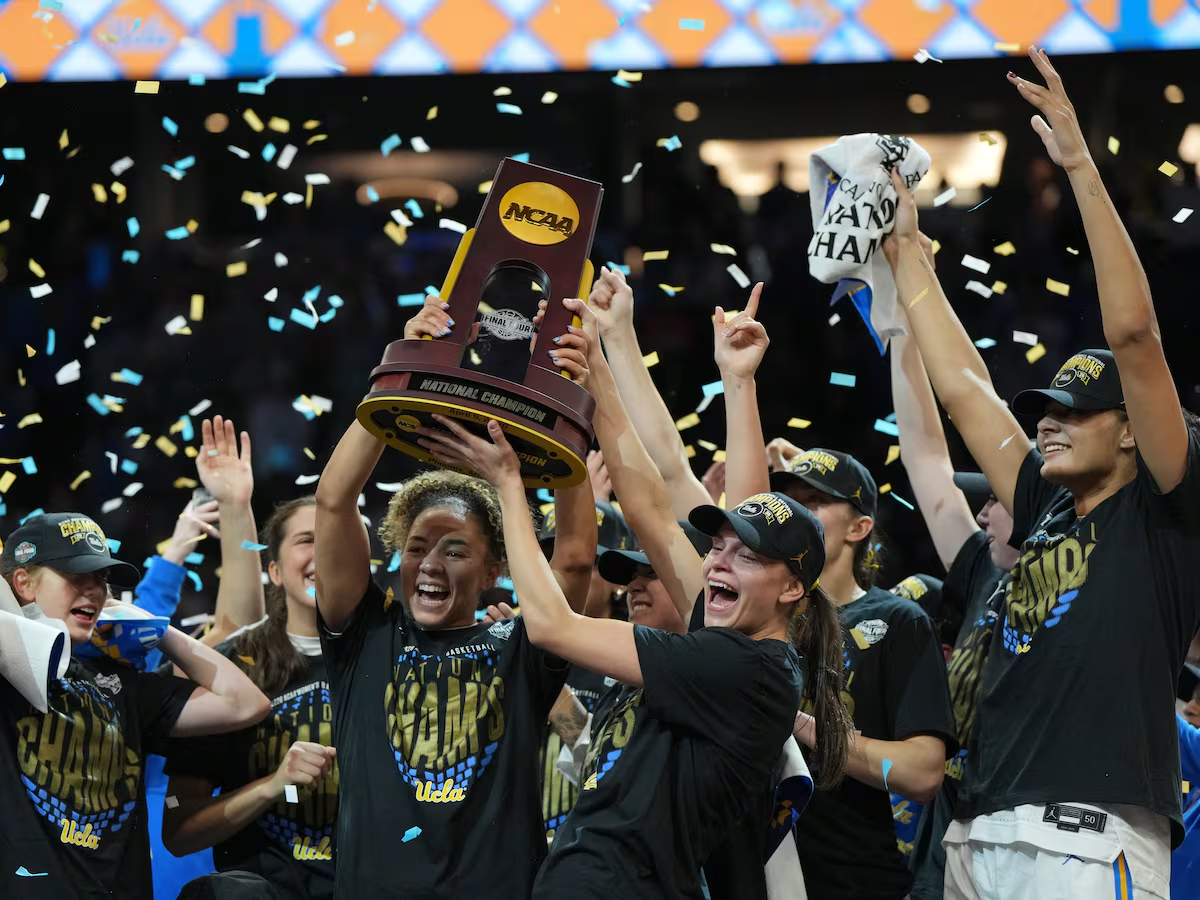
On April 5, 2026, in Phoenix, a mission nearly half a century in the making finally crossed the finish line. The UCLA women’s basketball team annihilated South Carolina 79–51 at Mortgage Matchup Center to win the program’s first NCAA women’s basketball national championship and its first national title of any kind since the 1978 AIAW crown.
The Bruins, 37–1 and a No. 1 seed, turned what was supposed to be a heavyweight showdown into one of the most lopsided championship games in women’s tournament history. UCLA never trailed, smothered a South Carolina team chasing its fourth NCAA title, and rode a senior-dominated lineup that had spent a year living with the sting of a Final Four blowout loss.
From Tip to Trophy: How UCLA Took Control of the National Championship
There was no feeling-out process. From the opening minutes, UCLA dictated tempo, physicality, and shot selection.
After 6-foot-7 center Lauren Betts briefly exited in the first quarter following a hit to the throat, some teams might have wobbled. Instead, the Bruins responded with an 8–0 run to close the period and build a 21–10 lead. South Carolina managed just 17 percent shooting in that opening frame, its lowest shooting quarter of the season, as UCLA clogged driving lanes, challenged every jumper, and cleared the defensive glass.
By halftime, the Bruins were firmly in command, leading 36–23. UCLA repeatedly fed Betts on the block and leveraged dribble penetration from senior guard Gabriela Jaquez and point guard Kiki Rice to force South Carolina into late, scrambling rotations. The Gamecocks rarely found rhythm or clean looks.
Any hope of a comeback died in the third quarter. UCLA opened the half with a 12–3 burst and outscored South Carolina 25–9 in the period, stretching the margin beyond 20 points and effectively ending the competitive portion of the championship before the final 10 minutes.
Senior Stars Deliver: Jaquez and Betts Dominate on the Biggest Stage
In a title game defined by experience and poise, UCLA’s seniors were the difference. Every one of the Bruins’ 79 points came from seniors or graduate students, a remarkable statistical snapshot of a veteran core executing a season-long plan.
Gabriela Jaquez Sets the Tone
Senior guard Gabriela Jaquez, playing in front of family and her brother Jaime, now with the Miami Heat, was the emotional and tactical engine from the jump. She led all scorers with 21 points on efficient shooting and added 10 rebounds and five assists, attacking gaps in South Carolina’s defense and punishing them in transition.
Jaquez’s ability to both score and facilitate turned South Carolina’s help rotations into a losing equation. When defenders collapsed, she kicked out to shooters or dropped passes to Betts inside. When they stayed home, she scored at the rim or from the midrange. Her complete performance embodied the balance that made UCLA so difficult to guard all season.
Lauren Betts Earns Most Outstanding Player Honors
In the paint, Lauren Betts controlled the game at both ends. The 6-foot-7 senior finished with 16 points, 11 rebounds, and three blocks, anchoring a suffocating interior defense that fundamentally altered South Carolina’s shot profile.
Her dominance across the Final Four earned her Most Outstanding Player honors, a fitting recognition for a transfer who became the centerpiece of UCLA’s rise. Betts, who started her college career at Stanford before transferring to Westwood, evolved over two seasons into the kind of matchup-proof force that championship teams are built around.
Together, Jaquez and Betts formed an inside-outside tandem South Carolina never solved. When the Gamecocks tried to contain penetration, Betts punished them with deep seals and touches on the block. When they loaded up on Betts, Jaquez and the backcourt carved up the remaining space.
Balanced Attack: Rice, Kneepkens, and Leger-Walker Step Up
Even in a night headlined by Jaquez and Betts, UCLA’s depth of senior contributors mattered. Graduate transfer guard Gianna Kneepkens added 15 points in the final, while Rice and Charlisse Leger-Walker chipped in 10 points apiece from the backcourt.
This senior core had already taken UCLA to its first NCAA Final Four in 2025, only to be overwhelmed by UConn in the semifinals. Many programs would have splintered in the portal era after such a setback. Instead, UCLA’s veterans came back with a clear objective: finish as champions.
In Phoenix, that continuity showed. They executed the scouting report, communicated defensive coverages, and closed possessions with disciplined rebounding. From closeouts to boxouts, it was a clinic in how older teams can control postseason games with attention to detail as much as raw talent.
South Carolina’s Rare Off Night on the Biggest Stage
For South Carolina, this game will stand out as an outlier in an otherwise dominant era. Dawn Staley’s program entered the title game 36–3 and in its third straight national championship appearance, seeking a fourth NCAA crown and a third title in five seasons after winning in 2024.
Instead, the Gamecocks suffered their poorest shooting performance of the year. They finished just 29 percent from the field and 2-of-15 from three, while committing 14 turnovers. By the end of the first quarter they trailed by double digits; in the second half the deficit ballooned to 30 before settling at 28, narrowly avoiding the record 33-point margin set by UConn in 2013.
Guard Tessa Johnson led South Carolina with 14 points and Agot Makeer added 11, but the Gamecocks never established any flow. Betts repeatedly blocked or altered shots at the rim, and UCLA’s length on the perimeter forced late-clock, contested attempts. For a program that has become synonymous with composure on championship Sunday, this was a night where every small crack widened under relentless pressure.
Context matters here: South Carolina’s dynasty-level success in recent years has helped drive national interest in women’s college basketball, from sold-out arenas to record TV ratings. On this night, though, the story belonged to UCLA. Resources like the NCAA’s own coverage and advanced breakdowns on sites such as ESPN’s women’s college basketball hub offer broader context for how rare such a lopsided title game truly is between programs of this caliber.
A Historic Season: 37–1, 31 Straight Wins, and Big Ten Supremacy
The championship game was the exclamation point on one of the most complete seasons in recent women’s basketball memory.
- Overall record: 37–1
- Lone loss: November setback to Texas at a Thanksgiving tournament
- Win streak: 31 straight victories to close the year
- Conference play: 18–0 Big Ten regular season
- Conference dominance: Rolled through the Big Ten tournament to claim a second straight conference tournament title
In the NCAA tournament, UCLA proved it could win fast or slow. The Bruins eliminated Duke 70–58 in a higher-possession game, then avenged their early-season loss to Texas in a grinding 51–44 semifinal where they held the Longhorns well below their usual scoring output.
By the time they reached Phoenix, the Bruins owned one of the nation’s most balanced profiles: elite defense paired with enough offensive depth to withstand an off night from any one scorer. That kind of versatility is exactly what analytics-focused observers of the women’s game, including analysts cited by outlets like The Associated Press, point to as the hallmark of true championship contenders.
Cori Close’s Long Build to a National Title
For head coach Cori Close, in her 15th season at UCLA, the national championship represents the culmination of a slow, deliberate build.
Early in her tenure, the Bruins missed the NCAA tournament in three of four seasons. Rather than chase quick fixes, Close focused on culture, player development, and adding the right transfers to complement high school recruits. Over time, UCLA grew into a consistent postseason presence and then into a Big Ten power with back-to-back league tournament titles.
Close has long cited the influence of legendary UCLA men’s coach John Wooden, whose “Pyramid of Success” she adopted as a framework for her own teams. As a young coach, she visited Wooden regularly, absorbing his emphasis on daily habits, toughness, and unselfishness over star power and short-term results.
The 2025–26 Bruins could be seen as a living version of that philosophy. Senior leaders stayed in the program when they could easily have transferred. Newcomers like Betts and Kneepkens chose not simply a system, but a culture. Together they responded to the disappointment of the 2025 Final Four defeat with an even more connected, disciplined version of themselves, culminating in the most dominant performance of this year’s women’s Final Four.
Big Ten Implications: A New Era of Conference Strength
UCLA’s title carries conference-wide significance. In just its second season as a Big Ten member, the Bruins delivered a women’s basketball national championship to a league whose current members already include past NCAA title-winners Purdue and Maryland.
For the Big Ten, which has aggressively expanded and invested in women’s sports, this championship is validation. It reinforces the conference’s growing profile in women’s basketball and adds another flagship brand capable of making deep NCAA tournament runs year after year. As conference realignment reshapes the landscape, UCLA’s breakthrough suggests the Big Ten’s future in the women’s game may be as influential as any league in the country.
Connecting Eras: From the 1978 AIAW Title to an NCAA Banner
UCLA’s history in women’s basketball has long included a national title, but until Phoenix, that championship lived outside the NCAA era. The Bruins won the 1978 AIAW crown, back before the NCAA sponsored women’s championships, and that banner still hangs in Pauley Pavilion.
Now a new banner is coming. UCLA officials have already scheduled a public celebration at Pauley, where the NCAA championship banner will rise alongside the AIAW one. The visual will link the pioneering program that broke through in the pre-NCAA landscape with the modern group that finally brought an NCAA trophy back to Westwood.
It is also a reminder that success like this rarely appears out of nowhere. Decades of investment in women’s sports, from facilities and staffing to marketing and recruiting support, helped create the conditions for this 2026 breakthrough. For recruits and their families, that track record matters when comparing destinations at the top of the women’s basketball world.
What This Title Means for UCLA Women’s Basketball Recruits
For high school players and club coaches, a national championship changes the recruiting conversation around a program overnight. But the reasons why should be understood clearly.
Visibility and Brand Power
A national title magnifies everything about a program. Television exposure increases, social media engagement spikes, and the program’s presence on national platforms becomes a near-constant. For a recruit, that can translate to:
- More nationally televised games and chances to play in front of WNBA and overseas scouts
- Elevated NIL (Name, Image, and Likeness) opportunities as brands seek out players at top-tier programs
- A stronger alumni and networking base in women’s basketball and beyond
Development in a Championship Culture
UCLA’s 2025–26 run was driven by seniors and graduate students who chose to stay, adapt, and grow together. For prospects, that speaks to a culture focused on:
- Long-term development instead of quick fixes
- Competition in practice that prepares players for national-level opponents
- Staff stability and a clear identity on both ends of the floor
As the Bruins defend their title in the coming years, the question for recruits becomes how they fit into that identity and what role they might play in sustaining it.
How Tools Like Pathley Can Help You Analyze UCLA and Its Peers
If you are an aspiring college basketball player, following a championship game like UCLA vs. South Carolina is only step one. The next step is evaluating whether a school like UCLA actually fits your academic goals, playing style, and campus preferences.
Platforms like Pathley Chat are built to help athletes go from headlines to informed decisions. You can ask how your grades, test scores, and on-court profile align with schools like UCLA, or compare possible targets across conferences and regions.
If you want a more structured view of fit, Pathley’s free College Fit Snapshot can break down your academic and athletic match for a specific college on a clear, coach-ready PDF. It is a way to ground the excitement of a national-title run in concrete next steps for your own recruiting plan.
Other Los Angeles Programs to Know If You Love UCLA’s Story
Not every recruit will land at a national champion or a Big Ten powerhouse, but the Los Angeles area offers multiple college basketball options with distinct profiles. If you are drawn to the combination of high-level academics, big-city energy, and competitive hoops that define UCLA, you may also want to explore:
- Loyola Marymount University: A private university on the Westside of Los Angeles with strong academics and a more intimate campus feel than a large public flagship.
- Occidental College: A selective liberal arts college in Northeast LA that offers a smaller-campus experience with access to the same major metropolitan area.
- California State University, Northridge: A large public institution in the San Fernando Valley that can offer a different blend of affordability, scale, and opportunity.
You can explore these and hundreds of other schools through the Pathley College Directory, which makes it easier to discover programs that match your goals even if they are outside the national spotlight.
How to Turn a National Championship into a Recruiting Plan
Watching UCLA lift its first NCAA women’s basketball trophy can be incredibly motivating if you are a high school guard, wing, or post player. The question is how to turn that inspiration into a real recruiting path.
Here are some practical steps:
- Study how UCLA plays: Do you fit their pace, spacing, and defensive demands?
- Be realistic about level: Use tools to compare your current metrics and film with typical players at Power Five, mid-major, and Division II/III programs.
- Build a clear, concise resume: College staffs do not have time to piece together your story from scattered links and screenshots.
If you need help with that last step, Pathley’s free Athletic Resume Builder can turn your stats, honors, and video links into a polished PDF in minutes. That kind of preparation matters when you reach out to championship-level programs or any college on your target list.
The Legacy of Phoenix: What Comes Next for UCLA and the Women’s Game
When the final horn sounded in Phoenix, UCLA players hugged, cried, and cut down the nets as confetti fell in blue and gold. But the legacy of this 79–51 rout of South Carolina will stretch far beyond a single night.
For the Bruins, it is the launching point for a new era. The national championship validates Cori Close’s long-term approach, elevates UCLA’s recruiting ceiling, and ensures the program will be discussed alongside the sport’s modern powers instead of just its historic ones.
For the Big Ten, it is further evidence that the league’s expansion and investment in women’s basketball are paying off. The conference now boasts another banner program capable of contending for national titles.
For the sport as a whole, it is one more reminder that dynasties can be challenged and that new champions can emerge from sustained work, savvy use of the transfer portal, and athlete-centered cultures. As interest in women’s college basketball surges, from ticket sales to media coverage, nights like UCLA’s breakthrough in Phoenix will only grow more important in shaping where the game goes next.
And for recruits watching from afar, it is proof that the right combination of patience, development, and opportunity can still lead to the top of the sport. Whether your path runs through a national champion like UCLA or a lesser-known program, tools like Pathley’s directories, fit snapshots, and AI guidance give you a clearer map to follow. Championships might be rare, but the chance to find a true college home is open to every athlete willing to do the work.