Quinnipiac men’s hockey clinched its sixth consecutive ECAC regular-season championship with a 4–1 road win at Harvard on February 28, 2026. The victory tied an NCAA record for consecutive conference titles and highlighted the Bobcats’ national scoring leader, veteran head coach, and postseason positioning.
Quinnipiac Men’s Hockey Clinches Record-Equaling Sixth Straight Cleary Cup with 4–1 Win at Harvard
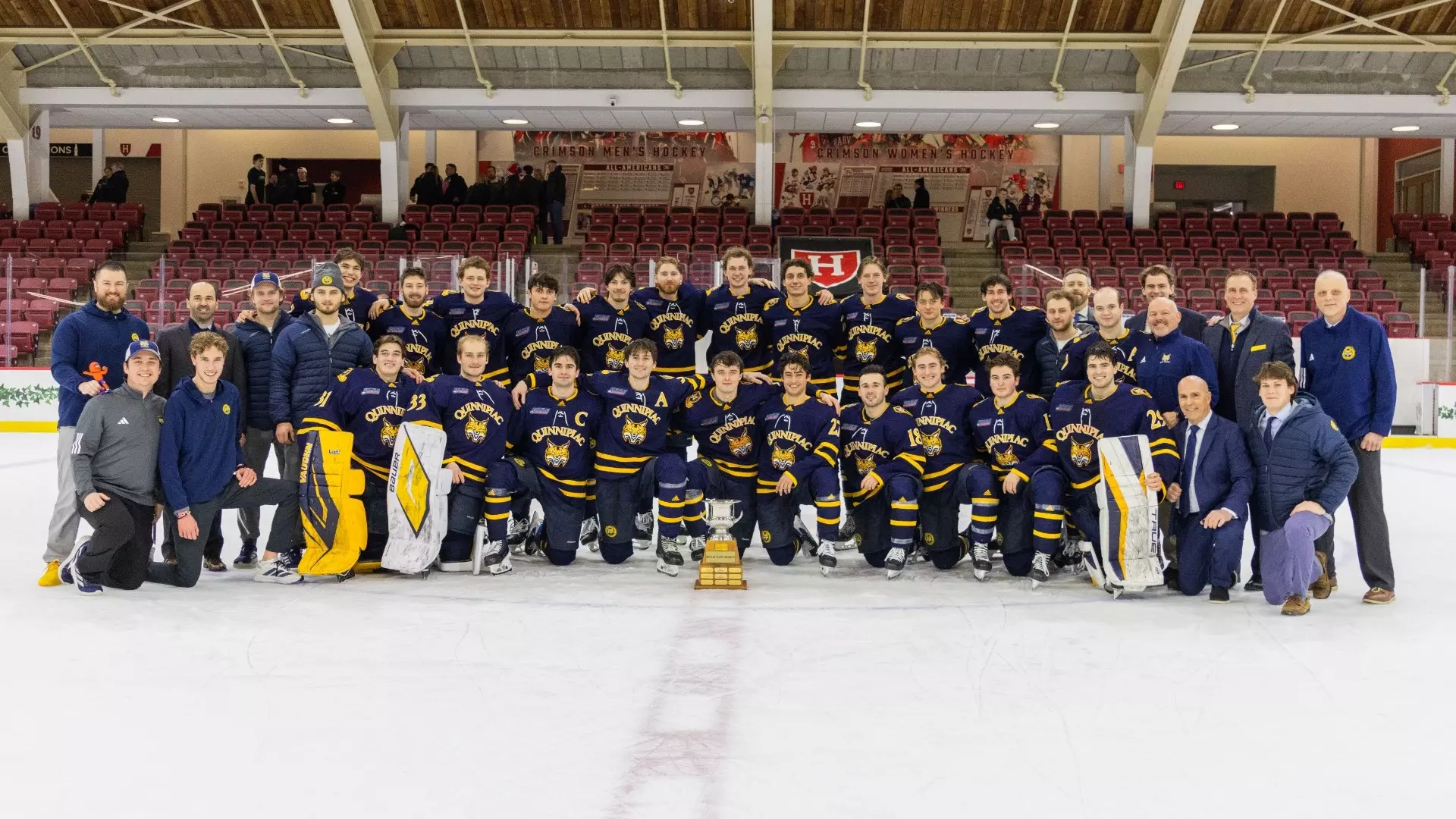
On a tense late-February night in Cambridge, Massachusetts, Quinnipiac University men’s ice hockey added another major chapter to its fast-growing legacy. The No. 7 Bobcats defeated Harvard 4–1 at Bright-Landry Hockey Center on February 28, 2026, to clinch the ECAC Hockey regular-season championship and secure their sixth consecutive Cleary Cup.
The victory not only locked up the 2025–26 ECAC regular-season title but also tied an NCAA Division I men’s ice hockey record. Quinnipiac’s run of six straight regular-season conference crowns now matches Minnesota State for the longest such streak in Division I history, and the Bobcats are the only program to accomplish all six in the same league.
For prospective college hockey players, families, and coaches tracking the sport, this game crystallized what the Quinnipiac University program has become under longtime head coach Rand Pecknold: a consistent national contender with elite depth, structure, and staying power.
How Quinnipiac Beat Harvard to Clinch the ECAC Regular-Season Title
Quinnipiac entered the final weekend of ECAC play with only a narrow lead in the standings and the pressure of history hanging over its season. A loss at Dartmouth the night before set up a must-respond scenario at Harvard, where the Crimson were battling for their own playoff positioning and a potential first-round bye.
Harvard struck first, scoring early in the second period to take a 1–0 lead and momentarily put Quinnipiac’s Cleary Cup hopes in jeopardy. The Crimson goal energized the home crowd and created a brief window where it looked like the Bobcats might see their six-year title run come to an end.
Instead, Quinnipiac did what elite programs do: respond quickly, and then impose their style on the game.
Verreault’s Game-Tying Goal Flips the Momentum
Sophomore forward Antonin Verreault delivered the turning point at 7:44 of the second period. After Quinnipiac had been blanked in the opening frame and fallen behind to start the second, Verreault’s shot deflected off a Harvard defender’s skate and slid past the goaltender to tie the game 1–1.
It was not the prettiest goal Quinnipiac will score this season, but it was precisely the kind of bounce championship teams tend to generate when they tilt the ice. The equalizer immediately blunted Harvard’s surge and swung momentum back toward the Bobcats just as the Crimson crowd sensed a chance to disrupt Quinnipiac’s title plans.
Aaron Schwartz Delivers the Game-Winning Strike
Later in the second period, forward Aaron Schwartz produced what stood as the game-winning goal and the defining skill play of the night. Gaining space in the offensive zone, he beat the Harvard netminder high to the glove side to give Quinnipiac its first lead at 2–1.
According to the program’s athletics report, Schwartz has recorded multiple game-winning goals this season, underscoring his emerging reputation as a clutch scorer. In a lineup packed with offensive options, his ability to seize big moments is one more reason Quinnipiac has separated from most of the ECAC and much of the national field.
Quinnipiac carried that 2–1 lead into the second intermission, 20 minutes away from retaining the Cleary Cup and cementing another historic season.
Third-Period Domination: McGroarty and Vidicek Put It Away
The third period showcased Quinnipiac’s depth, structure, and ability to manage games when hardware is on the line. The Bobcats outshot Harvard 36–20 overall and controlled the faceoff circle by a 46–23 margin, evidence of how thoroughly they dictated possession in all three zones.
Early in the third, forward Matthew McGroarty provided key insurance by extending the lead to 3–1. His goal gave Quinnipiac breathing room and forced Harvard to chase the game against a team that rarely yields much space in the neutral or defensive zones.
Later in the period, forward Markus Vidicek added a fourth goal for Quinnipiac, effectively ending any Crimson comeback hopes and allowing the Bobcats to spend the closing minutes protecting the lead and savoring the championship they had just secured.
Both teams finished 0-for-? on the power play in what was described as a whistle-light game. Special teams did not decide this one; Quinnipiac’s even-strength control and depth did.
Six Straight Cleary Cups: Quinnipiac’s Historic ECAC Run
Beyond the scoreboard, the 4–1 victory at Harvard carried major historical weight for Quinnipiac and for NCAA Division I men’s ice hockey overall.
The Cleary Cup, awarded annually to the ECAC Hockey regular-season champion, will reside in Hamden for a sixth consecutive year. That streak ties Minnesota State for the longest run of consecutive regular-season conference titles in Division I men’s hockey history, according to the program’s official recap on gobobcats.com.
Quinnipiac’s accomplishment stands out in one important way: all six Cleary Cups have come in the same league, ECAC Hockey. Minnesota State’s matching streak was split between two conferences, the former WCHA and the CCHA.
In total, Quinnipiac has now captured 10 ECAC regular-season titles, all since the 2012–13 season. For more than a decade, the Bobcats have been the standard in a conference that includes storied Ivy League programs and long-established hockey schools.
That level of sustained excellence is rare in college hockey, where player turnover, graduation, early departures, and parity generally make long dynasties difficult to build. Yet Quinnipiac has consistently reloaded, not just rebuilt, and the 2025–26 Cleary Cup is the latest proof of that formula.
Ethan Wyttenbach and Quinnipiac’s Deep, Nationally Elite Offense
Quinnipiac’s dominance this season is reflected as much by individual numbers as by banners.
Sophomore forward Ethan Wyttenbach finished the regular season with 57 points, a total that, according to the Quinnipiac athletics report, leads the nation by 10 points over the next closest player. That kind of gap at the top of the scoring charts is significant in modern college hockey, where elite point-per-game seasons are increasingly rare.
Wyttenbach’s 57 points already rank as the third-highest single-season total in program history, just two shy of the Quinnipiac record. His production puts him firmly in the conversation with some of the most prolific Bobcats ever to wear the blue and gold. For historical perspective on the program and its standout players, the Quinnipiac Bobcats men’s ice hockey page on Wikipedia outlines the rise of the program and the players who have defined it.
Yet Quinnipiac’s attack is far from a one-man show. The Bobcats are currently the only team in Division I with five skaters who have reached the 30-point mark. That group includes:
- Ethan Wyttenbach
- Markus Vidicek
- Chris Pelosi
- Antonin Verreault
- Mason Marcellus
This statistical balance has become a defining trait of Quinnipiac hockey under Pecknold. With multiple scoring threats spread across the lineup, opposing coaches cannot simply key on one line or one matchup. It also means that on nights when one star is held in check, another forward can step into the spotlight, as Schwartz, Verreault, McGroarty, and Vidicek did against Harvard.
Rand Pecknold’s 32nd Season: From Division III to National Power
Quinnipiac’s sixth straight Cleary Cup is not an overnight breakthrough. It is the latest milestone in a long-term build under head coach Rand Pecknold, who is in his 32nd season behind the Bobcats’ bench.
Pecknold took over what was once a small Division III program and oversaw its climb into Division I and eventually into the national elite. According to widely cited records and reporting, he is the active wins leader among Division I men’s head coaches, with more than 660 career victories. His tenure includes multiple Frozen Four appearances and the 2023 NCAA national championship, which gave Quinnipiac its first national title at the Division I level.
Pecknold’s long-term impact is documented in sources like Quinnipiac University’s Wikipedia entry and other national outlets. The Bobcats have become true fixtures in the NCAA tournament picture, with bids in every year from 2019 onward, except for pandemic-related interruptions.
This year’s group has followed that same template. With the victory at Harvard, Quinnipiac improved to 26–7–3 overall and 17–4–1 in ECAC play. The record, pairing strong nonconference wins with ECAC dominance, puts the Bobcats in an excellent position in national rankings and key NCAA tournament selection metrics.
What the Cleary Cup Means for Quinnipiac’s Postseason Path
Clinching the ECAC regular-season championship brings more than historical bragging rights. It also carries significant postseason advantages.
By reaching 50 points in league play, three ahead of Cornell and Dartmouth (who tied for second), Quinnipiac locked in the top seed in the ECAC Men’s Hockey Championship and secured a first-round bye.
The format for the ECAC postseason means the Bobcats will sit out the opening round and then host the lowest remaining seed in a best-of-three quarterfinal series at M&T Bank Arena in Hamden from March 13–15. Hosting that series on home ice matters in a league where travel, smaller rinks, and campus atmospheres can significantly influence results.
According to ECAC championship guidelines, the league’s automatic bid to the NCAA tournament goes to its postseason champion, not the regular-season winner. However, Quinnipiac’s overall record, ranking, and statistical profile position the Bobcats as strong contenders for an at-large NCAA berth even if they do not win the conference tournament.
National outlets such as the Boston Globe often highlight how late-season conference races influence NCAA tournament seeding and bubble teams, and Quinnipiac’s consistency has given it more margin for error than most.
Culture, Resilience, and What Recruits Should Notice
The Harvard game also highlighted the qualities that college coaches and recruiters emphasize most often: resilience, depth, and culture.
Quinnipiac entered the night coming off a loss at Dartmouth that could have shaken its grip on the title race. Instead of unraveling, the Bobcats delivered a poised, controlled performance in a hostile environment. They fell behind, regrouped, and then dominated the final 40 minutes with a 36–20 shot advantage and a 46–23 edge on faceoffs.
For recruits and families, that kind of response says as much about a program’s identity as any banner. It speaks to a culture that expects to compete for championships every season and prepares players to handle adversity, whether that is a rough shift, a poor game, or a tough road weekend.
Pecknold’s staff has clearly built a system where:
- Multiple lines can score and defend at a high level
- Players buy into a disciplined, structured style that travels well in big games
- Upperclassmen and sophomores alike contribute in critical situations
Those traits matter to athletes who want to compete on the biggest stages and to families looking for a program that develops players over multiple years, not just one breakout season.
Why Quinnipiac’s Run Matters in the National College Hockey Picture
In men’s college hockey, dynasties are tricky. The sport’s landscape is split across several conferences, each with its own style, travel demands, and scheduling challenges. The transfer portal and professional opportunities can also reshape rosters quickly.
That is what makes Quinnipiac’s six straight ECAC regular-season titles and 10 titles in a roughly 13-year span so significant. The Bobcats have managed to:
- Recruit and develop NHL-drafted talent and high-end college players
- Blend older, experienced lineups with impactful underclassmen
- Maintain a defensive identity that holds up in March, when mistakes are magnified
Programs like this tend to attract players who value winning culture as much as individual stats. The Bobcats’ ability to feature a national scoring leader in Wyttenbach and still spread points across multiple 30-point scorers provides a compelling model for athletes who want to play on deep, competitive rosters.
How Prospects Can Explore Quinnipiac and Other Hockey Programs
If you are an aspiring college hockey player, the Quinnipiac story offers both inspiration and practical takeaways: find programs with a clear identity, proven development track record, and consistent postseason presence.
One effective way to start that exploration is by using tools that centralize college information and recruiting context. Pathley’s free College Directory lets athletes and families browse schools across divisions, see basic details, and build a shortlist of potential fits. From there, you can dig deeper into individual programs, including national powers like Quinnipiac.
For hockey-specific research, the Ice Hockey Pathley Hub brings together top programs, rankings lists, and information about camps and showcases tailored to the sport. That can help you compare a school like Quinnipiac with other traditional powers or emerging programs in different conferences and regions.
If you already know a few schools that interest you, Pathley’s College Fit Snapshot can provide a quick, clear evaluation of how you match academically, athletically, and socially with a specific college. It is a fast way to see where a program like Quinnipiac may align with your goals and where you might need to improve.
Looking Ahead: Quinnipiac’s Next Steps After the Cleary Cup
With the Cleary Cup secured for a sixth straight season, Quinnipiac turns its attention to the two remaining items on its annual checklist: the ECAC postseason and a deep NCAA tournament run.
The Bobcats will open their ECAC title defense at home in mid-March, hosting the lowest remaining seed in a best-of-three quarterfinal at M&T Bank Arena. A strong showing there would move them into the conference semifinals and put them one step closer to securing the ECAC’s automatic NCAA bid, even as their regular-season resume already supports at-large consideration.
Beyond conference play, Quinnipiac’s ambition is clear: return to the Frozen Four and chase another national championship to pair with its 2023 title. With an active Division I wins leader behind the bench, a national scoring leader in Wyttenbach, and a roster loaded with multi-line scoring and defensive structure, the Bobcats are built to contend not just this year, but in seasons to come.
For recruits who prioritize consistent excellence, competitive environments, and the chance to play meaningful games every March, that kind of track record is exactly what they hope to find when they begin exploring college options.
How Pathley Can Help You Find Your Version of Quinnipiac
Not every athlete will end up at a program that just tied an NCAA record, but every athlete can benefit from a smarter, more informed search process.
Pathley is designed to make that search easier and more targeted. You can start on the main site at https://www.pathley.ai/ to learn how AI-powered tools can support your recruiting journey, then use features like the College Directory and Ice Hockey Hub to build a realistic and ambitious list of schools.
If you want direct, personalized help, Pathley’s AI recruiting chat assistant can suggest colleges, help refine your target list, and give you ideas for next steps based on your position, stats, academics, and goals.
Whether you are dreaming of playing for a perennial contender like Quinnipiac or looking for a different type of college experience, using structured tools and trusted information can bring you much closer to the right fit, on and off the ice.