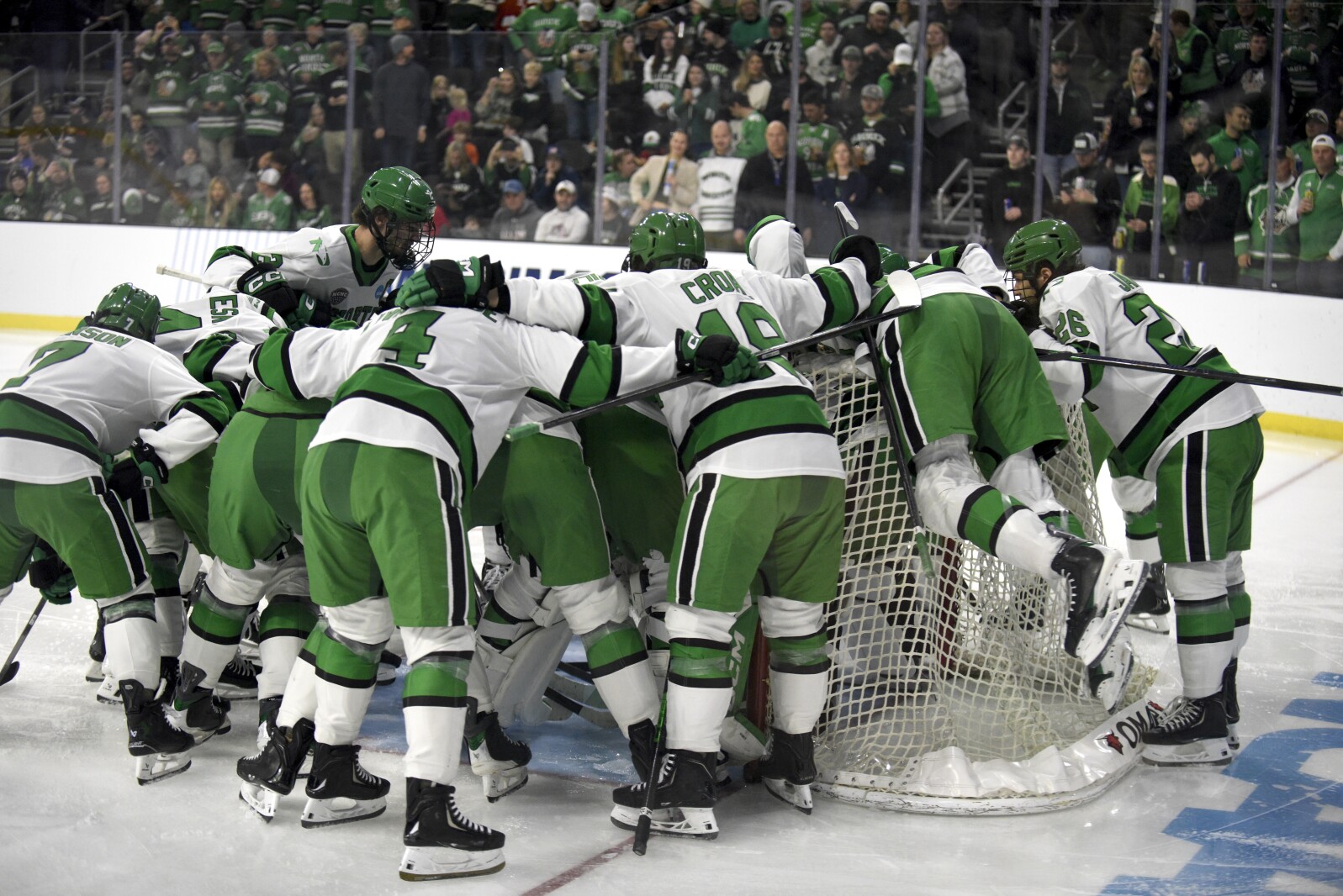
The University of North Dakota men’s hockey team is heading back to the Frozen Four for the first time in a decade after a dominant 5–0 NCAA regional win over Quinnipiac. Behind two goals from freshman Jack Kernan and back-to-back NCAA shutouts from rookie goalie Jan Špunar, the Fighting Hawks clinched the program’s 23rd Frozen Four and reinforced their status as a national power under first-year head coach Dane Jackson.
North Dakota Men’s Hockey Blanks Quinnipiac 5–0, Returns to Frozen Four for First Time Since 2016
The University of North Dakota men’s hockey program took a major step back onto the national stage on March 28, 2026, dominating Quinnipiac 5–0 in the NCAA Sioux Falls Regional final to punch its ticket to the Frozen Four for the first time in a decade. Behind an explosive start, airtight team defense, and another flawless performance from freshman goaltender Jan Špunar, the Fighting Hawks looked every bit like a national title contender again.
Played at the Denny Sanford PREMIER Center in Sioux Falls, South Dakota, top-seeded North Dakota – the No. 2 overall seed in the national bracket – overpowered an 11th/10th-ranked Quinnipiac team that entered the night at 27–10–3. The win improved North Dakota to 29–9–1 and secured the program’s 23rd Frozen Four appearance, tying the Fighting Hawks for fourth all time in Division I men’s ice hockey history.
For recruits and families watching from afar, the performance was a reminder of why the University of North Dakota consistently sits in the national spotlight. It also showcased how quickly a proud blue-blood can reassert itself under new leadership when talent, structure, and culture all click at the right time.
Fast start in Sioux Falls sets the tone
From the opening faceoff, North Dakota dictated pace and physicality, never allowing Quinnipiac to settle into its structure. According to the official boxscore data from College Hockey News, the Fighting Hawks outshot the Bobcats 14–11 in the first period and turned that edge into three goals in the first 12:20 of play, effectively seizing control of the regional final before it had a chance to become a back-and-forth battle.
Freshman forward Jack Kernan opened the scoring at 6:02 of the first period. Finding space in the slot, he finished off work along the boards by linemates including fellow rookie winger Will Zellers, beating the Quinnipiac goaltender cleanly to give North Dakota a 1–0 lead.
Less than three minutes later, another freshman made his presence felt. Forward Cody Croal doubled the lead by pouncing on a rebound and knocking it home, capitalizing on sustained offensive-zone pressure that had Quinnipiac defending on its heels.
Kernan then struck again at 12:20, capping a dream first period by tucking in his second goal of the night. That tally chased Quinnipiac’s starting netminder and staked North Dakota to a 3–0 cushion at the first intermission.
Official stats from College Hockey News show that North Dakota built its three-goal margin while holding a slight shot advantage and clearly controlling five-on-five play. For a Quinnipiac team used to methodically wearing opponents down, the early onslaught created a hill that quickly became too steep to climb.
Second-period surge leaves no doubt
If there was any question whether Quinnipiac might mount a response, North Dakota answered it quickly in the second period. Just over four minutes into the frame, sophomore forward Dylan James extended both his personal goal streak and the Fighting Hawks’ lead, deflecting a shot through traffic to make it 4–0.
Later in the period, freshman forward Cole Reschny added a fifth goal for good measure. Set up by veteran center Ben Strinden and defenseman Abram Wiebe, Reschny finished off a well-executed offensive sequence to push the margin to 5–0. North Dakota carried that commanding lead into the second intermission and never looked back.
By the final horn, the Fighting Hawks had outshot Quinnipiac 29–22 and scored three times in the first period and twice more in the second, while keeping the Bobcats off the board entirely. North Dakota never trailed in shots in any period, limited Quinnipiac to just 22 total attempts, and allowed only four shots on goal in the third period as they closed the game out with mature puck management.
On special teams, North Dakota went 0-for-3 on the power play, but the lack of a man-advantage goal barely mattered. The Fighting Hawks more than compensated at even strength and kept Quinnipiac’s power play off the scoresheet on two opportunities, continuing a regional trend of defensive dominance.
Jan Špunar’s back-to-back NCAA shutouts rewrite the UND record book
While the offense stole the headlines early, the backbone of North Dakota’s Sioux Falls Regional run was freshman goaltender Jan Špunar. Against Quinnipiac, Špunar stopped all 22 shots he faced, recording his second consecutive shutout of the regional and earning Most Outstanding Player honors.
According to North Dakota’s postgame notes, Špunar made program history in the process. He became the first Fighting Hawks goaltender ever to post multiple shutouts in a single NCAA Tournament, and the first in school history to record back-to-back NCAA shutouts. The strong weekend also brought his season totals to six shutouts and at least 20 victories, placing him in a select group of rookie goaltenders to reach that win milestone at North Dakota.
Defensively, North Dakota made life manageable for its freshman netminder. The Fighting Hawks suffocated Quinnipiac in the defensive zone, limiting quality looks and clearing rebounds quickly. The Bobcats managed only four shots on goal in the third period as North Dakota protected the shutout with disciplined structure.
By shutting out both opponents in Sioux Falls, North Dakota became the first team since UMass and Denver in 2019 to go through an NCAA regional without allowing a goal, as reported by regional coverage from KFGO. That level of dominance is rare in modern college hockey, and it is the kind of goaltending-and-defense combination that often fuels deep tournament runs.
A historic program reclaims its Frozen Four footing
The magnitude of the win for the University of North Dakota goes well beyond a single lopsided scoreline. With the 5–0 victory, the Fighting Hawks punched their ticket to the Frozen Four for the first time since 2016, which was also the last season they won the national championship.
That 2016 title, captured with a 5–1 championship-game win over Quinnipiac, added to one of the most storied résumés in college hockey. North Dakota has claimed eight national titles in Division I men’s ice hockey, trailing only Michigan in the all-time list of champions. The program’s 23 Frozen Four appearances are among the very best in history, underscoring UND’s status as a perennial powerhouse.
The latest NCAA meeting between the two programs once again tilted decisively in North Dakota’s favor. With the 5–0 result in Sioux Falls, the Fighting Hawks improved to a perfect 3–0 against Quinnipiac in NCAA Tournament play, according to coverage from KFYR-TV. For fans who remember the 2016 championship game, the symmetry of another dominant postseason win over the Bobcats only added to the storyline.
Dane Jackson’s first year sparks a resurgence
This Frozen Four berth also marks an important milestone for first-year head coach Dane Jackson. Taking over the bench for the 2025–26 season, Jackson inherited a proud program that expected to be in the national conversation every year but had not reached the Frozen Four since its last title run.
Under Jackson, North Dakota has quickly reclaimed its traditional place among college hockey’s elite. The Fighting Hawks earned a No. 2 overall seed in the national bracket, rolled through the Sioux Falls Regional without surrendering a goal, and played a fast, aggressive style that reflects both strong recruiting and clear identity.
For prospective student-athletes, that stability and resurgence matter. A program that can integrate impact freshmen such as Kernan, Croal, Reschny, and Špunar alongside experienced returners speaks to a healthy talent pipeline and a coaching staff that knows how to develop players for the biggest stages.
Frozen Four bound: Wisconsin awaits in Las Vegas
With the Sioux Falls Regional trophy secured, North Dakota’s focus now shifts to Las Vegas. The Fighting Hawks will head to T-Mobile Arena for a national semifinal matchup with the University of Wisconsin in the 2026 NCAA Division I Men’s Ice Hockey Championship.
The neutral-site environment in Las Vegas, highlighted in official tournament coverage from the 2026 NCAA Men’s Ice Hockey Tournament overview, adds another layer of intrigue. Both fan bases travel well, and UND’s national following is known for turning Frozen Four sites into green-and-white showcases.
One more win would put North Dakota back in the NCAA title game and within reach of a ninth national championship banner. Given the way the Fighting Hawks controlled play in Sioux Falls, they are likely to enter Las Vegas as one of the most feared teams in the bracket.
Key takeaways for recruits and hockey families
For high school and junior players eyeing a future in college hockey, this North Dakota run offers several clear lessons:
- Development of freshmen matters: UND’s ability to lean on first-year players like Kernan, Croal, Reschny, and Špunar in high-pressure NCAA games shows a strong development environment and a staff willing to give freshmen meaningful roles.
- Goaltending and team defense are difference-makers: Back-to-back NCAA shutouts are extremely rare. Programs that combine structure in their own zone with high-end goaltending often go deepest in March and April.
- Program history and culture still carry weight: North Dakota’s eighth national title in 2016 and now its 23rd Frozen Four appearance are part of a larger story. Recruits are not just joining a current roster; they are stepping into a legacy that includes NHL alumni, packed arenas, and consistent national relevance.
- Coaching transitions do not have to mean rebuilding: Dane Jackson’s quick impact shows that when a new coach understands the culture and maintains recruiting standards, a “transition” year can still end at the Frozen Four.
How to explore North Dakota and other college hockey options
If you are a player or parent interested in schools like North Dakota, the first step is understanding how a program’s academics, campus life, and hockey fit line up with your goals. Resources such as the Pathley College Directory make it easier to explore schools across all divisions, see basic details, and start building a shortlist of programs that look like a match.
Because men’s ice hockey recruiting is highly competitive and often starts early, it is helpful to have a clear picture of where you stand. Pathley offers tools to support that process, including:
- Pathley’s Ice Hockey Hub, which brings together college hockey programs, ranking lists, and event information to help you find showcases and camps that fit your level and target conferences.
- College Fit Snapshot, a free feature that lets you run a quick fit evaluation for a specific school, including academic, athletic, and campus-match indicators in one clear PDF.
- Athletic Resume Builder, which turns your stats, honors, and video links into a coach-ready PDF in minutes so you can send polished updates to college staffs.
These tools are designed to help you approach programs like North Dakota in a more organized way, whether you are targeting a national powerhouse or a smaller school that fits your academic profile and ice time goals.
Building your own path in college hockey
North Dakota’s 5–0 win over Quinnipiac is a reminder of what the top of college hockey looks like: deep lineups, confident freshmen, elite goaltending, and a standard that does not change with coaching transitions. Not every recruit will land at a school with eight national titles, but every prospect can learn from how UND builds and sustains its success.
When you evaluate potential colleges, consider factors that mirror what makes programs like North Dakota competitive:
- The stability and track record of the coaching staff.
- The program’s history of developing players for pro opportunities or strong careers after hockey.
- How many underclassmen are contributing in key roles.
- The balance between academics, campus fit, and hockey demands.
If you are not sure where to start, you can use tools like Pathley Chat as an AI recruiting assistant. It can help you discover new schools you might have overlooked, compare options, and think through what level of college hockey best fits your current and projected development.
Ultimately, the path that takes you to the NCAA Tournament or even a Frozen Four will look different from player to player. North Dakota’s latest run shows that when the right pieces align, a program’s culture and preparation can shine under the brightest lights. Whether your goal is an elite Division I powerhouse or a smaller program where you can play major minutes, using data, tools, and honest self-assessment will help you find the college hockey home that fits you best.
Next steps for athletes inspired by North Dakota’s run
If watching the Fighting Hawks celebrate another Frozen Four berth has you thinking about your own recruiting journey, consider these practical next actions:
- Build or update your athletic resume so coaches can quickly see your stats, video, and academic profile.
- Use college directories and sport hubs to identify programs that match your level and interests.
- Compare a few target schools side by side to understand differences in academics, campus feel, and hockey expectations.
Pathley is designed to streamline those steps. You can explore every college in one place through the College Directory, dive into hockey-specific context with the Ice Hockey Hub, or let AI guide you via Pathley Chat as you narrow down your options.
North Dakota’s dominant 5–0 win over Quinnipiac and return to the Frozen Four underline how special the college hockey stage can be. With the right tools and a thoughtful recruiting plan, you can chart your own route toward that same stage, at the school that fits you best on and off the ice.