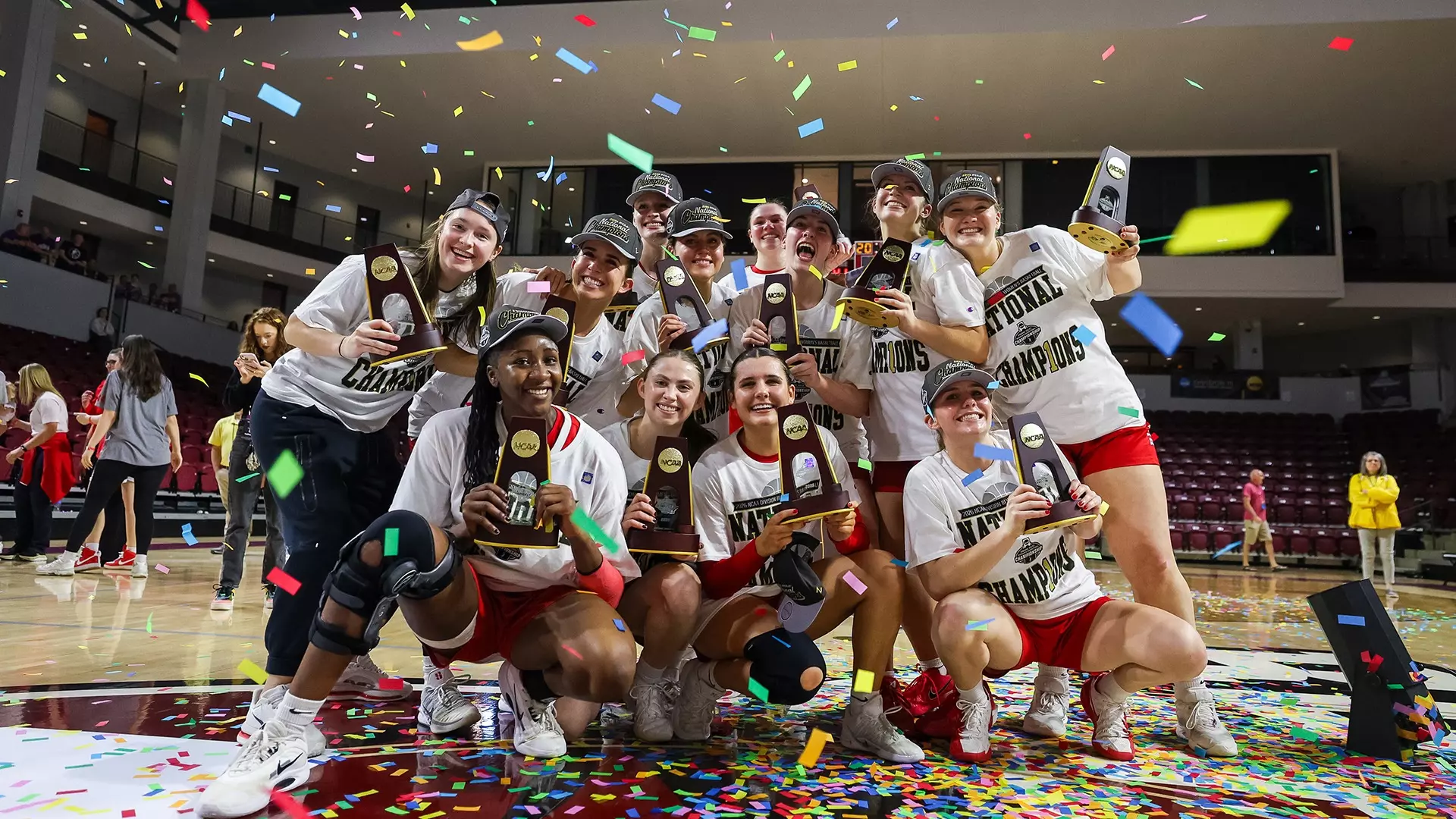
Denison University women’s basketball capped a historic 30–2 season by winning the program’s first NCAA Division III national championship with a 55–41 victory over previously unbeaten Scranton in Salem, Virginia. Fueled by lockdown defense, a 14–0 fourth-quarter run, and a breakout performance from NCAA tournament MVP Abby Cooch, the Big Red delivered a defining moment for the Granville, Ohio campus. With its entire starting lineup of underclassmen returning, Denison is now positioned as a rising force in Division III women’s basketball.
Denison Women Capture First NCAA Division III Basketball Title With 55–41 Win Over Scranton
In a defensive masterclass that will live in Denison University history, the Big Red women’s basketball team captured its first NCAA Division III national championship with a 55–41 victory over previously unbeaten Scranton on March 21, 2026, at the Cregger Center in Salem, Virginia.
Behind a game-changing 14–0 fourth-quarter run, elite team defense and a breakout performance from junior guard Abby Cooch, Denison closed out a 30–2 season and secured a long-sought national title for the Granville, Ohio campus. The win delivered the first women’s basketball national crown for Denison University, a North Coast Athletic Conference (NCAC) member long respected in Division III athletics but never before a champion in this sport.
How Denison Took Down an Unbeaten Power
Entering the championship game, Scranton owned a 32–0 record and one of the most explosive offenses in Division III women’s basketball, averaging more than 80 points per contest. The Lady Royals had just stunned the country by ending defending national champion New York University’s 91-game winning streak in the semifinals.
Denison, however, had spent the entire postseason building a defensive identity built on physicality, rebounding and disciplined rotations. That formula reached its peak on the biggest stage. The Big Red held Scranton to just 41 points, its lowest scoring output of the season and fewest points in more than a decade, while limiting the Royals to just 20.3 percent shooting from the field.
According to the NCAA’s own historical archives, Division III champions often separate themselves with depth and defensive consistency, not sheer offensive firepower. Denison’s performance in Salem was a textbook example: the Big Red didn’t try to outrun Scranton. They suffocated them.
A Defensive Struggle From the Opening Tip
The final began as a grinding, low-scoring contest. Denison edged ahead 11–10 after one quarter, using its size and rebounding to wall off Scranton’s driving lanes. In the second quarter, the Big Red’s defensive intensity climbed even higher. They held Scranton to just one point over the entire 10-minute period.
Despite their own cold shooting, Denison took a 19–11 lead into halftime by relentlessly controlling the paint and limiting second-chance opportunities. The offensive rhythm was far from smooth, but the Big Red dictated the game’s terms.
Scranton finally found life in the third quarter, erupting for 23 points and briefly resembling the high-powered team that had rolled through the season. Denison’s lead evaporated as the Royals surged ahead 34–33 going into the fourth, setting the stage for a tense finish between two teams that had dominated their respective regions all year.
The 14–0 Run That Flipped the National Championship
Early in the fourth quarter, Scranton extended its advantage to 39–36 and appeared to be seizing momentum. That is when Denison responded with the defining sequence of its season.
Junior guard Abby Cooch, already a central figure in Denison’s tournament run, hit back-to-back three-pointers to erase the deficit and jolt the Big Red offense awake. Fellow junior Ada Taute followed with a three-pointer of her own, forcing Scranton into a timeout as Denison suddenly grabbed control.
Out of the timeout, sophomore post player Anelly Mad-toingué finished a layup inside, stretching the lead and further demoralizing a Scranton team that could not find clean looks against Denison’s half-court defense. The Big Red ultimately pieced together a 14–0 run, turning a 39–36 deficit into a double-digit cushion while Scranton went several minutes without a field goal.
By the time Scranton finally scored again, Denison had both the scoreboard and the game’s tempo firmly in its grasp. What had been a one-possession battle transformed into a composed, controlled closeout by a group that looked far more experienced than its underclassmen-heavy roster would suggest.
Cooch Delivers Again, Claims NCAA Tournament MVP
Cooch, who had already hit a clutch late three to finish off Trine in the second round and send Denison to its first-ever Sweet 16, once again stepped into the spotlight. In the closing minutes in Salem, she dribbled down the shot clock and rose for a wing three that stretched the lead back to nine, effectively sealing the national title.
Her championship performance was complete and composed: 18 points, four made three-pointers, nine rebounds and four assists. Those numbers, combined with her timely shot-making throughout the tournament, earned Cooch NCAA tournament Most Valuable Player honors.
For high school guards and wings hoping to make a similar impact in college, Cooch’s run offers a template: efficient perimeter shooting, rebounding from the guard spot and the ability to handle late-game pressure. Athletes interested in learning what types of programs might fit their style can use tools like the Pathley Basketball Hub to explore colleges by level, conference and playing style.
Taute, Mad-toingué and the Big Red Frontcourt Set the Tone
While Cooch provided the headline moments, Denison’s frontcourt quietly controlled the interior and tilted the championship in the Big Red’s favor.
- Ada Taute posted 15 points and 10 rebounds, recording her second double-double of the NCAA tournament and earning a spot on the all-tournament team.
- Anelly Mad-toingué owned the glass with 16 rebounds and three blocks, repeatedly challenging Scranton drives and wiping away second-chance chances at the rim.
- Morgan Kress contributed key minutes off the bench, adding rebounding and shot-blocking to sustain Denison’s physical presence in the paint.
In total, Denison outscored Scranton 30–10 in the paint and dominated the boards, reflecting a season-long emphasis on physicality and rebounding. Teammates Violet Mitchell, Adelyn Moore, Molly Dorighi and Brooke Toigo added timely scoring and defensive pressure, giving head coach Maureen Hirt a balanced rotation that could switch, contest and recover across all five positions.
Per coverage from the North Coast Athletic Conference, which chronicled the run to the title, Denison’s ability to neutralize Scranton’s dribble penetration and deny clean catch-and-shoot looks was central to the outcome. The Lady Royals simply never found their usual comfort zones in the half-court.
Fourth-Quarter Shot-Making Meets Elite Defense
The statistical contrast between Scranton’s season averages and its performance in the final tells the story. The Lady Royals finished at just 20.3 percent shooting from the floor and mustered only 41 points, far below their season-long output. They were unable to string together the multiple scoring runs that had defined their unbeaten run.
Denison, by comparison, stayed patient and timely. The Big Red shot better than 56 percent from the field and 50 percent from three-point range in the fourth quarter alone. That late-game efficiency turned their suffocating defense into transition points and open perimeter looks as Scranton pressed to close the gap.
For recruits and families studying what wins in March at the Division III level, this game is a clear reminder: defense travels, and champions often emerge from teams with defined identities. Denison did not need to be perfect offensively for 40 minutes. It needed to defend for the full game and shoot confidently when it mattered most. That formula is repeatable, and it is one reason the Big Red project as a long-term factor in the national conversation.
From NCAC Champions to National Champions
The night in Salem was the culmination of a month filled with program-first milestones for Denison women’s basketball.
First, the Big Red clinched the NCAC regular-season title, establishing themselves as the standard-bearer in one of Division III’s most competitive conferences. They then advanced to the NCAA tournament and reached the Sweet 16 for the first time in program history with their win over Trine.
From there, the breakthroughs kept coming:
- Denison defeated Washington and Lee in the sectional final to secure its first-ever trip to the Final Four.
- The Big Red knocked off Wisconsin–Oshkosh in the national semifinals to book a place in the championship game.
- Both Washington and Lee and Scranton entered the NCAA tournament unbeaten; Denison handed each its only loss of the season.
In the context of Division III women’s basketball history, it was one of the most impressive postseason resumes in recent memory. Denison did not simply ride a favorable draw. The Big Red traveled through a gantlet of contenders and emerged with the trophy.
Head coach Maureen Hirt, in just her fourth year leading the program, was recognized as a Women’s Basketball Coaches Association Division III Coach of the Year finalist. Her leadership, and the staff’s ability to build a cohesive roster around a core of underclassmen, transformed Denison from a strong regional program into the nation’s best team in 2026.
Denison’s Broader Athletic Tradition Gets a New Centerpiece
Denison University has long been respected nationally in Division III athletics, particularly in sports such as swimming and diving, where the Big Red have collected multiple NCAA team titles. The women’s basketball championship adds a new chapter to that tradition and elevates the profile of the sport on campus.
For a private liberal arts college in Granville, Ohio, the title serves as both a campus-wide point of pride and a powerful recruiting tool. Prospective student-athletes now see Denison not only as a strong academic institution and all-around athletic department, but as a proven pathway to competing on the biggest stage in women’s basketball.
According to public data from NCAA Division III, the division emphasizes a balance of academics, athletics and campus life. Denison’s championship season aligns closely with that mission: a rigorous academic environment, a tight-knit campus community and a women’s basketball program capable of beating the very best.
Why This Title Matters for Recruits and Families
Denison’s run is significant for more than just banners and record books. It offers a clear, real-world case study in what a successful Division III pathway can look like for high school players who may be weighing offers or interest from multiple levels.
Some key lessons:
- Development over four years matters. Cooch, Taute and Mad-toingué have grown into impact players through deliberate development and consistent roles, not one-and-done pressure.
- Defense and rebounding travel. The Big Red did not rely solely on hot shooting to survive March. They built a foundation that held up against unbeaten teams.
- Fit can beat fame. Denison’s roster is built from players who found the right academic and athletic match, proving you do not need a Division I logo to compete for national titles.
For families exploring similar opportunities, tools like the Pathley College Directory make it easier to discover schools like Denison, compare basic details and build a shortlist of campuses that match both academic and athletic goals.
A Young Core With a Championship Pedigree
Perhaps the most striking part of Denison’s 2026 title: the starting lineup was composed entirely of underclassmen, and key contributors like Cooch, Taute and Mad-toingué are all scheduled to return for the 2026–27 season.
That continuity means the Big Red will not only enter next season as defending champions, but also as one of the most experienced and battle-tested rosters in Division III. With an established identity centered on lockdown defense, rebounding and poised guard play, Denison is positioned for a sustained presence on the national stage.
For recruits, that raises important questions about timelines and opportunity: do you want to join a defending champion and compete daily at a championship standard, even if early minutes might be tough to earn, or seek a quicker path to playing time at a rebuilding program? Pathley’s College Fit Snapshot can help athletes think through those tradeoffs by aligning academic priorities, athletic level and campus environment for specific schools.
NCAC’s Growing Presence in Women’s Basketball
Denison’s title also carries conference-wide significance. The Big Red became the second NCAC program to win an NCAA women’s basketball national championship, underlining the league’s growing reputation on the national stage.
Conference success matters in recruiting, especially at the Division III level. When multiple programs from the same league contend nationally, it raises the visibility of every team in the conference and signals competitive depth to prospective student-athletes. Denison’s 2026 run will likely attract more attention from recruits, but it also shines a spotlight on the NCAC as a whole.
How Athletes Can Learn From Denison’s Blueprint
If you are a high school basketball player or parent watching Denison’s ascent, there are several practical takeaways for your own recruiting journey:
- Be honest about your level. Many players who fit comfortably at strong Division III programs chase Division I interest for too long. Denison’s title shows how rewarding the right D3 fit can be.
- Study how teams play. Denison’s identity is physical defense and rebounding with confident perimeter shooting. Your film and resume should match the style of programs you target.
- Value coaching stability and vision. Hirt and her staff built a multi-year plan around underclassmen. Look for staffs that can clearly explain your role and how they develop players over time.
- Use tools that save time. Instead of guessing at good matches, let data and structured analysis guide you toward schools that fit academically and athletically.
Pathley’s AI recruiting assistant is built to help with exactly that. You can describe your GPA, test scores, desired major, position, measurables and level of play, then get guided suggestions on colleges that make sense to research and contact.
Next Steps: Turning Inspiration Into Your Own Recruiting Plan
Denison’s first NCAA Division III women’s basketball championship is more than a feel-good story. It is a blueprint for how the right college fit, coaching staff and program identity can create a championship window, even outside the limelight of major Division I conferences.
If you are inspired by what the Big Red accomplished and want to chart your own path:
Denison’s 55–41 win over Scranton in Salem will be remembered as the night the Big Red broke through for their first national title in women’s basketball. For future recruits, it may also be remembered as the moment they realized that the right Division III home can offer everything they are looking for: high-level competition, a meaningful role, and a degree that sets them up for life well beyond the last buzzer.
Whether you are aiming for a program like Denison or just starting to explore options, Pathley is here to help you find, compare and understand colleges that fit who you are on the court and in the classroom.