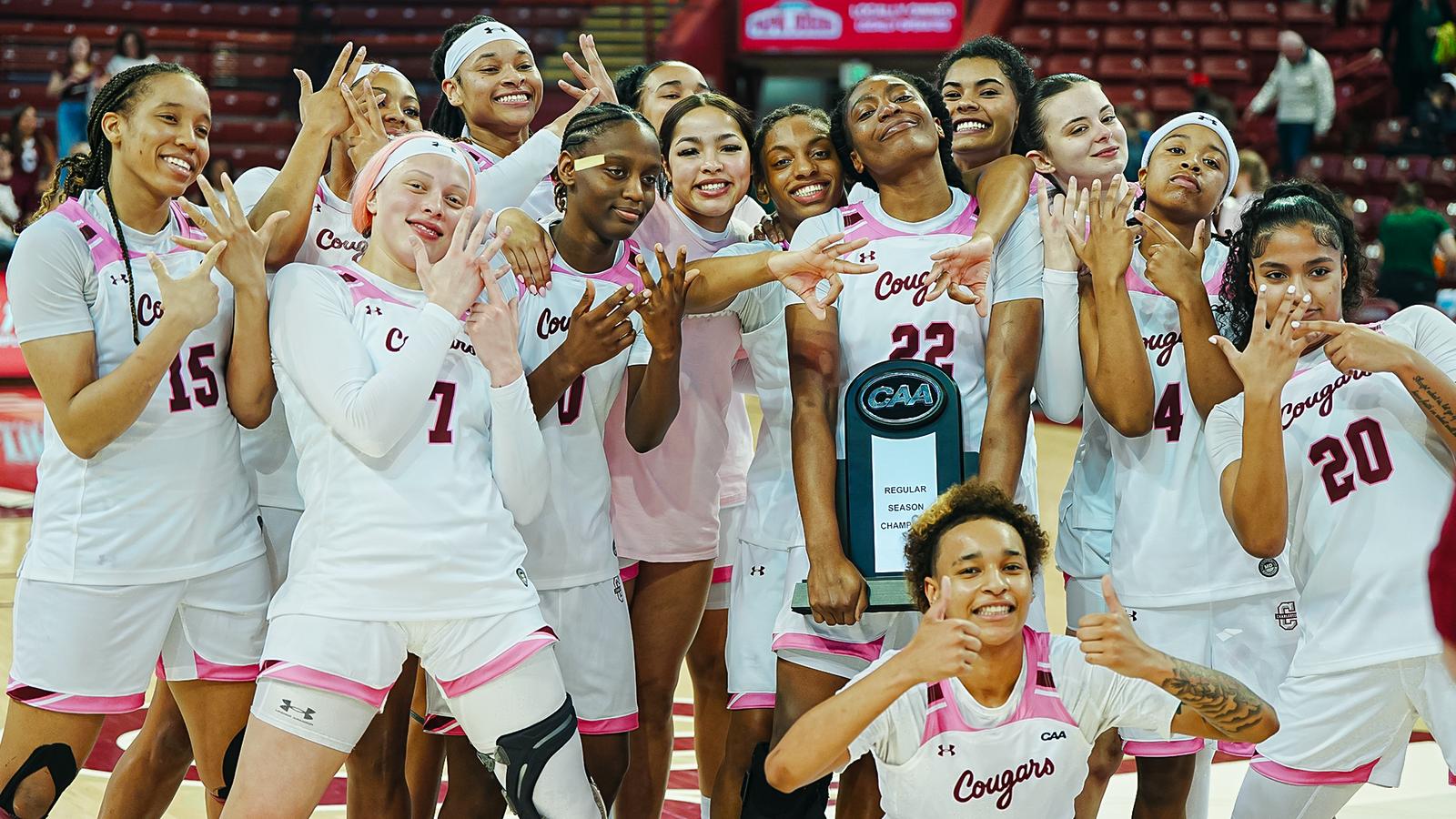
College of Charleston women’s basketball capped a historic rise with a 66–43 win over Stony Brook that secured the program’s first Division I regular-season title and the No. 1 seed in the CAA Tournament. Powered by the Barbot twins, Grace Ezebilo’s double-double, and a dominant third quarter, the Cougars finished alone atop the conference standings. The milestone also tied head coach Robin Harmony with Nancy Wilson for the most Division I wins in program history.
College of Charleston Women Clinch First Division I Regular-Season Title With CAA Rout of Stony Brook
On March 5, 2026, College of Charleston women’s basketball delivered the kind of performance that defines a program era. With a 66–43 demolition of Stony Brook at TD Arena, the Cougars locked up the outright Coastal Athletic Association (CAA) regular-season championship, claimed the No. 1 seed in the CAA Tournament, and formally wrote their name into the Division I history books.
The win did more than cap a strong year. It secured the first regular-season conference championship of the program’s Division I era, which dates back to the early 1990s, and showcased how a veteran core and a proven head coach have turned Charleston into a true CAA powerhouse. Led by junior guard Taryn Barbot, her twin sister Taylor, forward Grace Ezebilo, and head coach Robin Harmony, the Cougars finished the night 23–5 overall and 15–2 in league play, sitting alone at the top of the CAA standings.
A Championship Night at TD Arena
Charleston entered the showdown with Stony Brook already holding at least a share of the 2025–26 CAA regular-season title. A 70–48 home win over William & Mary on February 27 had guaranteed the Cougars a top-four seed, a double bye in the conference tournament, and the first regular-season championship in their Division I history. The only remaining question was whether they could turn a shared crown into an outright one.
Against one of the league’s better teams, they answered emphatically.
The first quarter, though, did not look like a coronation. Both offenses struggled to find rhythm as the defenses dictated the tempo. Stony Brook and Charleston traded stops and tough, contested looks until junior guard Taryn Barbot stepped into a deep three at the buzzer, pulling the Cougars even at 12–12 after ten minutes.
The second quarter followed the same grind-it-out pattern. The Seawolves nudged in front 23–22 before redshirt senior guard Sophia Tougas buried a corner three that shifted momentum back toward Charleston. Neither side shot efficiently in the opening 20 minutes, but the Cougars’ poise and timely buckets allowed them to carry a 27–24 lead into halftime.
The Third-Quarter Surge That Defined a Season
If the first half reflected nerves and defensive intensity, the third quarter reflected why College of Charleston women’s basketball has looked like a CAA champion in waiting for two straight seasons.
Coming out of the locker room, Charleston found another gear. The Cougars ramped up their pressure on the ball, cleaned the glass, and turned defensive stops into quality looks in transition and secondary break situations. That identity has been a hallmark of their rise under Harmony: defend, rebound, and let their guards attack space before the defense can get set.
A 9–0 run early in the period broke the game open. Tougas capped that surge with another three-pointer, stretching the lead to 36–25 and forcing a Stony Brook timeout. Rather than letting the Seawolves settle back in, the Cougars continued to dominate the quarter.
By the end of the third, Charleston had outscored Stony Brook 26–9 in the frame. What had been a tight three-point game at halftime transformed into a commanding 53–33 advantage. From there, the final ten minutes were about finishing the job and savoring the moment.
Final Score Confirms Dominance: 66–43 and a CAA Title
The Cougars closed the door in the fourth with a balanced, workmanlike effort. They avoided fouling, continued to win the rebounding battle, and took care of the ball well enough to deny Stony Brook any chance at a miracle run.
According to the ESPN box score, Charleston’s scoring by quarter read 12–15–26–13, compared with 12–12–9–10 for Stony Brook. The 23-point final margin mirrored what anyone at TD Arena could feel: this was a statement win befitting a championship celebration.
Charleston’s record improved to 23–5 overall and 15–2 in CAA play. In the updated league standings, the Cougars stood two games clear of second-place Drexel and three ahead of Campbell and Stony Brook, underscoring how convincingly they separated themselves from the rest of the conference.
Taryn Barbot’s 21 Points Lead the Way
On a night defined by team history, Charleston’s star guard played exactly like a player comfortable in the spotlight. Junior guard Taryn Barbot poured in a game-high 21 points, continuing her evolution into one of the Coastal Athletic Association’s premier scorers.
Barbot’s line was as complete as it was efficient from beyond the arc: 21 points on 7-of-17 shooting overall, including 4-of-7 from three-point range. She added five rebounds, three steals, and two assists in 36 minutes, constantly pressuring the Stony Brook defense and making plays at both ends.
The Stony Brook game marked the 15th time this season that Barbot has reached the 20-point plateau, a benchmark that speaks both to her scoring volume and her consistency. The performance also pushed her career total to 1,602 points, moving her into sixth place on Charleston’s all-time scoring list.
For recruits and families tracking guards who can score at all three levels and carry an offense in big moments, Barbot’s trajectory is a textbook example of how a player can grow into an elite mid-major star within a well-run program.
Grace Ezebilo’s Double-Double and a Rebounding Clinic
While Barbot’s shot-making fueled the scoreboard, forward Grace Ezebilo owned the interior. She recorded her eighth double-double of the season, finishing with 12 points and 14 rebounds, giving Charleston a stabilizing frontcourt presence that Stony Brook struggled to counter.
Behind Ezebilo, the Cougars controlled the glass by a 47–32 margin. That edge was even more impactful when translated into second-chance opportunities. Charleston converted its dominance on the boards into 23 second-chance points, compared with just five for Stony Brook.
That kind of differential is massive in any game, but especially in a championship clincher where early shooting struggles threatened to keep things tight. Ezebilo’s ability to extend possessions and close defensive sequences is exactly the sort of element that helps a contender survive poor shooting stretches and then explode once shots begin to fall.
Depth and Playmaking: Tougas, Brown, and Taylor Barbot Step Up
As Charleston’s third-quarter run unfolded, it was not just stars carrying the load. Redshirt senior guard Sophia Tougas and senior guard Marissa Brown both delivered big moments that gave the Cougars separation.
Tougas finished with eight points and four rebounds, including two three-pointers that came at critical junctures. Her second-quarter corner three pushed Charleston back in front after Stony Brook’s brief lead, while her third-quarter triple capped the 9–0 run that forced the Seawolves to burn a timeout. Those shots were classic veteran plays: poised, timely, and backbreaking for an opponent trying to hang around.
Off the bench, Brown added eight points and seven rebounds, giving Harmony another guard who could rebound in traffic and contribute to the Cougars’ transition game. Her ability to crash the boards from the perimeter helped make that 47–32 rebounding gap possible.
Meanwhile, junior guard Taylor Barbot, Taryn’s twin sister, orchestrated the offense. She posted six points, seven assists, and four rebounds, continuing a season in which she has ranked among the CAA leaders in assists per game. Taylor’s decision-making and passing allowed Charleston to toggle between half-court execution and transition pressure, keeping Stony Brook’s defense off balance.
Collectively, Charleston forced 17 turnovers, came up with eight steals, and turned those miscues into 16 points. That stat line captures the Cougars’ two-way identity: they are not just a high-powered scoring team, but one that can generate offense from defense and wear opponents down over 40 minutes.
A First-Ever Division I Regular-Season Title
Beyond the box score, this win’s historical meaning for College of Charleston women’s basketball cannot be overstated. The Cougars’ outright CAA regular-season championship is the first regular-season conference title they have claimed in their Division I era, which began in the early 1990s.
Charleston’s campus publication and the athletics department’s own recaps have both underscored that point: the 2025–26 CAA regular-season crown marks the first time the women’s program has finished atop a Division I conference standings table. For alumni, current students, and recruits, that milestone signals that Charleston is no longer a middle-of-the-pack program hoping for an upset or two in March. It is a standard-setter in its league.
Conference-wide coverage reflected the same perspective. In its March 5 women’s basketball recap, the Coastal Athletic Association highlighted Charleston’s victory over Stony Brook as the result that gave the Cougars sole possession of the regular-season title, noting how a dominant second half broke open what had been a close game at halftime. The CAA standings after the win showed Charleston comfortably out in front, with a two-game gap over Drexel and three-game separation from Campbell and Stony Brook.
For high school athletes looking at CAA programs, this context matters. Playing for a team that wins its league outright means competing in high-pressure environments every week, battling for NCAA Tournament positioning, and developing inside a culture that expects to be playing meaningful games in March.
Robin Harmony Ties Division I Wins Record at Charleston
The Stony Brook win also carried personal significance for head coach Robin Harmony. It was her 118th victory at College of Charleston, tying her with former coach Nancy Wilson for the most wins by a Charleston women’s basketball head coach in the Division I era.
Harmony arrived before the 2019–20 season and has steadily elevated the program. After building the roster through smart recruiting and player development, she guided the Cougars to a program-record 25 wins in 2024–25. One season later, they sit at 23–5 with a 15–2 mark in the CAA, an outright regular-season title, and another opportunity to chase postseason hardware.
Her tenure illustrates what many families look for when evaluating college programs: a clear trajectory of improvement, a staff that develops players over multiple years, and a track record of competing for championships in a stable, competitive conference.
For recruits interested in learning more about Harmony’s program or others like it, tools such as the NCAA’s resources on recruiting rules and program evaluation, or broader college basketball coverage from sites like NCAA.org and ESPN’s women’s basketball hub, can provide helpful context alongside school-specific research.
From Preseason Favorite to CAA Champion
Within the conference, this championship did not come out of nowhere. Preseason expectations pegged Charleston as a favorite in the Coastal Athletic Association, thanks in large part to its returning core of the Barbot twins, Ezebilo, Tougas, and Brown, plus key role players around them.
Still, turning “favorite” status into an outright regular-season title is not automatic. The Cougars had to validate that projection over four months of league play, enduring road trips, quick turnarounds, and the inevitable off-shooting nights. The dominant win over William & Mary to clinch a share of the title and the emphatic rout of Stony Brook to secure it outright tell the story of a team that learned how to close out big moments rather than simply survive them.
This trajectory also places Charleston squarely in the larger conversation about NCAA women’s basketball parity. Programs outside the traditional power conferences are increasingly building strong rosters, leveraging player development and continuity to challenge nationally. Charleston’s regular-season title and back-to-back high-win campaigns position it as one of the most intriguing mid-major stories in the sport.
Setting Up the CAA Tournament and NCAA Implications
With the Stony Brook victory, the next phase of Charleston’s journey shifts to Washington, D.C., where the CAA Tournament will determine the league’s automatic bid to the NCAA Tournament.
Thanks to their 15–2 conference record and No. 1 overall seed, the Cougars head to the nation’s capital with a double bye. That means fewer games to win the championship, extra rest, and more time to prepare for whichever opponents emerge from the earlier rounds.
For a program chasing its first Division I regular-season title and hungry for more, the goals are clear:
- Win the CAA Tournament to secure the league’s automatic NCAA bid
- Position themselves for a favorable seed in the NCAA bracket
- Show that their up-tempo, defense-fueled style can scale to the national postseason
Whether Charleston can earn an at-large bid if it falls short in Washington will depend on the full profile that the NCAA selection committee evaluates: overall record, strength of schedule, quality wins, and metrics. But the Cougars have at minimum guaranteed that they will be central to that mid-major at-large conversation if they keep winning.
What This Means for Future College of Charleston Recruits
For prospective student-athletes, the Cougars’ CAA regular-season championship is more than a banner in the rafters. It is a signal about what the women’s basketball experience at College of Charleston now looks like.
Key takeaways for recruits and families:
- Winning culture: Back-to-back high-win seasons, a record 25 wins in 2024–25, and now a first-ever Division I regular-season title.
- Player development: Guards like Taryn and Taylor Barbot and forward Grace Ezebilo are clear examples of players who have expanded their games and roles over multiple seasons.
- Coaching stability: Harmony’s tenure and win total suggest a consistent system and clear expectations.
- Competitive conference: The CAA provides strong mid-major competition and a realistic path to the NCAA Tournament.
Athletes exploring similar programs can use tools like Pathley’s College Directory to search for schools by sport, level, and location, then dig into details like campus setting, selectivity, and athletic fit.
Related Program to Watch Nearby: The Citadel
For families considering the Charleston area as a potential college destination, it is also worth noting another campus that blends academics, structure, and athletics: The Citadel, The Military College of South Carolina. While it follows a very different military-focused model from the liberal arts environment at College of Charleston, both schools share the same city and offer distinctive pathways for student-athletes who value discipline, tradition, and competitive college sports.
Comparing options like these side by side using tools such as Pathley’s Compare Two Colleges feature can help families see clear differences in campus culture, academics, and athletic opportunities within the same geographic region.
How Pathley Can Help You Find Your Own CAA-Level Fit
Watching a program like College of Charleston rise to a CAA championship level often sparks the same question for high school players: “Where could I fit like that?” Maybe your game mirrors a Barbot twin as a high-IQ guard, or maybe you see yourself in Ezebilo’s role as a versatile forward and elite rebounder.
That is where modern recruiting tools can make a real difference. With Pathley, athletes and families can move beyond guessing and start building a targeted plan:
- Use the Basketball Pathley Hub to explore college basketball programs across divisions and conferences, including mid-majors like those in the CAA.
- Run a College Fit Snapshot to see how your academics, athletic profile, and preferences align with specific schools.
- Build a polished PDF resume in minutes with the Athletic Resume Builder so coaches have a clear, organized view of your stats, film links, and background.
For athletes just starting to map their options or those dialing in a final list of target schools, Pathley’s free tools can help you find programs where your skills, goals, and personality align, whether that is a CAA contender like Charleston or a different conference and campus entirely.
From Historic Win to the Next Chapter
As the final horn sounded and the scoreboard read 66–43 in favor of the Cougars, the celebration at TD Arena was about more than one game. It was a recognition of a multiyear climb under Robin Harmony, the emergence of a veteran core that has changed expectations, and the official arrival of College of Charleston women’s basketball as a CAA champion.
The outright regular-season title, the No. 1 seed in the CAA Tournament, and a place in the program record book are all significant. But for Charleston, the next goals are already clear: win the conference tournament in Washington, D.C., and prove on the NCAA stage that this rise is sustainable, not fleeting.
For high school athletes watching from afar, the Cougars’ journey is a real-time case study in what happens when talent, development, and opportunity align. With the right information and tools, you can work toward finding your own version of that fit at the college level.