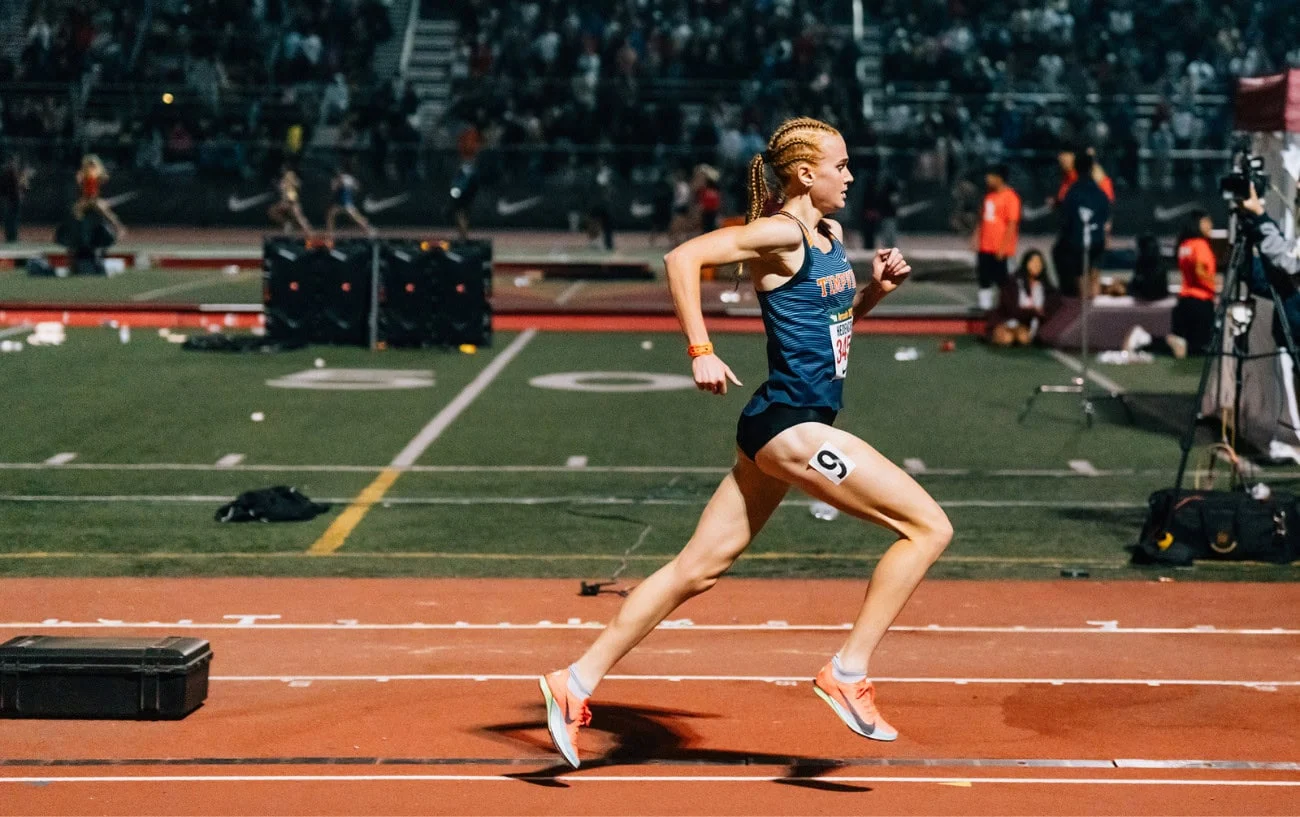
Brigham Young University freshman distance runner Jane Hedengren turned her first collegiate 10,000 meters into a historic night at the 2026 Stanford Invitational, breaking the NCAA women’s record in her outdoor debut. Her 30:46.80 win capped off a freshman campaign that already included an NCAA indoor 5,000m record and a rare national title double at 3,000m and 5,000m. The performance firmly positions Hedengren and BYU women’s track and field at the center of NCAA distance running conversations.
BYU Freshman Jane Hedengren Shatters NCAA 10,000m Record at Stanford Invitational
On a cool April night in California, Brigham Young University freshman Jane Hedengren turned her first collegiate 10,000 meters into one of the most significant distance races in NCAA women’s history. Racing under the lights at Stanford’s Cobb Track and Angell Field during the Stanford Invitational, the 19-year-old covered 25 laps in 30:46.80, breaking the NCAA women’s 10,000-meter record in her outdoor track debut for Brigham Young University.
The time is the fastest ever run by a collegiate woman over 10,000 meters, and it came in Hedengren’s very first attempt at the distance on the track. For athletes, parents, and coaches tracking the evolution of NCAA women’s distance running and looking for examples of freshman impact at the Division I level, this performance is a benchmark moment.
How the 10,000m Record Fell at the Stanford Invitational
Far from a solo time trial, Hedengren’s record was forged in a high-stakes duel with New Mexico star Pamela Kosgei, the reigning 2025 NCAA champion in both the 5,000 and 10,000 meters. From the early kilometers, the pair broke away from a deep field that featured distance powerhouses such as Colorado, Oregon, Northern Arizona and several other national-caliber programs.
According to meet reports from Stanford, the two leaders rolled through the halfway mark in roughly 15:33, already on pace to challenge the collegiate record. Rather than backing off, they continued to gradually squeeze down the tempo, turning the second half of the race into a sustained test of strength, efficiency, and composure.
With just over two laps to go, Kosgei briefly surged to the front, signaling that the race and record were truly up for grabs. The move could have broken a less experienced freshman. Instead, Hedengren responded decisively, tucking in, regathering herself, and positioning for a decisive final push.
A 66-Second Last Lap to Seal History
The decisive moment came in the final 400 meters. Hedengren uncorked a closing lap of about 66 seconds, an elite-level finish in any context and particularly impressive at the tail end of a 10,000-meter race already run at record pace.
That last lap gapped Kosgei for good and carried Hedengren down the homestretch to a new NCAA standard. Official results from the Stanford Invitational list her winning time as 30:46.80, with Kosgei second in 30:49.99 and Eastern Kentucky’s Edna Chelulei third in 31:33.57. That left Hedengren nearly 47 seconds clear of third place, a massive margin at this level over such a long distance.
Both Hedengren and Kosgei dipped under the previous NCAA record of 30:50.43, set by Florida’s Parker Valby in 2024. But it was the BYU freshman who claimed the new all-time mark, trimming almost four seconds from a record that already stood at a world-class level.
By pushing the event into sub-30:50 territory, Hedengren turned a regular-season invitational into a landmark 10,000-meter race that will shape how coaches and athletes think about NCAA women’s distance running standards going forward.
First Collegiate 10,000m, First Outdoor Race, First NCAA Record Outdoors
Context is crucial for understanding just how unusual this performance was. According to BYU’s official recap, the Stanford run marked:
- Hedengren’s first career 10,000 meters on the track
- Her outdoor track debut for BYU
- Her second NCAA record of the 2025-26 academic year
Executing at this level in a first attempt at the distance is rare. Even many elite distance runners spend an entire season learning how to pace, fuel, and mentally manage the longest standard track event. Hedengren not only handled those learning curves, she did it while facing the reigning NCAA champion and a nationally elite field.
Throughout the race, she stayed locked onto Kosgei, sharing the workload and responding to surges before deploying her own finishing gear. That 66-second final lap showed not just fitness, but race sense and emotional control that coaches often associate with veteran competitors.
For Brigham Young University, the performance was another signal that its women’s distance program is not just re-emerging, but actively setting the pace for the rest of the country.
A Historic Freshman Year: Indoors to Stanford
Hedengren’s record at Stanford would be newsworthy in isolation. But to fully appreciate its impact on NCAA women’s track and field, it has to be viewed alongside her indoor season.
During the 2026 indoor campaign, the BYU freshman established herself as one of the most decorated first-year athletes in NCAA history:
NCAA Indoor 5,000m Record in Boston
Earlier in the winter, Hedengren broke the NCAA indoor 5,000-meter record with a 14:44.79 performance in Boston, a time that immediately placed her among the fastest collegiate runners ever across any era. That run gave her the first NCAA record of her career and hinted that something special was coming when championship season arrived.
Championship Double at NCAA Indoors
At the NCAA Indoor Championships in Fayetteville, Hedengren delivered on that promise with a demanding double that few freshmen even attempt, let alone sweep:
- She won the 5,000 meters in 15:00.12, setting a facility record.
- She returned to win the 3,000 meters in 8:36.61, a championships record.
That double made her the first freshman ever to win both the 3,000 and 5,000 at the same NCAA indoor meet. It also made her the first BYU woman to capture two individual events at a single NCAA championship.
Those results, documented in BYU’s coverage of the meet, were already reshaping expectations for what a first-year athlete can do on the national stage. By the time she walked onto the track in California for her outdoor debut, she owned one NCAA record and two national titles.
USTFCCCA National Women’s Track Athlete of the Year
Her dominance and consistency across the indoor season led the U.S. Track & Field and Cross Country Coaches Association (USTFCCCA) to name Hedengren the 2026 National Women’s Track Athlete of the Year before the outdoor schedule even began. According to BYU’s announcement of the award, it marked the first time a BYU women’s track and field athlete had received that national honor.
For recruits and families evaluating programs, that accolade highlights both Hedengren’s individual ability and the environment around her: coaching, training partners, and a culture capable of supporting national-title performances under pressure.
Now Holding Both the 5,000m and 10,000m NCAA Records
With her 30:46.80 at Stanford, Hedengren now holds collegiate records at both 5,000 and 10,000 meters. That dual record status places her in the center of national and even international discussions about emerging distance talents.
To better understand how rare this is, it helps to look at NCAA record-keeping and progression. The NCAA maintains official performance lists and recognizes top marks that meet specific conditions for timing, venue, and competition level. Independent outlets like World Athletics and history-focused publications such as Track & Field News also track collegiate all-time lists and context, providing global comparisons.
Within that ecosystem, owning both long-distance track records simultaneously signals that an athlete is not just the best of the current NCAA generation, but on a trajectory that could translate to national teams, global championships, and professional racing once college eligibility ends.
For BYU and college track and field followers, it also reinforces that women’s distance running at the collegiate level is evolving quickly, with paces once considered out of reach now becoming realistic goals for well-prepared athletes.
BYU Women’s Distance Group Makes a Statement at Stanford
Hedengren’s record was the headline, but the Stanford Invitational also showcased the depth of the BYU women’s distance squad. On the same evening, several Cougars delivered standout performances that moved them up the program’s all-time lists and reshaped expectations for the outdoor season.
Among the highlights:
- Raygan Peterson won the 3,000-meter steeplechase in 9:55.03, climbing into BYU’s all-time top ten in the event.
- Taylor Lovell captured the 5,000 meters in 15:15.46, the third-fastest performance in school history.
- Several other BYU athletes recorded personal bests across distance events, signaling a group-wide upswing as outdoor championships approach.
Taken together, BYU’s results in California underscored the strength of coach Diljeet Taylor’s training group and the program’s ability to both develop a generational talent and build meaningful depth behind her. For high school distance runners evaluating where they might fit on an NCAA roster, that combination of a star and a strong supporting cast can be especially appealing.
What This Means for NCAA Women’s Distance Running
The Stanford race will likely be remembered as a pivot point in the ongoing evolution of NCAA women’s distance running. Several broader themes emerge from Hedengren’s record:
Raising the Bar for Freshman Impact
It is not unheard of for freshmen to contend for NCAA titles, but sweeping the indoor 3,000 and 5,000, breaking an indoor record, winning USTFCCCA National Women’s Track Athlete of the Year, and then breaking the outdoor 10,000-meter record in an outdoor debut is unprecedented territory.
For recruits, that suggests that with the right environment and preparation, it is possible to contend at the highest level of college track much earlier than in past eras. For coaches and parents, it is a reminder that managing training volume, competition schedules, and recovery for elite young athletes is more important than ever.
Depth and Performance at Major Distance Meets
The Stanford Invitational has long been viewed as a meet where distance runners chase fast times with the help of strong fields and ideal conditions. With Hedengren and Kosgei both breaking the existing NCAA record in one race, the 2026 edition strengthened that reputation.
For many distance programs, Stanford is now even more clearly a circle-on-the-calendar opportunity to qualify for NCAA Outdoor Championships, secure regional marks, and gain national attention. Hedengren’s performance will likely encourage more programs to align their training around peak efforts at meets like Stanford and similar high-performance invitationals.
International-Level Pacing in Collegiate Races
Times like 30:46.80 and 30:49.99 are not just good for college; they are competitive on broader stages. When collegiate athletes are closing 10,000-meter races with laps around 66 seconds after extended record-pace running, it suggests that NCAA competition is increasingly aligned with global standards, especially on the women’s side where depth has grown rapidly over the last decade.
Takeaways for Recruits Considering BYU and Top Distance Programs
For high school distance athletes and their families, performances like Hedengren’s provide concrete data points about what certain programs can offer in terms of development, competition opportunities, and support.
Some recruiting-relevant takeaways include:
- Development environment: BYU has built a culture and system that helps athletes take big but sustainable leaps, from indoor records to outdoor breakthroughs.
- Race opportunities: Competing at meets like the Stanford Invitational gives athletes exposure to fast fields and national-caliber pacing.
- Coaching and training groups: The presence of multiple national-level athletes and a deep distance squad can accelerate growth for incoming freshmen who are ready for the workload.
If you are exploring where you might fit within NCAA track and field, especially in distance events, tools like the Pathley Track and Field Hub can help you discover programs, compare options, and identify rosters where your current times and projected growth make sense.
How to Evaluate Your Fit at a Program Like BYU
Not every recruit is going to step in and run NCAA records as a freshman, and that is perfectly fine. What matters is finding a program where your current level, academic goals, and long-term upside match the environment.
When you look at programs like Brigham Young University that are producing national champions and record-holders, consider:
- How do your current times compare to the team’s depth chart and recent recruits?
- Are you more likely to develop best on a team where you are immediately in the top group, or where you will be pushed by runners ahead of you?
- Does the school’s academic profile align with your interests and target major?
- How does altitude, climate, and conference schedule fit your preferences and strengths?
Pathley’s tools are designed to support this kind of thinking. For example, you can use the College Fit Snapshot to quickly see how your academic and athletic profile lines up with a specific school and get a clearer sense of whether a program like BYU or another Division I, II, or III option might be a better match.
Looking Ahead: NCAA Outdoor Championships and Beyond
The Stanford record is not an end point for Hedengren or BYU. With NCAA Outdoor Championships still to come, she now heads into June as the collegiate record-holder at both 5,000 and 10,000 meters, and as a proven finisher against established national champions.
For BYU, the combination of an individual superstar and a deep, improving supporting cast means the Cougars are likely to be factors in team scoring whenever the nation’s best gather on the track. For the broader NCAA landscape, her presence ensures that distance races at championship meets will demand high-level tactics, bold pacing, and the confidence to go with record-threatening splits.
And for recruits watching from afar, it serves as a reminder that in the right setting and with the right guidance, a freshman year can be more than just an adjustment period. It can be the start of something historic.
Use Pathley to Explore Track and Field Programs Like BYU
If Hedengren’s breakout season has you thinking more seriously about college track and field, you do not have to navigate the recruiting process alone. Pathley offers several free tools to help you discover and evaluate programs:
As the NCAA distance scene continues to evolve, tools like these can help you stay informed, realistic, and strategic about your own path, whether your goal is to chase records, qualify for nationals, or simply find a program where you can grow on and off the track.
Hedengren’s 30:46.80 at Stanford will stand as a milestone in NCAA women’s track and field. For the next wave of recruits, it is also a powerful signal: the bar is high, the opportunities are real, and with thoughtful planning and the right program fit, your own breakthrough might be closer than you think.