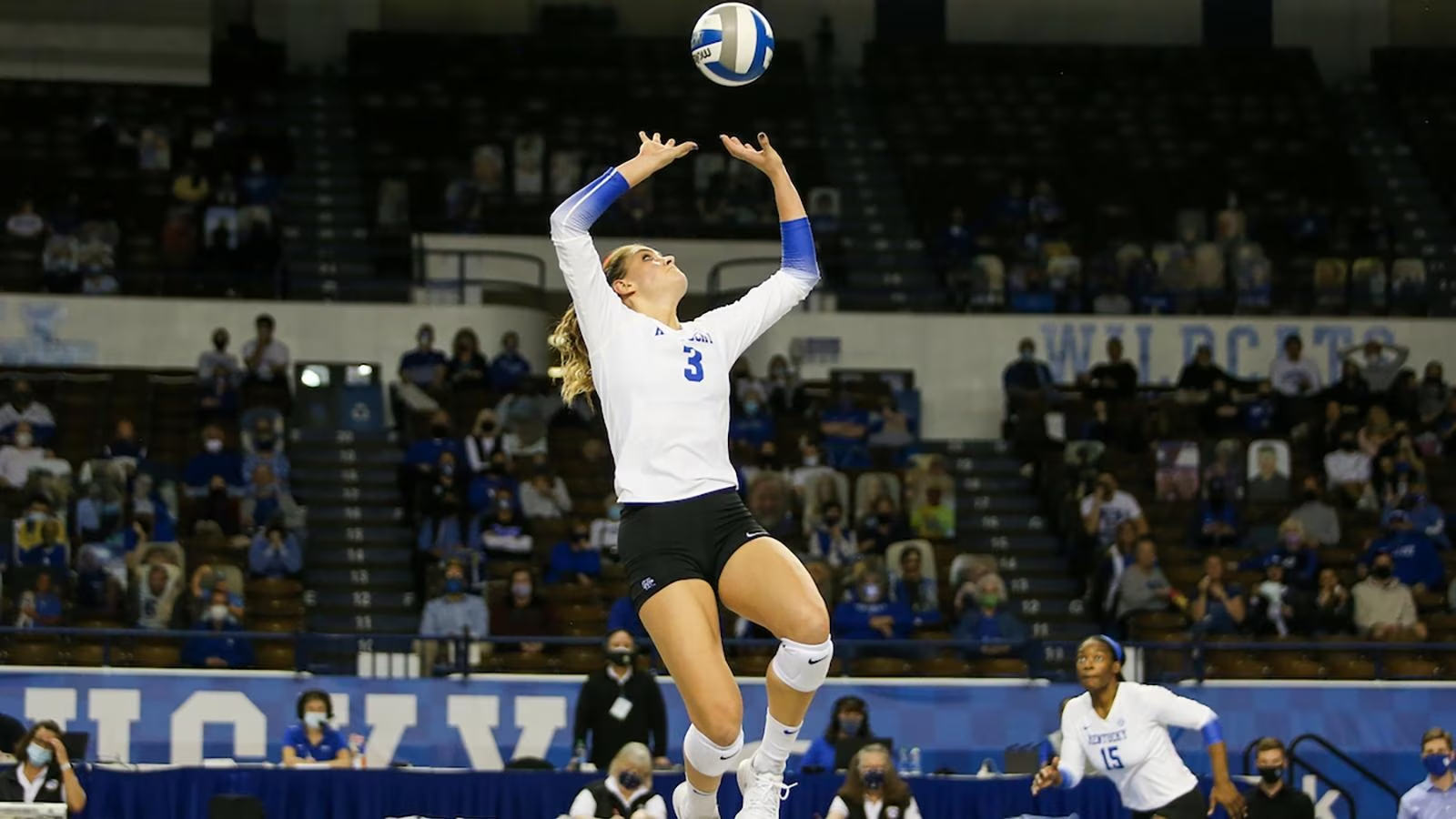
Wesleyan University women’s lacrosse broke through to its first NCAA Division III championship game with a 5–4 semifinal win over previously unbeaten Salisbury. A stifling defense, Dylan Green’s free-position hat trick, and senior goalie Izzy Weintraub’s leadership defined a program-changing night in Rochester.
Wesleyan Women’s Lacrosse Stuns Undefeated Salisbury to Reach First NCAA Division III Final
A defensive masterpiece at Judson Stadium sends Wesleyan into uncharted territory
In a season that had already rewritten the record book, Wesleyan University women’s lacrosse reached a new level on May 22, 2026. The Cardinals outlasted previously unbeaten Salisbury University 5–4 in the NCAA Division III semifinals at Judson Stadium in Rochester, New York, grinding out a defensive clinic that sealed the program’s first trip to a national championship game.
In a matchup of the No. 2 and No. 3 teams in the country, Wesleyan leaned on its nationally elite defense and a free-position hat trick from senior midfielder Dylan Green to hand the Sea Gulls their first loss of the year. Senior goalkeeper Izzy Weintraub anchored the back line with nine saves, as the Cardinals held one of Division III’s most explosive attacks to its lowest scoring output since 2018.
The 5–4 victory capped a decade-long rise under head coach Kim Williams and set up an all-NESCAC title showdown with top-ranked Middlebury, giving Wesleyan a third crack at the Panthers after two narrow regular season and conference tournament defeats.
How the semifinal set up: elite defense vs elite offense
The stage in Rochester was the product of contrasting paths. Wesleyan arrived at the Final Four at Rochester Institute of Technology with a 19–3 record, built on suffocating team defense and steady play in the NESCAC, widely regarded as one of the deepest leagues in Division III women’s lacrosse.
Entering the semifinals, the Cardinals had allowed just 15 goals across three NCAA tournament wins and held opponents under six goals per game on the season. Wins over Cortland, Chicago and conference rival Trinity showcased a unit that was not just stingy but consistent, with Weintraub posting save percentages above 50 percent throughout the postseason.
Salisbury, on the other hand, brought an unblemished 20–0 record and one of the most feared offenses in Division III. The Sea Gulls averaged just under 15 goals per game and owned 11 victories over ranked opponents, a resume befitting a program making its 15th all-time Final Four appearance. According to the NCAA’s published championship materials, Salisbury has long been a fixture in the Division III women’s lacrosse bracket, regularly advancing deep into May play and setting the standard for sustained excellence at this level of the sport (NCAA.com).
That context made Wesleyan’s defensive performance on this night even more significant. To reach its first national final, the Cardinals would have to take away what Salisbury does best.
First quarter: a defensive tone and an early breakthrough
From the opening draw at Judson Stadium, the game unfolded as advertised: two elite defenses dictating tempo, forcing turnovers and denying the kind of clean looks both teams had grown used to generating.
Wesleyan’s backer zone, a staple of its defensive identity, immediately caused problems for Salisbury. The Sea Gulls committed turnovers on their first several possessions as passing lanes disappeared and cutters were bumped off their spots. Both teams probed for openings, but the scoreboard stayed quiet.
Nearly seven minutes passed before either side broke through. The Cardinals finally capitalized on a player-up opportunity, working the ball to senior midfielder Kyra Browne. Isolated against a defender, Browne spun free, slipped inside, and finished from close range to give Wesleyan a 1–0 lead.
Salisbury, a championship-tested program, answered late in the quarter. Attacker Mackenzie Demaio found space and scored with under 30 seconds remaining, tying the game at 1–1 heading to the first break. The opening 15 minutes underscored how thin the margins would be: every possession was hard-won, and any mistake was magnified.
Second quarter: trading punches to halftime
The second quarter loosened slightly on the offensive end but remained a tug-of-war between two disciplined squads. Each time Wesleyan nudged ahead, Salisbury responded, preventing any momentum from snowballing.
Senior attacker Addie Cummings restored the Cardinals’ lead at 2–1, slipping a shot low inside the right post, a veteran finish in traffic that came after patient ball movement against the Sea Gulls’ compact defense. Later in the period, Wesleyan again crept in front, only to see Salisbury find an equalizer.
At halftime, the teams were locked at 3–3. The stat sheet showed a near dead heat, but the story within the numbers was Wesleyan’s ability to dictate the terms of engagement. Both defenses limited high-quality chances, and both goalkeepers delivered timely stops. For Wesleyan, Weintraub continued her postseason form, tracking shots cleanly and controlling rebounds to prevent second opportunities.
For a program seeking its first national title appearance, the first half in Rochester was a test of patience and poise. The Cardinals did not flinch.
Third quarter: Dylan Green’s free-position heroics
The decisive stretch of the semifinal arrived in the third quarter, when Wesleyan earned the game’s only two-goal cushion by pairing its trademark defense with sharp execution on free-position chances.
Early in the period, Salisbury appeared poised to seize control after a strong dodge by midfielder Regan McDonnell created one of the Sea Gulls’ cleanest looks of the night. McDonnell’s shot was headed toward the upper corner, but Weintraub delivered what both sidelines would later describe as a turning-point save, snatching the ball out of the air and preserving the 3–3 tie.
On the ensuing possession, Wesleyan drew a free-position attempt. Senior midfielder Dylan Green stepped to the hash and buried the shot, giving the Cardinals a 4–3 lead. It was the sort of moment that can tilt a national semifinal, converting a near-goal at one end into an actual goal at the other.
A few minutes later, Wesleyan earned another free-position opportunity. Again, Green took responsibility. Again, she delivered, extending the advantage to 5–3. It was the first time either team had scored on consecutive possessions, and it forced Salisbury to chase the game against a defense built to play with a lead.
The Sea Gulls cut the deficit to 5–4 late in the quarter, keeping pressure on Wesleyan’s margin, but the Cardinals carried that one-goal edge into the final 15 minutes with the confidence of a group that trusted its structure and senior leadership.
Fourth quarter: composure, ground balls and a championship ticket
The final quarter at Judson Stadium became a test of Wesleyan’s composure and defensive discipline. Salisbury, unwilling to let an unbeaten season slip away quietly, increased its pressure, outshooting the Cardinals in the final period and stringing together several long possessions in the offensive end.
Wesleyan’s field players responded with the sort of detail work that often separates winners in low-scoring NCAA tournament games. Senior defensive midfielder Lindsey Diomede and freshman defender Elise Kurtis led the effort in disrupting passes, poking away sticks and winning contested ground balls. Weintraub added several more saves to finish with nine on the night, consistently reading Salisbury’s shooters and managing the clock with her outlets.
Even as the clock wound under a minute, the drama spiked. Salisbury generated two late looks at an equalizer, but both shots sailed wide. On the second miss, senior defender Molly Simon seized the moment, scooping up a crucial ground ball and drawing a green card with just 17 seconds remaining, earning Wesleyan a vital man-up situation in the closing seconds.
Out of a timeout, Salisbury pulled its goalkeeper in a last-ditch effort to force a turnover. Instead, Wesleyan safely placed the ball in the stick of senior midfielder Bridget Horst. She sprinted the length of the field as the final seconds ticked away, and when the horn sounded, the Cardinals had secured a 5–4 victory and a place in program history.
Box score tells the story: defense and possession dominance
On paper, the semifinal win over the Sea Gulls was as much about the hidden areas of the game as it was about the scoreboard. Wesleyan held Salisbury to its fewest goals in any game since 2018, a staggering achievement against an offense that had spent the season filling nets across the country.
The Cardinals controlled critical possession metrics, finishing with a 17–10 advantage in ground balls and an 8–3 edge on draw controls. In a game with just nine total goals, those extra opportunities were invaluable.
Green’s three goals gave her nine in the NCAA tournament, underscoring her emergence as a go-to scorer in the biggest moments. Cummings added a goal and an assist, and Browne provided the game’s opening strike. Horst quietly dominated the draw circle, securing six controls to keep the ball in Wesleyan’s hands. Kurtis collected five ground balls and added two caused turnovers, while Diomede contributed two caused turnovers and two ground balls, building on a season in which she had already reset Wesleyan’s defensive record book.
For a national audience watching Division III women’s lacrosse, this performance cemented what coaches around the NESCAC had already known: Wesleyan’s defense was not just good enough to keep it in games, it was good enough to carry the Cardinals to the sport’s biggest stage.
A decade-long rebuild under Kim Williams pays off
While the 60 minutes in Rochester will be remembered for Green’s finishing, Weintraub’s saves and the collective grit of the Cardinals’ defense, the semifinal victory also marked a milestone in a longer journey for the program under head coach Kim Williams.
When Williams took over in 2016, Wesleyan was emerging from a stretch of losing seasons and had little recent history on the national stage. The task was not simply to tweak tactics; it was to reimagine what Wesleyan University women’s lacrosse could be within the NESCAC and across Division III.
Over the next decade, the Cardinals steadily climbed. They became a fixture in the national rankings, made deeper runs in conference play and earned their first trip to the Final Four. Each step built belief and raised the program’s recruiting profile, with top prospects increasingly viewing Wesleyan as a destination where they could combine high-level academics with championship-caliber lacrosse.
The 2026 semifinal win over Salisbury represented the next major step: not only arriving on the national semifinal stage, but taking down one of Division III’s true bluebloods in a one-goal thriller on a neutral field. It was the type of result that parents, high school coaches and club directors across the country notice as they guide athletes evaluating Division III options.
An all-NESCAC final and a new place among Division III’s elite
By beating Salisbury, Wesleyan earned a third matchup this season with Middlebury in the national championship game. The Panthers, who advanced on the other side of the bracket, have long been a standard-bearer in Division III women’s lacrosse and entered the final ranked No. 1 nationally (USA Lacrosse Magazine).
Middlebury had already edged Wesleyan twice in 2026, winning 5–4 in the regular season and 7–5 in the NESCAC championship game. Both contests were tight, low-scoring and emblematic of the defensive intensity that defines the conference. An all-NESCAC final only reinforced the league’s reputation as one of the deepest and most competitive environments in Division III.
Regardless of the result in the championship game, Wesleyan’s performance in Rochester confirmed that the Cardinals now belong firmly within the upper tier of Division III women’s lacrosse. For recruits and families looking at small-college options, the program now offers proof of concept: you can chase a national title while competing in a rigorous academic setting and a high-level conference.
What this means for recruits looking at Wesleyan and Division III lacrosse
For high school players and club athletes, the 2026 semifinal offers a window into what makes a Division III contender like Wesleyan successful and how prospects can prepare to thrive in that type of program.
Defense, versatility and IQ matter
The box score and narrative from Judson Stadium highlight traits that college coaches at this level value highly:
- Defensive discipline: Wesleyan’s ability to stay connected in its backer zone, slide on time and trust its communication was the foundation of the upset.
- Positional versatility: Players like Diomede and Kurtis impacted the game in multiple ways, from on-ball defense to ground balls and clearing, which mirrors what many Division III staffs look for when they cannot specialize as much as larger Division I rosters.
- Situational composure: From Green’s free-position finishes to Simon’s late ground ball and Horst’s game-ending sprint, Wesleyan’s seniors showed the value of playing with poise in pressure moments.
Recruits who can show film, stats and notes that reflect similar qualities often stand out to coaches in the NESCAC and other top Division III leagues.
Balancing academics and championship ambitions
Wesleyan is also a reminder that athletes do not have to choose between high-level academics and high-level competition. Many families assume that chasing championships requires a Division I path, but the Division III women’s lacrosse landscape regularly features academically rigorous schools competing deep into May.
If you are trying to map out where you might fit, tools like the Pathley Lacrosse Hub and the broader Pathley College Directory can help you quickly scan programs by level, location and academic profile, then compare options side by side.
Using Pathley to explore Wesleyan-level programs and build your plan
Stories like Wesleyan’s rise under Kim Williams are powerful case studies for recruits contemplating the Division III route. But turning inspiration into a real recruiting plan requires clear information and a sense of where you might realistically belong.
Pathley was built to make that process simpler and more transparent. Athletes and families can use tools such as:
- Pathley College Directory: Search hundreds of colleges, including schools like Wesleyan, filter by state, size, and other basics, and save programs that match your goals in one shortlist for easier comparison (https://app.pathley.ai/college_directory).
- Lacrosse Sport Hub: Explore the college lacrosse landscape, see curated lists of strong programs, and find showcases and camps that fit your position and competition level (https://app.pathley.ai/sport/lacrosse).
- AI recruiting guidance: Chat with an assistant who can suggest schools with similar profiles to Wesleyan, help you prioritize targets, and refine your outreach strategy (https://app.pathley.ai/).
Takeaway: Wesleyan’s semifinal win as a blueprint
The 5–4 win over Salisbury at Judson Stadium will be remembered as a watershed moment for Wesleyan women’s lacrosse: the night the Cardinals turned years of steady building into a shot at a national championship. It was a performance defined by defense, senior leadership and execution in the smallest details, from ground balls to free-position shots.
For recruits, parents and coaches watching from afar, it also offered a blueprint for what it takes to reach that stage in Division III: choose a program with a clear identity, embrace roles that go beyond scoring, and commit to the daily work that turns close losses into program-defining upsets.