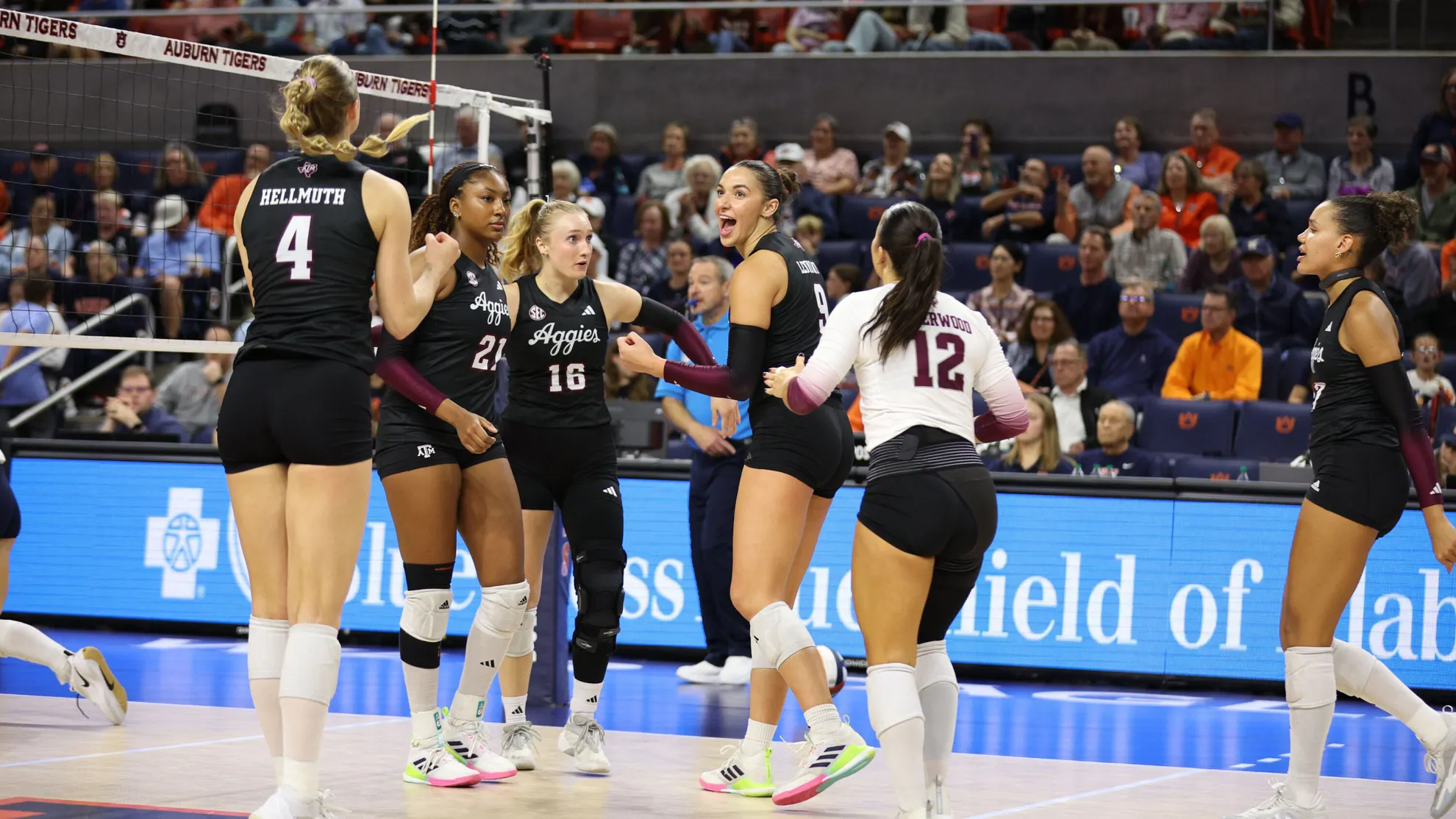
Texas A&M women’s volleyball stunned previously unbeaten No. 1 Nebraska in a five-set regional final in Lincoln to clinch the program’s first-ever NCAA Final Four berth. The upset ended Nebraska’s perfect season and snapped one of the sport’s most dominant home streaks, signaling Texas A&M’s arrival as a true national contender.
Texas A&M volleyball stuns No. 1 Nebraska to reach first NCAA Final Four
In Lincoln, Texas A&M rewrites its volleyball history books
On December 14, 2025, Texas A&M women’s volleyball delivered one of the defining results of the modern NCAA era: a five-set upset of previously unbeaten, top-seeded Nebraska in the regional final in Lincoln to clinch the Aggies’ first trip to the national semifinals.
In front of 8,650 fans at the Bob Devaney Sports Center’s volleyball configuration, known as John Cook Arena, the third-seeded Aggies outlasted the Cornhuskers 3–2 by scores of 25–22, 25–22, 20–25, 35–37 and 15–13. The win pushed Texas A&M to 27–4 and handed Nebraska its only loss of the season, dropping the Huskers to 33–1.
The result did more than just send the Aggies to Kansas City. Nebraska entered the match as the No. 1 overall seed, had not lost at home since 2022, and was riding a home winning streak north of 60 matches while having dropped only seven sets all season prior to this regional final. Ending that kind of dominance, in that building, turns a regional title into a program-defining moment.
How Texas A&M toppled an undefeated No. 1 seed
A 10–0 run flips the script in the opening set
Early on, it looked like the script would follow Nebraska’s season-long pattern of control. The Huskers raced out to a 10–3 lead in the first set behind the attacking of outside hitter Harper Murray, a focal point of their offense all year.
Then the match’s first major turning point arrived. Texas A&M ripped off a 10–0 run, sparked by aggressive serving from middle blocker Ifenna Cos-Okpalla and a balanced attack from multiple hitters. That surge turned a seven-point deficit into a lead, quieting the Devaney crowd and signaling that the Aggies weren’t there just to keep it close.
With their confidence growing, the Aggies closed out the frame 25–22. Instead of Nebraska front-running, the top seed suddenly trailed, and the pressure shifted squarely onto the Huskers.
Second set doubles down on service pressure
The second set followed a similar rhythm but with different keys. Texas A&M’s serve continued to bother Nebraska, this time with setter Maddie Waak providing the primary pressure line. The Aggies grabbed an early lead, forcing Nebraska to dig out of another hole.
Nebraska briefly surged in front, but Texas A&M’s composure at the pins and from the service line held. Senior opposite Logan Lednicky capped the set with a kill for another 25–22 win, and suddenly the Aggies led 2–0 on the No. 1 overall seed in its own building.
For context, this was a Nebraska team that had lost only seven sets all season before the regional final. Texas A&M had just taken two in less than an hour on the road, a sign that the Aggies’ game plan on serve and block was working at an elite level.
Nebraska answers in sets three and four
You don’t reach 33–0 without a high level of resilience, and Nebraska showed it in the third and fourth sets. In set three, the Huskers cleaned up their side-out game and tightened their block. Murray continued to score, and middle blocker Rebekah Allick found more rhythm offensively.
Nebraska took the third set 25–20, halting Texas A&M’s momentum and waking up the Devaney crowd. For a moment, it looked like the top seed might be ready to reassert itself and ride the energy back into control.
Then came the fourth set, a 37–35 marathon that will live on in tournament highlight reels for years. Texas A&M built an 18–11 lead and eventually earned three match points, putting the Huskers on the edge of elimination. But Nebraska clawed back through extended rallies, emotional defensive plays and repeated set-point chances.
In a back-and-forth sequence of sideouts and extra points, Nebraska finally pushed across the 37–35 win to force a decisive fifth. The Aggies had watched a big lead and multiple match points disappear, exactly the kind of emotional swing that can break an underdog’s upset bid.
Fifth-set reset: Aggies regain control
Despite losing the fourth, Texas A&M regrouped quickly for the race to 15. The Aggies leaned again on the formula that had built their early advantage: pressure from the service line and a dominant block.
In the fifth, Texas A&M jumped ahead 10–6 and then 12–7, forcing Nebraska timeouts and taking much of the air out of the normally raucous Devaney atmosphere. Nebraska responded with one final push, trimming the margin to 13–12 and igniting hope of a comeback that would match the program’s season-long resilience.
But Texas A&M had answers. Sophomore outside hitter Kyndal Stowers delivered a kill to give the Aggies match point. After Nebraska saved one championship-point opportunity, Lednicky tooled the block for the final kill, closing out a 15–13 fifth set and ending Nebraska’s perfect season.
The numbers behind the upset
Over five sets, Texas A&M’s statistical profile told the story of a team that executed a specific strategy at a high level:
- Hitting percentage: Texas A&M .275, Nebraska .270
- Blocks: Texas A&M 17, Nebraska 8
- Service aces: Texas A&M 9, Nebraska 8
In most matches, Nebraska’s offense is efficient enough to overcome ordinary blocking. Here, Texas A&M’s 17 blocks not only created direct points but disrupted rhythm and forced the Huskers into tougher swings late in rallies. The modest edge in aces also reflected how consistently the Aggies kept Nebraska out of system.
Stowers and Lednicky fuel the attack
Individually, Stowers and Lednicky authored performances that will sit near the top of Texas A&M’s postseason lore.
Stowers, a sophomore outside, posted a career-high 25 kills while hitting .327 and adding 16 digs. She gave Texas A&M a reliable left-pin option against an elite block, and her two-way impact kept Nebraska from keying too heavily on any single attacker.
On the right side, Lednicky delivered 24 kills and extended her streak of double-digit kill matches to 21 straight, a run that has pushed her into the upper tiers of the Aggies’ all-time kills list. Her final swing to end the match added an exclamation point to a senior season already marked by four All-SEC selections.
Waak, Cos-Okpalla and the system that beat Nebraska
The Aggies’ win was also a showcase for their system play. Waak, one of four Aggies on the All-SEC first team, orchestrated the offense with 63 assists. She mixed tempo, spread the ball and added four service aces, repeatedly putting pressure on Nebraska’s passers.
Cos-Okpalla and fellow middle Morgan Perkins anchored the block. Their presence in the middle funneled Nebraska’s attackers into tougher angles and produced many of the Aggies’ 17 total blocks. Behind them, libero Tatum Thomas provided the platform, making timely digs that allowed A&M to turn defense into transition kills.
Nebraska still produced big numbers. Murray finished with 25 kills and Allick added 15 on .480 hitting, proof that the Huskers’ stars did not simply disappear under the pressure. But Texas A&M’s depth, balance and late-point resilience were decisive when it mattered most.
A historic weekend in Lincoln for Texas A&M
This upset didn’t happen in isolation. It capped a remarkable weekend in Lincoln for Texas A&M volleyball.
Two days earlier, in the Sweet 16, the Aggies had staged a reverse sweep of Louisville, last season’s national runner-up. Down two sets, Texas A&M rallied to win in five, securing the program’s first regional final appearance since 2001. That win alone would have been a significant step forward.
Instead, it became the prelude. By following it with a win over the undefeated No. 1 seed on the same floor where Texas A&M had lost in the regional round a year earlier, the Aggies effectively rewrote their postseason identity in a single weekend.
Historically, Texas A&M’s best NCAA results were Elite Eight runs in 1999 and 2001. The 2025 trip to the national semifinals is the program’s first advancement beyond the regional final and its first NCAA Final Four appearance, a clear new benchmark. According to the program’s historical record, the win over Nebraska is also its first victory against a No. 1-ranked opponent since beating Stanford in 1995.
Jamie Morrison’s rapid rebuild into a national contender
Central to this story is third-year head coach Jamie Morrison. A former U.S. women’s national team assistant coach with multiple Olympic medals on his résumé, Morrison brought both high-level technical expertise and a global lens for how elite volleyball is played.
When he arrived, Texas A&M was closer to the middle of the SEC pack than the top. Within three seasons, under his direction, the Aggies have gone from respectable to national contender, blending system-oriented play with impactful recruiting and development.
The run to the 2025 Final Four validates that trajectory. It shows recruits that Texas A&M can not only make the NCAA tournament but play deep into December against the sport’s true blue-bloods. It also signals to the rest of the SEC and national landscape that the Aggies are building something sustainable, not just riding a single hot season.
For broader context on how quickly a coach can reshape a volleyball program, consider examples like Kentucky’s national title run in 2020–21 and Pittsburgh’s ascent from solid ACC team to perennial Final Four threat. The NCAA’s official coverage of women’s volleyball postseason trends highlights how coaching, system continuity and recruiting fit combine to create breakthrough years for programs that historically sat just outside the top tier (https://www.ncaa.com/news/volleyball-women).
What this upset means for the NCAA volleyball landscape
Nebraska’s streaks fall, but the standard remains
Nebraska’s loss snaps one of the sport’s most dominant home stretches, a streak that had turned Devaney into arguably the toughest environment in college volleyball. The Huskers’ ability to regularly draw sellout crowds and compete for national titles has been a key storyline for the growth of the women’s game, including breaking the world record for attendance at a women’s sporting event in 2023 (ESPN).
This loss doesn’t lessen Nebraska’s position as a national power, but it is a reminder that the gap has closed, particularly when opponents bring elite serving and blocking. For athletes and coaches, it underscores a key theme: system execution and depth can neutralize even the most talented rosters on the biggest stage.
Texas A&M’s run changes the recruiting conversation
Deep NCAA tournament runs tend to create ripple effects in recruiting. Final Four appearances signal to club coaches, high school programs and families that a school has:
- A proven player development track record
- Experience on national TV and in high-pressure environments
- A competitive culture that can compete with and beat traditional powers
For a program like Texas A&M, which already benefits from SEC exposure, this run raises its profile further with elite prospects across the country and internationally. Athletes who might have viewed Big Ten or Pac-12 powers as the default destination for national-title pathways may now see College Station as a viable route to the final weekend of the season.
At the same time, the upset reinforces a broader trend across Division I: more programs are building the infrastructure and support needed to challenge volleyball’s legacy powers. That parity is good for the sport, creating more meaningful matches throughout the regular season and postseason.
Looking ahead: Kansas City and beyond
With the regional title in hand, Texas A&M heads to the T-Mobile Center in Kansas City, Missouri, for the national semifinals on December 18, where the Aggies will face Pittsburgh. A win there would send them into the NCAA championship match on December 21, with a chance to add an even larger chapter to the best season in program history.
Regardless of what happens in Kansas City, the 2025 season has reset expectations for Texas A&M volleyball. National rankings, RPI positioning and future tournament seeding will now be evaluated through the lens of a program that has proved it can survive a regional hosted by Nebraska and emerge with the trophy.
For current and future student-athletes, that matters. It shapes how they think about conference strength, style of play and where they can realistically compete for Final Four and national title opportunities.
What recruits and families can take from this run
Evaluating programs beyond the brand name
For high school and club athletes following this tournament, Texas A&M’s upset is a textbook example of why you shouldn’t evaluate programs only by long-term brand reputation. When you’re researching schools, it’s worth asking:
- Is the coaching staff on an upward trajectory with recent postseason success?
- Does the team’s style of play fit your strengths (tempo, system, defensive scheme)?
- Is there evidence of player development, like athletes making All-Conference teams or breaking program records?
Tools like Pathley’s AI-powered recruiting platform can help athletes identify programs where performance data, roster fit and academic options align with their long-term goals. You can start exploring colleges and building your recruiting strategy with Pathley’s main platform at https://www.pathley.ai/.
Using AI tools to find your best-fit volleyball programs
Not every athlete will end up at a program that just knocked off a No. 1 seed, but the decision-making process is the same whether you’re aiming for a Power Five roster or a strong mid-major. You need clarity on:
- Level of play that matches your current and projected ability
- Academic priorities and campus environment
- Coaching stability and program direction
With Pathley Chat, athletes can get AI-guided help on building a target school list, comparing programs and understanding where they realistically fit in the broader NCAA landscape. For those ready to take the next step, creating a free profile at https://app.pathley.ai/sign_up unlocks AI college matching, recruiting tools and personalized insights tailored to your sport and goals.
Related programs to consider if you like this level of volleyball
If you’re interested in high-level Division I experiences similar in intensity and structure to what you see from top-tier programs, it can also be helpful to look at other competitive universities with strong academic and athletic traditions. For example, service academies like the United States Air Force Academy and United States Military Academy, or research-focused public institutions such as The University of Akron and private schools like American University, all offer distinctive environments where athletics and academics intersect at a high level.
Why this match will be remembered
In the long history of NCAA women’s volleyball, certain matches stand out as turning points for programs and for the sport. Texas A&M’s five-set win in Lincoln checks every box for that kind of moment:
- It ended an undefeated season for the No. 1 overall seed.
- It snapped one of the longest and loudest home winning streaks in the game.
- It pushed a historically solid program into the national semifinals for the first time.
- It showcased high-level serving, blocking and late-match poise on both sides.
For Texas A&M, it is the night the program officially joined the conversation with the sport’s elite. For Nebraska, it is a painful but representative chapter in what has been a golden era for the program and for women’s volleyball attendance and visibility. For recruits, families and coaches watching, it is a live case study in how preparation, system fit and mental toughness can alter the trajectory of an entire program.
Explore your own path to the Final Four level
Not everyone will play on a stage like John Cook Arena with a Final Four berth on the line, but every athlete can be intentional about finding the right college environment. Whether your goal is a Power Five roster spot, a competitive mid-major, or a service academy experience, using data and AI to guide your search gives you a real edge.
Pathley is built for exactly that. Start at https://www.pathley.ai/ to learn how AI-powered tools can simplify your recruiting journey. Then, when you are ready, create your profile at https://app.pathley.ai/sign_up and let the platform help you discover programs that fit your academic goals, playing style and long-term ambitions.
The same way Texas A&M found its breakthrough on the biggest stage, you can build a plan to find the college volleyball program where you can grow, compete and write your own postseason story.